
Bangladesh and Dhaka in particular is in the grip of an election fever, with the Dhaka University Central Students’ Union (DUCSU) polls being the talk of the town. From morning headlines to endless social media updates, it’s almost impossible to escape the flood of DUCSU election coverage.
So, we thought this might be the perfect moment to revisit some of the region’s most memorable political and student-political dramas. Some were blockbuster sensations, while others quietly slipped under the radar — but all remain worth watching.
Bikkhov (1994)

Let’s start off with one of our own with a movie that surely was ahead of its time whilst starring few of the biggest names in Bangladeshi entertainment history.
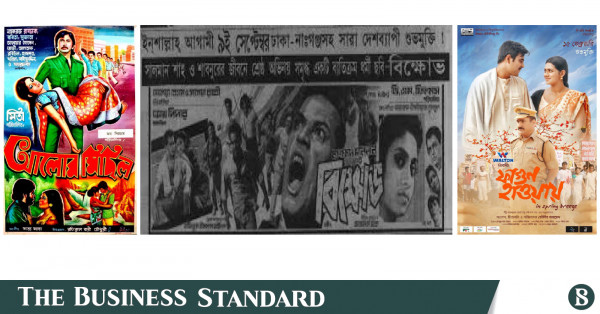
Released in 1994, Bikkhov (The Protest) stands out as one of Bangladeshi cinema’s bold explorations of student politics and its entanglement with national power struggles. Directed by Mohammad Hannan and produced, the story was penned by Farida Hossain, with screenplay contributions from Joseph Shatabdi and Hannan himself.
At its heart, the film follows Asad, a fiery student leader opposing authoritarian rule, whose untimely death — the result of political conspiracy — shifts the balance of power.
His rivals, Mahmud Chowdhury and Sharafat Ali Khan, benefit from his downfall, but soon become locked in their own power games. Mahmud rises to national ambitions, while Sharafat, betrayed and imprisoned, later returns to challenge him by launching a newspaper that exposes his misdeeds.
Alongside them, a new generation of student leaders — including the principled VP Anik — pick up the fight, embodying the struggle between corruption and conscience on campus.
The film starred some of the era’s most celebrated names — Salman Shah, Shabnur, Bulbul Ahmed, Rajib, and Dolly Zahur — and featured a stirring soundtrack composed and written by Ahmed Imtiaz Bulbul, with vocals from legends like Runa Laila, Syed Abdul Hadi, Subir Nandi, and others.
Three decades on, Bikkhov remains a sharp reminder of how cinema can capture the turbulence of student politics and the enduring fight for integrity in Bangladesh’s political culture.
Gulal (2009)
Anurag Kashyap’s Gulaal (Crimson) is less a film than a raw dissection of power, politics, and betrayal, set against the dusty backdrop of Rajasthan. The story unfolds through Dilip (Raj Singh Chaudhary), a timid law student swept into the murky underworld of campus politics, caste pride, and a separatist movement seeking to resurrect a Rajputana kingdom.
Initially drawn into the orbit of the fearless prince Ransa (Abhimanyu Singh), Dilip finds himself manipulated by the calculating Dukey Banna (Kay Kay Menon), a leader who sees student elections as a rehearsal for secessionist ambitions. What begins as a tale of bullying and revenge spirals into murder, corruption, and ideological conflict.
Along the way, Dilip is ensnared by Kiran (Ayesha Mohan), whose charm masks ruthless ambition. His eventual descent from idealistic outsider to tragic pawn is both inevitable and devastating.
Kashyap’s script brims with sharp dialogue, irony, and symbolism — from hostel ragging that strips characters bare, to power games that expose deeper fractures of class and caste.
Performances are uniformly powerful: Menon delivers Dukey with hypnotic menace, Abhimanyu Singh’s Ransa bursts with raw charisma, while Chaudhary captures Dilip’s tragic naivety. The supporting cast — Piyush Mishra’s sardonic Bhati, Jesse Randhawa’s disillusioned Anuja — add layers of satire and melancholy.
Upon release, critics praised its grit, taut screenplay, and unflinching portrayal of India’s political psyche. Today, Gulaal has achieved cult status, standing as Kashyap’s crimson-hued meditation on power — seductive, corrosive, and ultimately fatal.
Fagun Haway (2019)
Tauquir Ahmed’s Fagun Haway (In Spring Breeze) takes audiences back to 1952 Khulna, against the turbulent backdrop of the Bangla Language Movement. Based on Tito Rahman’s short story ‘Bou Kotha Kao’, the film follows the love story of Dipti (Nusrat Imrose Tisha), a wealthy Hindu girl, and Nasir (Siam Ahmed), a Dhaka University student, as political unrest swells around them. Looming over their romance is a stern Pakistani police commander (Yashpal Sharma), determined to enforce Urdu as the sole state language.
Ahmed has been clear that the film is not a documentary but a work of fiction meant to entertain. Indeed, Fagun Haway often favours romance, humour, and mass appeal over historical authenticity. Period details sometimes falter — a lipstick here, a saree there — pulling viewers out of 1950s Khulna and into modern-day Dhaka. Even tonal shifts, from political drama to moments of slapstick, occasionally blur the film’s focus.
The narrative, too, leans heavily on Sharma’s commanding antagonist, leaving the leads underdeveloped. Dipti’s decision to join the movement feels ambiguously tied to love rather than conviction. Yet, the director’s courage to bring the Language Movement to mainstream cinema cannot be overlooked. Few Bangladeshi filmmakers have ventured into this territory, and Ahmed deserves credit for approaching it without overt political messaging.
Despite its flaws, Fagun Haway connects with mass audiences — not critics or cultural elites. Its success at the box office and recognition at the National Film Awards prove its resonance. As a cultural milestone, the film sets a foundation, reminding future storytellers of the importance — and the challenge — of marrying history with cinema.
Alor Michil (1974)
Alor Michil (Procession of Light) remains one of the most significant patriotic films in Bangladeshi cinema. Written and directed by Narayan Ghosh Mita, the film stars screen legends Abdur Razzak, Babita, Farooque, and Anwar Hussain. Its importance has been formally recognized, with the Bangladesh Film Archive selecting it for preservation.
The narrative is set in the turbulent years immediately after the Liberation War of 1971. At its core lies the story of a family grappling with the moral and social upheavals of the time.
A low-paid worker, disillusioned by poverty, turns to hoarding and black-market profiteering in hopes of rapid wealth. His opportunism, however, collides with the values of his wife, his brother, and his friends — men who had fought for freedom and still believed in the ideals of sacrifice and justice.
As profiteering spreads and communities rise against such exploitation, public protests ignite. The movement for accountability grows, but with it comes state violence. In one of the film’s most tragic moments, a young niece of the family is killed, symbolising the innocence lost in the chaos of post-war opportunism.
Alor Michil captures the disillusionment that followed independence — the clash between the ideals of the Liberation struggle and the harsh realities of corruption, greed, and inequality. Half a century on, it continues to resonate as a cinematic reminder of the costs of freedom and the vigilance needed to preserve its spirit.
Rang De Basanti (2006)
Saving the best for last, few films have captured the restless energy of India’s youth like Rang De Basanti (Paint Me Saffron). Directed by Rakeysh Omprakash Mehra, this coming-of-age political drama fuses the past with the present, blending the stories of India’s revolutionary heroes with the frustrations of modern-day students confronting corruption and disillusionment.
The film begins with Sue (Alice Patten), a British student who travels to Delhi to make a documentary about Bhagat Singh and his fellow freedom fighters. She casts a group of carefree young men — DJ (Aamir Khan), Karan (Siddharth), Aslam (Kunal Kapoor), Sukhi (Sharman Joshi), and Laxman (Atul Kulkarni) — who initially dismiss patriotism as outdated. But when personal tragedy strikes with the death of Air Force officer Ajay (Madhavan), the group is jolted into political awakening. Their transformation from apathy to activism, mirroring the revolutionaries they portray, culminates in a daring and tragic stand against government corruption.
What makes Rang De Basanti remarkable is its tonal agility. It shifts from lighthearted camaraderie to stirring political drama without losing authenticity. Mehra’s direction and Kamlesh Pandey’s script give the story urgency, while Binod Pradhan’s cinematography paints Delhi with raw vibrancy. A R Rahman’s soundtrack ‘Roobaroo’ — became an anthem in its own right, amplifying the film’s emotional core.
Critics praised the ensemble cast, the sharp writing, and the way the film avoided preachiness while still inspiring debate. Its impact extended beyond cinema, sparking real-life conversations on corruption, accountability, and youth responsibility. Nearly two decades later, Rang De Basanti remains a cultural milestone — a film that didn’t just depict rebellion, but ignited it.