
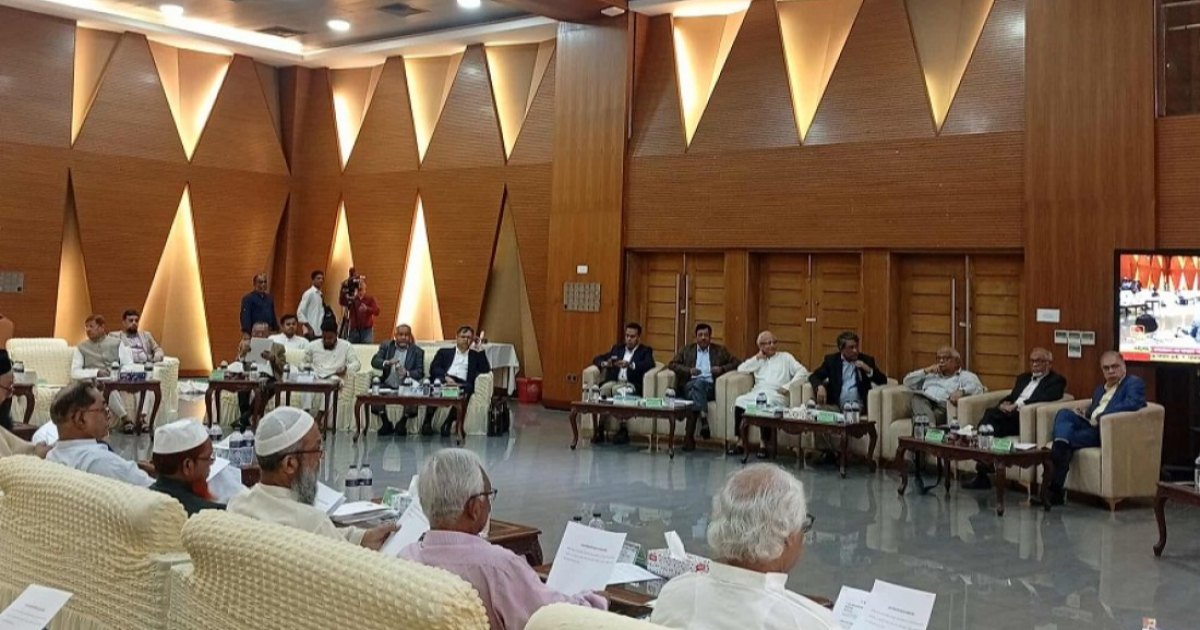
Leaders from various political parties are set to formally sign the “July Charter” on October 17, marking a pivotal moment in Bangladesh’s evolving political landscape.
In a bid to ensure public participation in its implementation, the parties have reached a consensus to hold a national referendum.
However, disagreement has emerged over the timing of the vote.
Jamaat-e-Islami, the Nationalist Consensus Party (NCP), and several others are advocating for the referendum to be held prior to the national election.
In contrast, the BNP and its allies propose conducting the referendum on the same day as the parliamentary polls, using a separate ballot to capture public opinion.
Political analysts suggest that regardless of timing—whether under an interim government or alongside the general election—a referendum could serve as a powerful tool to gauge public support for the July Charter.
Although the Awami League government abolished the referendum provision from the Constitution in 2011, the Supreme Court later reinstated it following the 15th Amendment case after the government’s fall.
The procedural framework for implementing the restored provision, however, remains undefined.
A historical overview
Since independence, Bangladesh has held three national referendums—two administrative and one constitutional—each under distinct political circumstances:
1977: The first referendum was held under president Ziaur Rahman on May 30, asking voters whether they had confidence in his leadership and policies.
With 38.4 million registered voters across 21,685 polling centers, the official results showed an 88.1% turnout, with 98.9% voting “Yes.”
1985: The second referendum took place on March 21 under then-president HM Ershad, again seeking public endorsement of his policies.
The Election Commission reported a 72.2% turnout, with 94.5% voting “Yes.”
1991: Following the mass movement that led to Ershad’s resignation in December 1990, the BNP won the February 27 parliamentary election.
Parliament subsequently passed a bill on August 6 restoring the parliamentary system of government.
To validate this shift through the 12th Amendment, a nationwide referendum was held on September 15.
Of the 35.2% voter turnout, 84.38% voted “Yes,” endorsing the return to parliamentary democracy.
The mechanism
A referendum is a direct voting process through which citizens express their stance on major national or political issues.
Rather than leaving decisions solely to elected representatives, referendums empower the public to accept or reject proposals through ballots.
Globally, referendums have been used to resolve high-stakes questions—such as the 2016 Brexit vote in the UK.
In Bangladesh, Article 142 of the Constitution permits referendums when fundamental structural changes are proposed.
The renewed focus on the July Charter has once again placed this democratic tool at the center of national discourse.
Diverging views on timing
Professor Ali Riaz, vice-chairman of the National Consensus Commission, said: “There has been remarkable progress among political parties regarding the implementation of the July Charter, and they have agreed in principle to hold a referendum.”
BNP Standing Committee member Salahuddin Ahmed told Dhaka Tribune: “We proposed that the referendum be held on the same day as the national election. Separate ballots can be used to record the people’s opinion.”
“That way, implementing the July Charter will become mandatory, and no one will be able to interfere.”
Jamaat-e-Islami, however, insists the referendum should precede the election.
“The referendum will determine whether the people approve the July Charter. If it passes, the charter will gain a strong legal foundation. It should be held first,” said Hamidur Rahman Azad, assistant secretary general of the party.
As the signing date approaches, the debate over referendum timing continues to shape the national conversation around democratic reform, public accountability, and the future of governance in Bangladesh.