
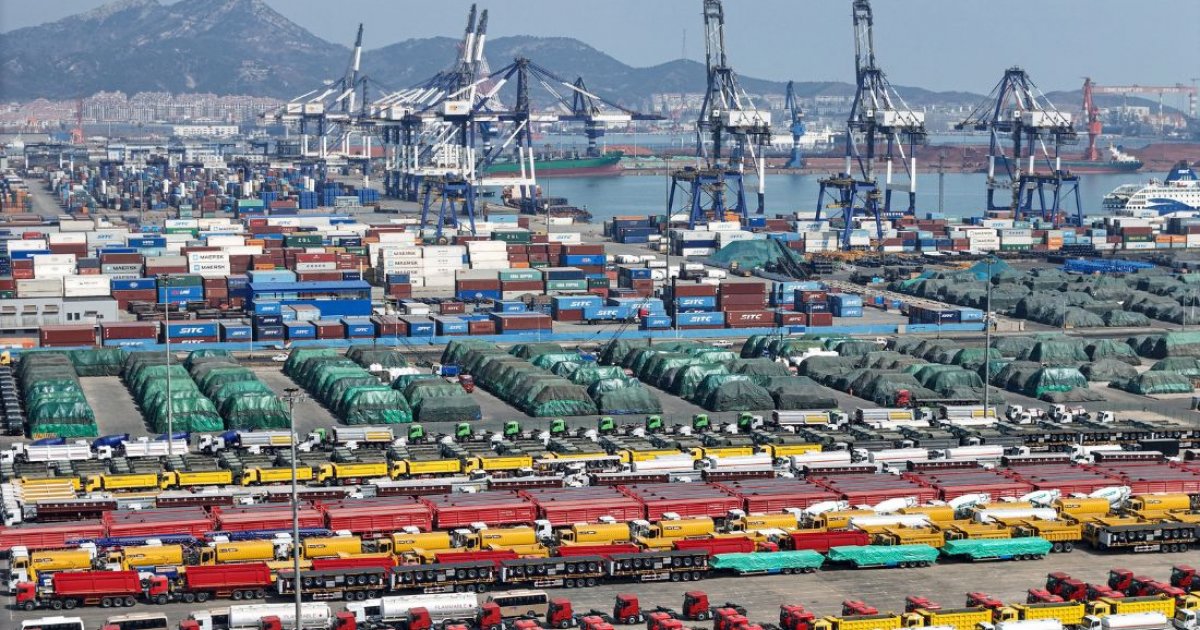
Many of the container trucks that rush towards Dhaka through the fog of Chittagong Port every day contain various raw materials, including machinery, clothing, electronic goods, and other goods marked “Made in China.”
On the other hand, containers filled with shrimp, leather, jute products, and other export goods cross the port gate and set off for China.
China’s rise has created a new reality not only in the global economy but also in the economy of Bangladesh. Now the question is, is Bangladesh ready to move in step with this change?
China has been supporting not only trade but also the construction of major infrastructures, including the Padma Bridge, the Padma Rail Link Project, the Dhaka Elevated Expressways, and the Karnaphuli Tunnel.
Chinese investment and technology are not only helping Bangladesh build infrastructure but are also bringing new momentum to industrial production, exports, and foreign trade.
Contribution to exports
Bangladesh Bank officials say that most of the raw materials and equipment needed to keep Bangladesh’s export sector dynamic come from China.
Prof Mostafizur Rahman, distinguished fellow at the Centre for Policy Dialogue (CPD), said: “Earlier, capital equipment mainly came from Germany, the United States, and South Korea. Now China has taken over that place. As a result, Bangladesh has greatly increased its imports of Chinese raw materials and equipment.”
Bangladesh’s dependence on China to sustain its industrial production and export capacity is gradually increasing.
This has deepened economic relations between the two countries, where China’s influence is clear not only from an economic perspective but also from a strategic perspective.
China’s supply of equipment and raw materials has reduced the export period. As a result, local manufacturers are able to compete quickly in the international market. Chinese supplies are playing an important role, especially in the export activities of the garment, leather, jute products, and electronics sectors.
Infrastructure investment
China’s presence in Bangladesh is most visible in infrastructure projects. From the Padma Bridge connection road to Payra Port, Karnaphuli Tunnel, development around the Rooppur Nuclear Project, or the expressway, Chinese companies have their hands everywhere.
Chinese government loans and investments are now among the largest sources of funding for Bangladesh.
China is investing in more than 30 projects in Bangladesh under the Bangladesh-China Economic Corridor (BCIM) and the “Belt and Road Initiative” (BRI).
According to economists, the current amount of Chinese investment stands at more than $10 billion.
These investments include industrial parks, power plants, railways, port expansion, and telecom infrastructure.
Asked about this matter, Zahid Hossain, former chief economist of the World Bank’s Dhaka office, told Bangla Tribune: “Chinese investment is playing an important role in filling Bangladesh’s infrastructure deficit. However, ensuring the loan conditions and sustainability of the projects is now a big challenge.”
A large part of Bangladesh’s digital infrastructure now relies on Chinese technology.
Huawei and ZTE play a giant role in mobile network components, fibre optics, CCTV cameras, and even government IT projects.
Almost all of Bangladesh’s telecom companies (except Grameenphone) use Chinese equipment. In addition, Chinese companies’ technology is present in government security infrastructure, smart city projects, and data centres.
There is a geopolitical reality here. While the United States and Western countries are boycotting Huawei in 5G networks, Bangladesh is relatively open to adopting Chinese technology.
China is playing a major role not only in investment but also in technical assistance.
Chinese companies are working directly in the development of Bangladesh’s digital economy—especially in fiber optic networks, smart data centers, and cloud technology.
The combination of Chinese technology with the government’s “Smart Bangladesh” initiative is giving rise to new markets and service sectors.
For example, e-commerce, mobile payments, AI-powered supply chains, and digital agricultural markets are now rapidly expanding. All of these are creating a new world of market economy, where technology and innovation are influencing pricing and competition.
Momentum in investment
Chinese investment in the first three months of 2025 increased threefold compared to the previous year.
Currently, about 1,000 Chinese companies are operating in the country in the garment, construction, power, renewable energy, and IT sectors.
In the Chittagong EPZ, the Chinese-owned Direction Technology (Bangladesh) Limited is setting up a headphone and data cable manufacturing factory with an investment of $30 million. This will add 478 local workers to new jobs.
China Leso Group is also setting up a new factory with an investment of about $327.7 million, where solar panels, PVC pipes, sanitary ware, and construction materials will be produced, and 500-600 jobs will be created.
According to the Bangladesh Economic Zone Authority (Beza), more than 30 Chinese companies are operating in the China Economic and Industrial Zone in the Anwara area of Chittagong alone. Beza recently handed over 12.5 acres of land to the Chinese multinational industrialist China Leso Group.
Chinese direct investment (FDI) is expected to reach $1.35 billion by the end of 2024, one of the highest among South Asian countries.
The presence of Chinese companies in such sectors as readymade garment (RMG), electronics, construction, and renewable energy is growing rapidly.
According to Bangladesh Export Processing Zones Authority (Bepza), China is currently the second largest investor in Bangladesh.
The number of Chinese-owned or jointly operated factories in the Chittagong and Mongla export processing zones is increasing rapidly.
Textile, plastic, and electronics factories have also been set up in the industrial zones of Dhaka and Narayanganj with Chinese investment. Many Chinese entrepreneurs see Bangladesh as a new manufacturing hub in South Asia, as labor costs are comparatively low here.
The “Bangladesh-China Friendship Exhibition Center” is being built in Narayanganj with the help of China, which is expected to further enhance trade relations between the two countries.
Influence on Bangladesh economy
Chinese capital and technology are bringing new momentum to Bangladesh’s industry, infrastructure, and information technology sectors.
Their investment in ports, roads, power, and digital services is increasing the country’s market efficiency.
Analysts believe that through a balanced and sustainable partnership, Bangladesh can emerge as one of the emerging market economies in South Asia in the next decade.
Beza has approved the establishment of three Chinese economic zones in Anwara, Chandpur, and Bhola in Chittagong.
Meanwhile, China has promised to continue duty-free benefits for Bangladesh for the next two years after it graduated from the LDC list.
In this context, Nahian Rahman Rochi, head of the Business Development Department of the Bangladesh Investment Development Authority (Bida), believes that the 50-year-old friendly relationship between Bangladesh and China has now reached a stronger and more effective level. The two countries’ economic and technological cooperation is creating new opportunities.
“China is one of our largest investment partners. For 15 consecutive years, China has been Bangladesh’s largest trading partner. Currently, about 1,000 Chinese companies are operating in Bangladesh.”
Rochi said that Chinese investment is now increasing in the infrastructure development, ready-made garments, pharmaceuticals, renewable energy, information technology (ICT), and electronics sectors. “We are optimistic that Bangladesh will move forward in these sectors after seeing the interest of Chinese investors.”
He also said: “A special economic zone has already been created in Bangladesh for Chinese investors. Now, work is underway to create a second zone.” We are offering very attractive opportunities for investors in terms of tax and other incentives.”
According to government statistics, Bangladesh imported about $23 billion worth of goods from China in 2024. These include machinery, electronic equipment, cotton, chemicals, and various raw materials.
On the other hand, Bangladesh exported only about $700 million worth of goods to China. This means that the trade deficit is still wide. However, government data shows that exports have increased slightly in the last two years—especially in the garment, pharmaceutical, leather, and agricultural sectors.
Another Bida official said that China is not just an export destination for Bangladesh but also a huge source of technology, production, and innovation.
Al Mamun Mridha, former secretary general of the Bangladesh-China Chamber of Commerce and Industry (BCCCI), told Bangla Tribune: “Bangladesh exporters can easily procure raw materials from China at relatively low prices and in a short time. As a result, they have been able to play an important role in competitively exporting products in the global market.’’
“Although Bangladesh’s direct exports to China are low, China’s contribution is significant behind most of the products we export around the world. The country’s entrepreneurs import raw materials from China and then export them to various countries by adding value to them.”
Mridha further said: “China’s role in the development of Bangladesh’s electronics industry is also undeniable. Most of the machines and components used in the industry come from China. Due to the supply of these materials at affordable prices, we can compete not only in our own market but also in the international market.”
Balance in trade and industry
Trade relations between Bangladesh and China have increased manifold in the last decade. However, it is still one-sided.
In FY23, Bangladesh’s exports to China were only $715 million (1.61% of total exports), while imports from China were about $28 billion—one-third of Bangladesh’s total imports.
According to data from the Bangladesh Bureau of Statistics (BBS), in the first half of FY25, more than $22 billion worth of goods were imported from China, which is about a quarter of the country’s total imports.
At the same time, exports from Bangladesh to China were only about $850 million. That is, the trade deficit is huge—about $210 billion.
However, this deficit is not only negative. A large part of the goods coming from China are raw materials and machinery for Bangladesh’s manufacturing sector.
A large part of the fabrics, yarns, buttons, zippers, etc. needed for the ready-made garment industry, especially for the garment industry, comes from China. As a result, even though imports have increased, it is keeping the country’s industrial sector active.
The list of exports from Bangladesh to China is relatively small. Still, some sectors are slowly gaining ground. Especially seafood, leather and leather products, jute, and pharmaceuticals.
Some positive effects have been seen after China announced duty-free benefits for Bangladesh in 2020. Still, the volume of exports is small compared to imports.
Analysts say that to reduce the export deficit, Bangladesh will have to work on diversifying its export products and expanding its market. There is potential for exporting ready-made garments, medicines, jute products, and light engineering materials, especially to the Chinese market, but active trade diplomacy is needed to utilize it.
BRI’s strategic impact
Since Bangladesh joined the BRI in 2016, Chinese financing for infrastructure development has increased manifold.
Currently, more than 40 projects have Chinese financing or technical assistance. Under the BRI project, Chinese financing has been provided to the Padma Rail Link, Payra and Matarbari Ports, Karnaphuli Tunnel, and various road and energy projects.
These projects are increasing Bangladesh’s manufacturing, logistics, and export capabilities.
According to economists in the country, these infrastructures are not only facilitating trade but also making the local market economy competitive.
Analysts believe that transparency and debt sustainability are important in these projects. Relations with China play an important role in Bangladesh’s development framework, but excessive debt-dependent projects can put pressure on the economic balance.
Debt-driven development
There are differences of opinion in Bangladesh about Chinese loans. The government says that these projects are accelerating the country’s development.
But a section of economists believes that excessive debt dependence could create pressure in the future.
China’s share of Bangladesh’s total external debt is about 6%-7%. Although it is not as high as Sri Lanka’s, many projects involve Chinese loans and contractors together.
There are also allegations that this reduces competition and increases costs.
A 2024 IMF report said that transparency in debt management is essential to increase the effectiveness of Bangladesh’s large infrastructure projects and bring economic diversification.
Is Bangladesh prepared?
Economic relations with China require a combination of opportunities and challenges for Bangladesh.
Export deficit, technology dependence, and debt sustainability are major challenges.
However, Bangladesh can reap the maximum benefits from this relationship through skilled manpower, policy transparency, and industry-friendly infrastructure development.
According to experts, if Bangladesh can further stabilize the investment environment in the next five years, Chinese investment and technology cooperation will play a significant role in the country’s industrialization and employment.
The rise of China has created a new reality not only in the global economy but also in the economy of Bangladesh.
The question now is, is Bangladesh ready to keep pace with this change?
If good governance, transparency, and efficient planning can be ensured, then the economic partnership with China can be one of the driving forces of Bangladesh’s next growth.