
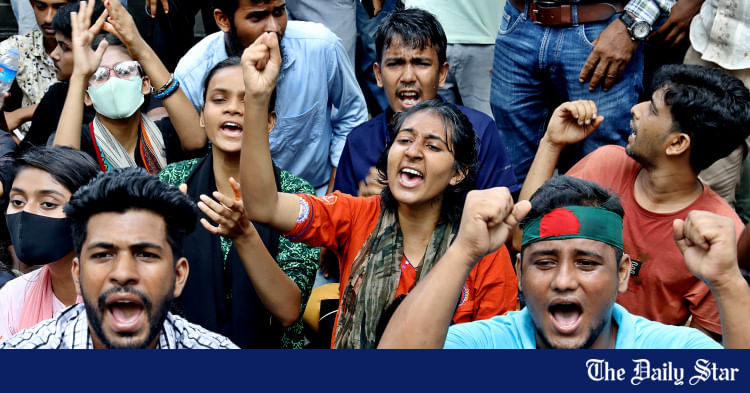

During the July uprising, the youth, once exalted as Bangladesh’s dividend, became its critics. FILE PHOTO: ANISUR RAHMAN
“>

During the July uprising, the youth, once exalted as Bangladesh’s dividend, became its critics. FILE PHOTO: ANISUR RAHMAN
When Bangladesh’s youth poured into the streets in July 2024, the trigger was a court ruling on job quotas. This was no policy dispute. It was an inevitable eruption—the moment a generation which was promised a future through education finally declared war on the system that betrayed them.
For over a decade, we have been celebrating our “demographic dividend,” a youth bulge seen as the engine of growth. Every university degree was supposed to be a step towards prosperity. Yet in 2024, the numbers told an unambiguous tale of failure. Youth unemployment, aged between 15-24, stood at 11.46 percent. Among university graduates, the rate stood at 13.11 percent. Some estimates suggested that one in three graduates remained without work for up to two years.
 For all latest news, follow The Daily Star’s Google News channel.
 Moreover, nearly 40 percent of Bangladeshi youth fell into Not in Education, Employment, or Training (NEET) category. The gender divide remained harsh as the female NEET rate was almost 50 percent higher than that of males. Education had been framed as a path to dignity, but became a symbol of exclusion. At its root, the education system was disconnected from market needs. Nevertheless, that cohort of “educated unemployed,” digitally connected and deeply frustrated, was the movement’s core energy.
Beneath the social unrest lay an economic model that equated growth with success even as its core engines broke down. Bangladesh’s GDP looked strong, but its foundations were not. The banking sector was one key cause and symptom of the malady. By early 2025, the non-performing loan (NPL) ratio had climbed to 24.13 percent, meaning nearly one in every Tk 4 lent was unrecoverable. This was no ordinary banking failure—it was money heist in plain sight. The mountain of bad loans stood as a monument to impunity, where connected borrowers drained capital unchecked. With credit to private enterprise drying up, investment stalled. The SME sector was choked by a financing shortfall estimated at $2.8 billion.
Meanwhile, dependence on the RMG sector evolved into a trap. With the industry accounting for about 85 percent of export value, the jobs it offered were low-skill and low-pay, inadequate for a rising class of graduates. Gender exclusion deepened the fracture. Women’s workforce participation had risen, but remained concentrated in the garment work, lacking security. The mismatch was stark: talent was being produced for which no roles existed.
As job creation stagnated, living costs continued to rise. Inflation peaked officially at 11.7 percent in July 2024, eroding household purchasing power. Analyses suggested that nearly 28 percent of the population slipped back into poverty. Inequality soared as local studies placed the Gini coefficient near 0.50—a level typically associated with serious social tension.
The uprising is not supposed to be a passing eruption. The youth, once exalted as Bangladesh’s dividend, became its critics. Deprived of economic mobility, they seized political agency. And so, in a sandbox where the economy was made to serve politics, sense must prevail and politics must serve the economy.
The foremost priority now for any elected government must be job creation. This starts with financial-sector cleanup. It will require more than just new regulations or reform; it demands the political courage to dismantle the networks of impunity that have protected willful defaulters for years.
Once credit returns, education reform and SME revival must follow in tandem. Education must move beyond theory to build AI and digital skills, applied learning, and university-industry partnerships, backed by a national commitment of at least four percent of GDP. At the same time, closing the $2.8 billion SME credit gap through guarantee schemes and fintech tools can offer the fastest, most inclusive path to employment generation.
This will provide Bangladesh with the groundwork to realistically diversify into value-added sectors, such as ICT, pharmaceuticals, and light engineering, which are capable of absorbing educated labour sustainably.
The July uprising was not a riot; the masses rallied to a simple call—a call for economic justice, which would uphold their right to a brighter future.
Regardless of the failings of current politics, a generation that feels its future is being stolen will not wait quietly. If we answer their call, this chapter in our history may become a turning point. If they are ignored, the next eruption will be louder.
Saba El Kabir is a sustainability practitioner. He can be reached at [email protected].
Views expressed in this article are the author’s own.
Follow The Daily Star Opinion on Facebook for the latest opinions, commentaries and analyses by experts and professionals. To contribute your article or letter to The Daily Star Opinion, see our guidelines for submission.