
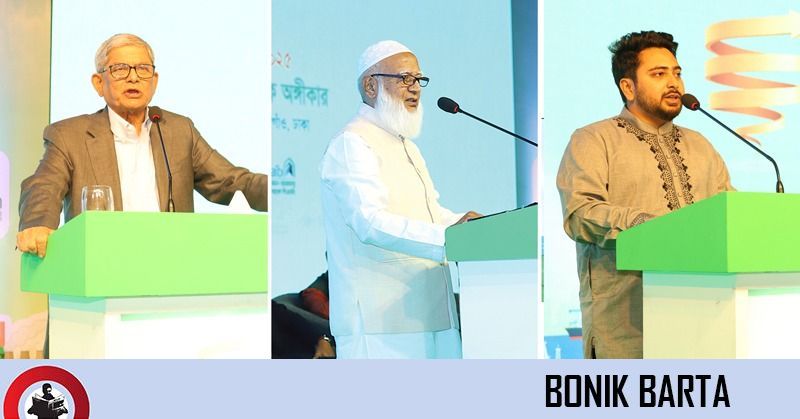
The top leaders of the Bangladesh Nationalist Party (BNP) and Bangladesh Jamaat-e-Islami have pledged to lift the country’s economy to $1 trillion. BNP leaders said that if they came to power, they would create 10 million jobs within 18 months and push the economy toward broader democratic reforms. Jamaat-e-Islami leaders said their priority would be to build a corruption-free state and establish justice across society, while emphasizing justice in the economy.
Leaders of the National Citizen Party (NCP) vowed to help recover laundered assets and prosecute those responsible, whether the party joins a future government or not. The Ganosamhati Andolon said it intends to position itself as a new political force capable of shaping a new political settlement.
Speakers argued that the economy has absorbed severe damage over the past decade and a half, citing irregularities, corruption, and large-scale looting across the banking sector. State-backed oligarchs siphoned national wealth overseas, leaving the financial system weakened. With the 13th national election expected in the first half of February 2026, senior politicians said they want to build an economy that works for all citizens, not engage in corrupt and undemocratic practices of the past, regardless of who wins or loses at the polls.
They made the promises on Saturday, November 29, at the 4th Bangladesh Economic Summit 2025, hosted by Bonik Barta at the Pan Pacific Sonargaon hotel in Dhaka. The event featured four sessions moderated by Dewan Hanif Mahmud, the newspaper’s editor and publisher.
BNP Secretary General Mirza Fakhrul Islam Alamgir, former commerce minister Amir Khasru Mahmud Chowdhury, Bangladesh Jamaat-e-Islami Ameer Dr. Shafiqur Rahman, NCP convener Nahid Islam, and Ganosamhati Andolon coordinator Zonayed Saki spoke at the conference, which centered on the theme “Future Economic Roadmap and Political Commitment.” Bangladesh Bank Governor Dr. Ahsan H Mansur chaired two sessions. Business leaders, industrialists, senior civil servants, bankers, academics, and civil society representatives also attended.
Amir Khasru Mahmud Chowdhury outlined the BNP’s economic plans and said a BNP government would prioritize large-scale job creation. “If the BNP forms the next government, we will create employment for 10 million people within 18 months,” he said. “We are ambitious about employment because our previous administrations kept the employment curve moving upward.”
He added, “I can promise that if the BNP forms the government, it will take the economy into the trillion-dollar bracket.”
BNP Secretary General Mirza Fakhrul Islam Alamgir said the country needs a political roadmap alongside an economic one. He said stability and continuity in both arenas are essential, and added that his party is working toward that goal.
Former Senior Secretary Muhammad Safiullah, who is involved in drafting Bangladesh Jamaat-e-Islami’s election manifesto, outlined the party’s plans. “The economy is standing at the edge of a cliff,” he said. “Bangladesh Jamaat-e-Islami aims to recover this collapsing economy by curbing corruption and establishing good governance, then restoring GDP growth. Our goal is to transform the economy into a trillion-dollar one by 2040, within the next 15 years.”
Bangladesh Jamaat-e-Islami Ameer Dr. Shafiqur Rahman said the party seeks steady, rational progress rather than abrupt upheaval. “We need collective effort, across political lines, to build the country’s future,” he said. “We have a responsibility to move past old mistakes and shape what comes next.”
NCP Convener Nahid Islam said the party will press to recover laundered funds whether it joins the next government or stays outside it. “That money belongs to the country,” he said. “It must be brought back. We will hold accountable those who took advantage of the past fascist era, exploited the public, and acted against the national interest. We will prosecute the looters and their networks.”
Ganosamhati Andolon Coordinator Zonayed Saki said the next political force will have to stabilize the banking and financial sectors and protect investment firms. Meeting that challenge, he said, requires political groups to carry public demands and place citizens’ interests above everything else. “This moment calls for a new force,” he said. “We are working to build that.”
The conference’s opening session, titled “Business, Investment, and the Macroeconomy,” was chaired by Bangladesh Bank Governor Dr. Ahsan H Mansur. Speakers included BIDS Director General Dr. AK Enamul Haque; AK Azad, chairman and managing director of Ha-Meem Group; Mohammed Jahangir Alam, president of the Bangladesh Steel Manufacturers Association and chairman of GPH Group; and Mashrur Arefin, chairman of the Association of Bankers Bangladesh and managing director and CEO of City Bank PLC.
Dr. AK Enamul Haque said Bangladesh’s economy now stands at about $450 billion and could reach $1 trillion by 2035, but only if the country undertakes significant reforms. He said the 2024 protest stemmed largely from the lack of employment. He noted that growth in recent years had been “jobless growth.” Employment generation, he said, must sit at the center of any strategy.
Ha-Meem Group Chairman AK Azad raised concerns about the scale of nonperforming loans in the banking sector. He said, “NPLs account for roughly 35 percent of all loans in Bangladesh. Where did that money go, and who took it? The issue is already surfacing in the media. We expect the next government, regardless of who forms it, to trace the funds and bring those responsible under the law.”
GPH Group Chairman Mohammed Jahangir Alam described the moment as “a period of severe crisis.” He said the industry sought help from the central bank, and the governor responded with a policy measure, though factories still cannot run at full capacity and are incurring losses. “The governor’s support may offer temporary relief. But long-term measures remain essential.” He added that businesses expect both the current administration and any future government to act.
City Bank PLC Managing Director and CEO Mashrur Arefin said loan growth in the banking sector has fallen to about 6 percent, the lowest level in two decades. But he said stronger banks are performing well, citing 21 percent loan growth at City Bank and solid growth at Dutch-Bangla, BRAC, EBL, and Trust Bank. He added, “The economy would not be harmed if 10 to 12 weaker banks stopped lending. Governance in the sector has improved. Bank boards have halted loan sales. That has also slowed loan growth. There is far more discipline now. Supervision is stronger than at any time in the past. We expect loan growth in the private sector to pick up, along with GDP growth.”
Arefin also voiced optimism about Bangladesh’s prospects. He said global banking giant JPMorgan invited chief executives from 11 Bangladeshi banks to Singapore last week. Bangladesh typically receives credit lines from Mashreq Bank and Commerzbank, he said, but JPMorgan signaled a new level of interest. “They are ready to extend credit lines worth more than a billion dollars. International lenders still trust Bangladesh because we have never defaulted. Bangladesh’s economy is now on the runway. It will definitely take off,” he added.
In his remarks as chair of the session, Bangladesh Bank Governor Ahsan H Mansur said, “We face a long list of problems, and none of them will be fixed overnight. We are still identifying some of them. Nonperforming loans remain a major issue. New policies and quarterly updates now give us a clearer picture of the true NPL situation. When the previous government claimed the NPL rate was 8 percent, I estimated the real figure was closer to three times that, about 25 percent. It has now reached 35 percent. This is not a small problem. When more than a third of all loans are nonperforming, running a banking system on the remaining two-thirds imposes enormous pressure. It will take at least five to ten years to work our way out of this.”
The second session focused on “Democratizing the Economy.” Mirza Fakhrul Islam Alamgir, secretary general of the BNP, chaired the discussion. Former commerce minister and BNP standing committee member Amir Khasru Mahmud Chowdhury joined as a panelist. “The gains from Bangladesh’s economic growth have not reached ordinary citizens,” he said. “They have been captured by a narrow circle, creating a privileged political and economic order. Democratizing the economy is fundamental to the country’s broader development, and political and economic reforms must move together. The economy must operate as part of a democratic system, and its primary aim must be public welfare. As long as the economy remains concentrated in the hands of a few groups, ordinary people will never see its real benefits.”
He called for long-term investment in the energy sector and universal access to reliable internet. He also outlined several institutional reforms needed for a sustainable economy, including developing the capital market by bringing in state-owned enterprises, reforming the telecommunications regulator, reforming the stock market, and creating a more citizen-friendly environment through deregulation. He said every district should have a digital skills center to help young people build expertise, add value to local products, and strengthen the broader economy.
As chair of the session, Mirza Fakhrul Islam Alamgir added, “In 2016, our chairperson, Begum Khaleda Zia, laid out Vision 2030. Many of the priorities we agreed on today were already there. Our 31-point plan, released in 2023, also included economic and political reforms. We have always aspired not only to a new Bangladesh but to a prosperous one, where every person can live with dignity, good governance prevails, and democracy is given the highest importance. Based on our past experience, we want to guide Bangladesh toward a genuinely prosperous state.”
The third session focused on “Justice in the Economy” and was chaired by Bangladesh Jamaat-e-Islami Ameer Dr. Shafiqur Rahman. Former senior secretary Muhammad Safiullah served as the panelist. Outlining Bangladesh Jamaat-e-Islami’s economic plan, he said the party had identified two priorities for turning around the current situation and driving growth. He added, “One is sector-based. We are developing a roadmap through creative strategy work, focus group discussions, and expert consultations to determine what should be done in each sector. With limited time, I cannot present the full plan. We want to diversify the ready-made garment industry, remittances, and agriculture. These are the three pillars of the country’s GDP. If good governance can be established, these pillars could anchor a more diversified economy and help expand it into the trillion-dollar range.”
He further said that political and economic reforms must advance together. The country must invest in its young people, he argued, or by 2035 the youth population could become a burden rather than an asset. “Jamaat-e-Islami believes technical training centers should be established not only at the district and subdistrict levels but also in every union. No single party or group can move the country forward alone. Progress will require a unified effort that draws on the nation’s productive workforce. Jamaat-e-Islami would pursue that path if given the responsibility to govern,” he noted.
Bangladesh Jamaat-e-Islami Ameer Dr. Shafiqur Rahman said entrepreneurs face corruption, red tape, and extortion when trying to set up factories. In his remarks as chair of the third session, he said, “Delays begin with acquiring land and continue through every stage of approval. Industries that should open within a year end up stalled for years, leaving the bank loans taken by entrepreneurs as nonperforming. Extortion and insecurity discourage new investment to the point that many capable business owners avoid expanding altogether. Foreign investors hold back for the same reasons and often state clearly that they will not invest without a safe and stable business environment. As a result, domestic businesses feel compelled to align themselves with the ruling party. This is not their failure, but evidence of our political failure. When politics does not function, the economy cannot operate normally.”
The conference’s closing session examined the “Economic Aspirations of the July Uprising.” Bangladesh Bank Governor Ahsan H Mansur chaired the discussion. Speakers included Zonayed Saki, chief coordinator of the Ganosamhati Andolon; Nahid Islam, convener of the National Citizen Party (NCP); and Dr. Badiul Alam Majumdar, secretary and chief executive of Citizens for Good Governance (SHUJAN).
Jonayed Saki said, “We talk about increasing investment, creating new jobs, and expanding business activities, and these are certainly important. But we also have to remember that an economy has not just capital but labor as well. If workers, the real makers of production, do not see improvement, then commerce and industry will not naturally flourish. There is no economic future without reducing inequality.”
Nahid Islam, coordinator of the NCP, said, “Two major challenges right now are generating employment and ensuring a sustainable livelihood for the rising middle class in metropolitan cities. Beyond that, it is essential to meet the fair demand for health, education, and basic services. Urban public transport, youth employment, and entrepreneurial development require special attention. Many expatriates want to engage politically in the country’s development, and that should inform the creation of a just economy.”
Dr. Badiul Alam Majumdar added, “We are heading to a referendum after implementing reforms. Although the referendum includes four questions, it is really a single package. The core question is whether you support the reforms or oppose them. A ‘yes’ vote supports them; a ‘no’ vote opposes them. Then it’s up to the people to decide what changes they actually want. Sheikh Hasina has fled, but the path to fascism remains open. If people do not act, someone else could occupy that seat and repeat the same course.”
In an open discussion, Transcom Group CEO Simeen Rahman said, “Our economy is navigating challenges in growth and consumer spending. Inflation and high interest rates have suppressed economic activity. The depreciation issues we faced in recent years have now stabilized. A year or two ago, bank lending faced some hurdles, but that is no longer a problem. We are undergoing a transition. Many of our past challenges are being addressed. Looking ahead, I am optimistic about Bangladesh’s economy.”
Ahsan Khan Chowdhury, chairman and CEO of PRAN-RFL Group, said, “Business must be made easier to strengthen our capital markets. If entrepreneurs cannot repay loans, the consequences are devastating. Overall, we need a more positive business environment. That requires proper planning, a well-equipped and modernized agricultural system, and steps to further energize the economy.”
Mostafa Kamal, chairman and managing director of Meghna Group, said, “We (business owners) face daily challenges. Our main request is to make business easier. Bureaucracy is too dominant here. These issues need to be addressed. If business remains difficult, new entrepreneurs will not be motivated to enter the market.”
In the open discussion, Nasim Biswas, managing director of Nasir Group, addressed the country’s tax system. He said, “VAT shouldn’t have rigid targets. It should be sales-oriented. At the same time, I urge the business community to keep social responsibility in mind. Don’t think only about profit; we have to think about our employees as well.”
MasterCard Bangladesh country manager Syed Mohammad Kamal highlighted the importance of the digital economy. “A larger digital economy will reduce corruption, increase transparency, and ultimately expand our GDP,” he said.
NRB Bank chairman Iqbal Ahmed noted that most current remittances come from low-skill workers. “The contributions of non-resident Bangladeshis who have invested here rarely get attention. I urge everyone to recognize the achievements of NRBs,” he said.
KSM Mostafizur Rahman, managing director of National AgriCare group, said import hurdles have raised costs in the agrochemical sector. “If these issues are resolved, farmers could buy the BDT 150 billion of pesticides they currently purchase at least BDT 40 billion cheaper, and these products could also be exported like pharmaceuticals,” he said.
Mohammad Hatem, president of the Bangladesh Knitwear Manufacturers and Exporters Association (BKMEA), addressed non-performing loans. “Reports show that non-performing loans have already reached BDT 6.5 trillion. We expect this may rise further. We are hopeful that reforms under the governor’s leadership will improve the situation. Still, measures must ensure that non-performing loans do not increase and that ongoing industries can continue operations.”
Kamran T Rahman, president of the Metropolitan Chamber of Commerce and Industry (MCCI), warned, “I saw in the media that a Bangladesh Bank chief economist has indicated that non-performing loans could exceed BDT 6.5 trillion. The economy could soon face a major crisis if this trend continues.”
Small-business owner Tanvir Mohammad Dipu added, “Extortion has risen to a level that puts small businesses in serious jeopardy. Curbing extortion would allow small entrepreneurs to contribute far more to the economy.”
Representatives from donor agencies and development partners attending the Fourth Bangladesh Economic Summit 2025, organized by Bonik Barta, included Jean-Pesme, division director for Bangladesh and Bhutan at the World Bank; Baiba Zārina, deputy head of Delegation at the EU Mission to Bangladesh; Pawan Badhe, deputy high commissioner of India in Dhaka; and Ricky Salmina, press specialist at the US Embassy in Dhaka. Dr. Mohammad Akhtar Hossain, chief economist of Bangladesh Bank; Dr. Md. Ezazul Islam, and Md. Sarwar Hossain, executive director of the central bank, and Md. Mostafizur Rahman Khan Chowdhury, deputy head of BFIU, were also present.
Chairmen, directors, and senior executives of various public and private banks joined the summit. Among them were Md. Nurun Newaz, chairman of NCC Bank PLC and Electro Mart Group; AKM Shaheed Reza, former chairman of Mercantile Bank PLC; Mohammad Abdul Mannan, former Chairman of First Security Islami Bank PLC; Mohammed Nurul Amin, former chairman of Global Islami Bank PLC; Md. Ali Hossain Prodhania, chairman of NRBC Bank PLC; Helal Ahmed Chowdhury, chairman of BASIC Bank PLC; Prof. Dr. M Abu Yusuf, Director of Al-Arafah Islami Bank PLC; and Muklesur Rahman, Director of National Bank PLC.
Among managing directors present were Syed Mahbubur Rahman of Mutual Trust Bank; Md Omar Faruk Khan of Islami Bank Bangladesh; Mohammad Mamdudur Rashid, MD of United Commercial Bank; Mosleh Uddin Ahmed of Shahjalal Islami Bank; Ahsan Zaman Chowdhury of Trust Bank; M Shamsul Arefin of NCC Bank; Mohd. Rafat Ullah Khan, acting MD of Al-Arafah Islami Bank; AKM Shahnawaj, acting MD of Dhaka Bank; Md Ahsan-uz Zaman of Midland Bank; Md Shafiul Azam of Modhumoti Bank; Syed Mizanur Rahman of AB Bank; Alamgir Hossain of Citizens Bank; Md. Mahbubur Rahman, AMD of City Bank; Mesbaul Asif Siddiqui and Nurul Azam Mozumder, DMDs of City Bank; Md. Altaf Hossain Bhuyan, DMD of SBAC Bank; and Mohammed Emtiaz Uddin, DMD of Padma Bank.
Former managing directors attending included Ahmed Kamal Khan Chowdhury of Prime Bank, Safiul Alam Khan Chowdhury of Pubali Bank, and Md Arfan Ali of Bank Asia.
Entrepreneurs and top corporate executives were also in attendance, including Mahbubul Anam, managing director of Expo Group Bangladesh; ASM Mainuddin Monem, MD of Abdul Monem Ltd.; Md Alamgir Kabir, vice chairman of Crown Cement; Humayun Rashid, MD and CEO of Energypac Power Generation PLC; Mohammed Fasiul Mowla, CEO of Anwar Landmark Ltd.; Galib Mohammad, CEO of Akij Ispat Ltd.; Basab Bagchi, CEO of Thakral Information Systems Pvt. Ltd.; Amin Ahmad, chairman of Best Holdings Ltd., and Hasan Ahmad, its Managing Director; Tanveer Mostafa and Tasnim Mostafa, Directors of Meghna Group of Industries (MGI); Nazrul Islam Raja, MD of Raja Metal Industries Ltd.; former BGMEA president Quazi Moniruzzaman; Parvez Saiful Islam, COO of Square Food & Beverage Ltd.; Md Reaz Uddin, MD and CEO of Summit Meghnaghat II Power Company Ltd.; Mohammad Shahjahan Chowdhury, President of the Bangladesh Frozen Foods Exporters Association; and Shyamal Das, MD of MU Sea Foods Ltd.
Business leaders from various chambers also joined the event. They included Shabbir A Khan, president of the Bangladesh-Malaysia Chamber of Commerce and Industry (BMCCI); Anwar-Ul Alam Chowdhury (Parvez), president of the Bangladesh Chamber of Industries (BCI); Mohammad Hatem, President of BKMEA; former BGMEA President Quazi Moniruzzaman; Kamran T. Rahman, president of the Metropolitan Chamber of Commerce and Industry (MCCI); Simeen Rahman, vice president of MCCI; Anwar Shahid, vice president of JBCCI; Abdul Wahed, joint secretary general of IBCCI; and Mantasha Ahmed, President of the Association of Fashion Designers of Bangladesh (AFDB).
Regulators and policymakers present included former BSEC Chairman Faruq Ahmed Siddiqui; Dr. Md Sajjad Hossain Bhuiyan, chairman of the Financial Reporting Council (FRC); Minhaz Mannan Emon, director of DSE; Maj General (Retd) Mohammad Quamruzzaman, DSE director; Khandaker Asad Ullah, advisor at LankaBangla Asset Management Company Limited.; AF Nesaruddin, Former president of ICAB and Partner at Hoda Vasi Chowdhury & Co; Muhammad Mehedi Hasan, acting president of ICAB and Partner at KPMG Bangladesh; Suraiya Zannath Khan, lead governance specialist (Financial Management) at the World Bank and Vice President of ICAB; Khandoker Saffat Reza, CEO of LankaBangla Securities; Md Moniruzzaman, managing director of Prime Bank Securities Ltd.; Mohammed Nasir Uddin Chowdhury, director of the Chittagong Stock Exchange and MD of LankaBangla Securities; Alamgir Morshed, executive director and CEO of IDCOL; Mohammad Rafiqul Islam, MD of United Finance PLC; Md Golam Sarwar Bhuiyan, former BLFCA chairman; Kanti Kumar Saha, CEO of Lankan Alliance Finance PLC; Md Mamunur Rashid Molla, MD of Phoenix Finance and Investment Ltd.; Shah Md. Abdul Bari, MD of First Finance Ltd.; and Muhammad Nurul Alam Chowdhury, CEO of South Asia Insurance Company Limited.
Among the writers, researchers and academics attending the event were Professor Dr. Mohammad Ismail, vice chancellor of Noakhali Science and Technology University; Professor Dr. Md Abul Kashem Mia, vice chancellor of United International University (UIU); Professor Dr. Abdur Rab, vice chancellor of IUBAT; Professor Dr. Engineer Ayub Nabi Khan, acting vice chancellor of BGMEA University of Fashion and Technology (BUFT); Dr. Rashed Al Mahmud Titumir, director of Bangladesh Bank and professor of Economics at the University of Dhaka; and Dr. MA Rashid, professor of Cardiology at Ibrahim Cardiac Hospital & Research Institute.
Also present were former secretary Sikder Anwar; Dr. Mostafa Abid Khan, former member of the Bangladesh Trade and Tariff Commission; Md Alamgir Hossain, former member of the National Board of Revenue (NBR); Md Ataur Rahman Sarker Rojel, general secretary of the Bangladesh Sustainable and Renewable Energy Association (BSREA) and chairman of Muspana; Atiqur Rahman Sarkar Sohel, managing director of Muspana; Dr. Yusuf Khan, chairman of the Governing Body of Bureau Bangladesh; and Dr. Isharaf Hossain, secretary general of the Foundation for Strategic and Development Studies (FSDS).
Other attendees included Md Zulhas Uddin, former Executive Director of Bangladesh Bank; Agricultural Economist Jahangir Alam; Professor Dr. Sohel Ahmed, pro vice chancellor (Administration) of Jahangirnagar University; Professor Dr. Md Shamsul Alam, acting dean of the Faculty of Social Sciences at Jahangirnagar University; Professor Ireen Akhter, director of the Institute of Business Administration of Jahangirnagar; Professor Kh. Lutful Elahi, provost of Shaheed Tajuddin Ahmad Hall and professor of History; Associate Professor Abu Sayef Md Muntaquimul Bari Chowdhuri, acting dean of the Faculty of Business Studies; Professor Md Mizanur Rahman of the Department of Archaeology; and Assistant Professor Sahadat Hossain of the Department of Public Health and Informatics. Student leaders also joined, including Ferdous Al Hasan, AGS of Jahangirnagar University Central Students’ Union (JACSU). Professor Dr. Md Tofazzal Islam of Gazipur Agricultural University (GAU); Professor Dr. Md Main Uddin, former chairman of the Department of Banking and Insurance at the University of Dhaka; Professor Dr. Shahidul Zahid, chairman of the Department of Banking and Insurance; Professor Dr. Mohammad Omar Farooq, head of the Economics Department at UIU; Professor Dr. Md Sirajul Islam of the Department of Civil and Environmental Engineering (CEE) at North South University; Dr. Rezaul Karim Chowdhury, maritime consultant and faculty at University Malaysia Terengganu (UMT), Security Analyst Sazzadul Kibria Dipu; and Md. Azhar Uddin, Policy Analyst at the ICT Division of the Government of Bangladesh, Dr. Shaykh Ahmad, Assistant Professor (Adjunct Faculty), and Shamim Ehsanul Haque, Assistant Professor at BRAC Business School. Also present were Tanzila Amir, Lecturer in Economics at UIU; Proma Paromita Chowdhury, Lecturer in Economics at East West University; Mahmudul Hasan, General Secretary of Bangladesh Study Forum (BDSF); and Syed Rayan Amir, spokesperson of BDSF.
The event was joined by several prominent planners and administrators, including former BIP president and Jahangirnagar University URP Professor Dr. Md Akter Mahmud; Monodeep Ghorai, Secretary of the National Housing Authority; and Akter Un Nesa Sheuly, Regional Executive Officer of Zone 10 at Dhaka South City Corporation.
Political figures in attendance included Ismail Jabiullah and Zahir Uddin Swapan, advisers to the BNP Chairperson; Barrister Ruhul Quddus Kajol, member of the BNP National Executive Committee; Md Nurul Islam Bulbul, ameer of Jamaat-e-Islami Dhaka South; Fahima Nasrin Munni, BNP assistant secretary for International Affairs; Barrister Abdullah Al Mamun, chairman of the Legal Education Committee of the Bangladesh Bar Council; and SM Tasmirul Islam, lawyer at the International Criminal Court.
Academics and professionals present included Professor Mahbubul Alam Majumdar, Dean of the School of Data and Sciences at BRAC University; Kabir Ahmed, director (Mails) at the Postal Directorate; Md Nizam Uddin, vice president of Jatiyatabadi Chhatra Dal (JCD); former JCD vice president Sultana Jesmin Jui; Jannatul Ferdous, JCD secretary for Women’s Affairs; Jannatul Nawrin Urmi, JCD joint general secretary; and Mollik Wasi Uddin Tami, office secretary of DU Chhatra Dal. Leaders from the Nationalist Citizen Party (NCP) included Alauddin Mohammad, Joint Member Secretary; Faridul Haque, Joint Member Secretary; Molla Mohammad Faruq Ehsan; Abdullah Al Mamun Faisal, organizer (Southern Region); and Sardar Amirul Islam, Member Secretary of Dhaka North.
Representatives from the Amar Bangladesh Party (AB Party) attending included Farah Naz Sattar, Secretary for Women’s Affairs; Hazera Mehjabin, member of the International Affairs Committee; and Professor Foysal Munir, Assistant Secretary for Education Affairs. Student representatives present included Saikat Arif, General Secretary of Bangladesh Student Federation; Armanul Haque, Convener of the DU unit of the Student Federation.