
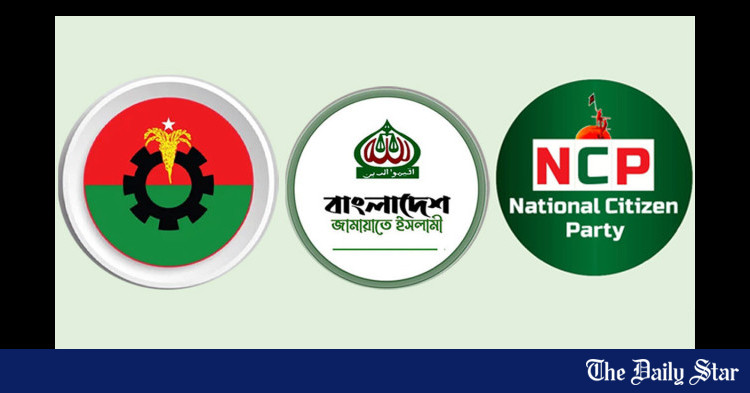
BNP, Jamaat-e-Islami, and National Citizen Party yesterday outlined their plans focusing on fairer economic and education systems, as well as increased employment opportunities.
Leaders of the three major parties shared their ideas at the fourth edition of the “Bangladesh Economic Conference 2025”, organised by Bangla daily Bonik Barta at a city hotel. “Future Roadmap of the Economy and Political Commitment” was this year’s theme for the conference.
 For all latest news, follow The Daily Star’s Google News channel.
 BNP presented a detailed economic plan promising inclusive growth and job creation.
Its Standing Committee member Amir Khasru Mahmud Chowdhury said, “We have seen that the benefits of economic growth have not reached the people. Political alignment and proximity to power have created a privileged economy. BNP seeks to bring economic democracy to everyone.
“Poor people have worked for generations, but their products and lives have not improved. We must provide loans, inputs, skill development, design support, branding, and internet access …”
He said investing in people’s skills and quality products will create demand, increase employment, and contribute to the GDP.
Regarding digital infrastructure, Khasru said, “Power and internet must reach everywhere so that ordinary people can access call centres, data centres, and online businesses.”
Citing Thailand’s “One Village, One Product” programme as a model, he said, “We plan to support specialised village products with loans, skills, and marketing for global sales.”
He outlined four criteria for investment: value for money, return on investment, job creation, and environmental sustainability.
“We have calculated how one crore jobs can be created in 18 months through targeted investment. Sports, culture, and digital skills are also major priorities.
“Bangladesh does not really have a capital market. The banking system is overdependent. We need to move from frontier markets to emerging markets, where access to trillion-dollar funds is possible.”
He added, “Bangladesh is an over-regulated country. Citizens should not have to go through so many government offices. We will empower the people, not the government.”
BNP Secretary General Mirza Fakhrul Islam Alamgir said, “Those who looted banks and committed corruption over the last 15 years should be punished. But [many of] these people also own factories where thousands of workers are employed. Around 14 lakh workers have already lost their jobs. Where will they go? Why are we creating this unemployment? We need to think seriously about this.”
He said the government should focus on building trust with businesspersons rather than constantly trying to catch offenders, adding that BNP has always prioritised economic development.
Saying that the party’s reforms will focus on education, anti-corruption measures, and justice for all, Fakhrul added that Bangladesh needs major reforms in education and health.
Jamaat-e-Islami Ameer Shafiqur Rahman said, “Bangladesh’s economy cannot move forward unless fairness and equal opportunity are ensured for all citizens … foreign loans are shared equally by all citizens. The economic system must be fair.”
He criticised bureaucratic delays and corruption, which discourage both local and foreign investors.
Warning that the political leadership must be fit to ensure proper functioning of the systems, he also raised the issue of brain drain and said talented Bangladeshis settle abroad because their skills are undervalued in the country.
NCP Convener Nahid Islam said the July uprising was driven by economic grievances, not just politics.
“The [2015] anti-Vat movement, the 2018 quota reform movement, and the [2018] road safety movement were all precursors to this uprising, driven by youth aspirations and the living crisis of the urban middle class,” he said, adding that the previous regime created a discriminatory system run by a nexus of corrupt bureaucrats, politicians, and business elites.
“We must break this corruption nexus. Legal reforms alone are insufficient. We need a profound shift in social values and a peaceful transition of power. Without stability, reforms cannot be sustainable, and foreign investment will not come.”
He proposed a shift from infrastructure-based development to a justice-based economy. “This model prioritises reducing inequality, ensuring fair market competition, and establishing state welfare.”
Nahid added that long-term planning for employment, education, public health, environmental protection, and modernising agriculture is necessary.
He also suggested decentralising power and strengthening local governments to ensure equitable development.
On investment, the NCP chief said, “We must attract foreign capital while fostering domestic capital to protect our national sovereignty.”
Zonayed Saki, chief coordinator of Ganosamhati Andolan, pointed to inequality in urban slums, citing a recent fire in Korail. “These citizens have no recognition of their basic rights, yet they continue to survive because they are part of the system. The government has not acted [yet].”
He emphasised the need for labour empowerment and quality education. “Workers are the real producers. If their well-being does not improve, business and investment cannot truly grow …. Without improving people’s earnings, no market will thrive. Reducing inequality is key to building a strong national economy.”
Badiul Alam Majumder, member of the now-defunct National Consensus Commission, said Bangladesh cannot achieve sustainable democracy without intense political and structural reforms.
“Our dream of a democratic state remains a dream. The election is only the beginning. To reach the goal [of a democracy], we need many reforms.”
Warning that money and criminal influence dominate politics, he said, “We have the best ‘democracy’ that money can buy. If we do not end corruption and criminalisation, all our efforts will be wasted.”