
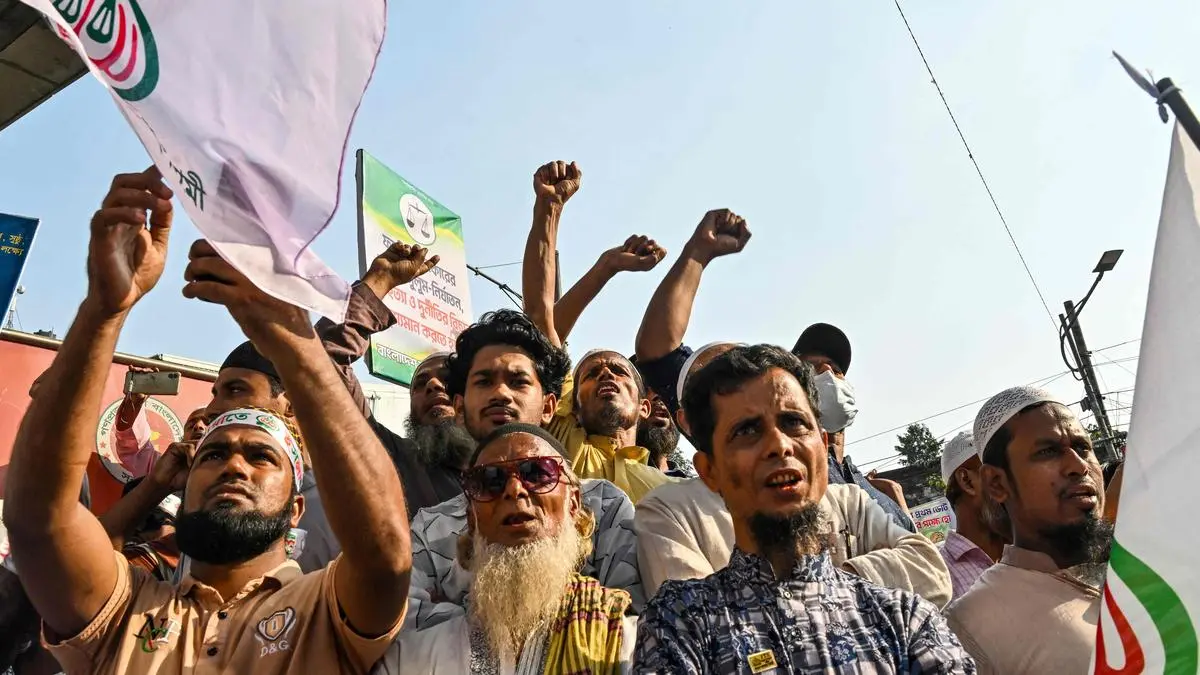
The July–August 2024 mass uprising of Bangladesh, culminating in Sheikh Hasina’s ouster and the collapse of the Awami League’s rule, did much more than remove a government. It also ruptured a decades-old alliance that once seemed unshakeable—between the Bangladesh Nationalist Party (BNP) and Jamaat-e-Islami. That alliance between these centre-right and ultra-right parties, built largely around opposition to Awami League rule, has collapsed.
By late 2025, the two parties are essentially arch rivals, and the political fallout of that rupture is already reshaping alliances and even the broader ideological orientation of Bangladesh politics.
This shift begins with a simple fact: the common enemy is gone. For decades, the BNP and the Jamaat hung together to oppose Awami League dominance and push back against state repression. With Hasina’s removal on August 5—and the subsequent abolition of Awami League’s political dominance—the glue binding them together evaporated. Many political analysts argued that without a shared opponent, the alliance was bound to fracture, and the months that followed confirmed that view.
Diverging strategies, deepening grievances
The first cracks appeared almost immediately after the changeover. Jamaat’s leader publicly claimed that BNP had already “grabbed 80 percent of the power”. That incendiary assertion reopened old nervousness among Jamaat’s rank-and-file, especially after a youth leader from the BNP allegedly tried to seize control of the country’s first Shariah-based bank—a move Jamaat reportedly regarded as encroachment on its domain.
From there, the rift deepened as the two parties began to publicly diverge on basic political goals. The issue of elections and institutional reforms proved especially contentious. The interim government, shepherded by Muhammad Yunus, proposed a new “roadmap”—including constitutional reforms and a national “July Charter”.
But while Jamaat expressed willingness to wait and allow the reforms to play out, the BNP pressed insistently for early elections. That impatience—perhaps tactical, perhaps ideological—signalled a decisive break in strategy.
Also Read | Sheikh Hasina: How the daughter of a slain leader went from democratic hope to authoritarian casualty
Tensions rose further when BNP’s senior leadership began publicly accusing Jamaat of opportunism. On December 29, 2024, BNP’s Ruhul Kabir Rizvi accused Jamaat of behaving like the corrupt S Alam Group (a major beneficiary of the AL regime)—alleging that they were using religion for political gain and attempting to rebrand themselves as defenders of national interest.
Old wounds of 1971 resurfaced as well. The BNP reminded voters of the significance of upholding the values of the Liberation War, while Jamaat’s wartime record and its apparent revisionist attempts remained a lightning rod.
These disputes soon took violent form. Clashes between the BNP and Jamaat activists erupted across many districts—sometimes over control of local institutions, sometimes over duelling rallies, often over sheer territorial dominance. Human rights monitors and political analysts say the volume of these confrontations has spiked dramatically since 2024. Data from the Human Rights Support Society (HRSS) shows 1,047 political-violence incidents between September 2024 and September 2025, leaving 160 people dead and more than 8,000 injured.
BNP, however, has also been hit by 291 internal clashes, resulting in 3,352 injuries and 74 deaths nationwide, according to HRSS.
Behind these conflicts lie more than skin-deep disagreements. Each party is increasingly orientated toward a different vision of post-Hasina Bangladesh. The Jamaat is shedding the veneer of a junior partner and reasserting itself as a standalone force, aiming to rally conservative, religiously inclined voters—often campaigning on stricter Islamist politics, alliance-building with other faith-based parties, and demands for institutional changes tailored to their vision.
The BNP, by contrast, is trying to project itself as moderate, liberal, secular-leaning, and palatable to a broader electorate—including secular voters and segments of the international community wary of Islamist revival. By distancing itself from the Jamaat, the BNP hopes to consolidate power on its own, contest the next election as a mainstream political force, and possibly build a “national government” with a different class of allies.
New and unfamiliar terrain
The consequences of this schism for Bangladesh’s political landscape are already substantial. First, the very logic of electoral politics is changing. In the 1990s and early 2000s, the BNP–Jamaat alliance was often invoked as a binary alternative to the Awami League. Now, with that axis gone, Bangladesh is moving toward a fractured multipolar contest. Both the BNP and the Jamaat are scrambling for new allies, courting smaller parties, and reconfiguring old calculations.
Second, this reconfiguration has opened space for new political actors—especially those born out of the uprising itself, such as the National Citizen Party (NCP), formed by student leaders. The NCP, casting itself as a break from the old duopoly of the BNP and the Jamaat, seeks to channel youth discontent, reform ambitions, and post-uprising idealism into a new political force. Its emergence complicates the old two-party logic and presents a third axis in national politics.
Third, the rift has given the country’s banned former ruling party—the Awami League—a potential path back. Some observers note that the disunity between the BNP and the Jamaat could allow Awami League or its sympathisers to regain support, especially in communities torn between Islamist, secular, and youth-driven politics. As one commentator put it recently, the BNP–Jamaat conflict has inadvertently “helped Awami League regain ground.”
Finally—and perhaps most strikingly—the split marks an ideological shift in Bangladesh’s mainstream opposition. What was once a brittle alliance between a centre-right nationalist party and a conservative Islamist party is now breaking along lines of ideology and identity politics. Jamaat’s revival, aggressive push for Islamist-orientated reform, and alliance with other faith-based or conservative forces may shift the political centre of gravity to the right. At the same time, BNP’s attempt to reposition itself as moderate and secular could reshape its identity into something quite different from its past.
Yet the picture remains far from settled. Both parties face serious challenges. For Jamaat, the question is whether its revival can translate into real electoral strength—after years of stigma from its wartime reputation and after losing many allies. For the BNP, the risk lies in alienating core supporters who favoured the old alliance or in being perceived as opportunistic by voters who demand consistency and clarity of purpose. Already, internal factionalism and turf wars are emerging within the BNP as different groups scramble for control over “spoils” in the post-Hasina political order.
Also Read | Can Yunus still deliver Bangladesh from the brink?
Meanwhile, with the institutional reform process underway—particularly debates over the implementation of the July Charter and electoral system reforms—tensions over how much to reform, when, and under whose model are surfacing. Jamaat seems open to a slower, more conservative approach; the BNP appears impatient for a democratic transition and an early election under the old rules, while a third lot of political aspirants pushes for structural overhaul.
In this flux, Bangladesh’s political future remains deeply uncertain. What is certain is that the split between the BNP and the Jamaat is not a simple “difference of opinion”. It is a fundamental restructuring of political alliances and aspirations that will shape what Bangladesh looks like in the coming years.
Faisal Mahmud works at the Bangladesh High Commission in New Delhi.