
 From the night of December 24 into the early hours of Christmas Day, a curious ritual unfolded across Bangladesh and among its political diaspora abroad. Screens glowed with a single obsession. Leaders, organisers and ordinary supporters of the Bangladesh Nationalist Party (BNP) refreshed a popular flight tracking website again and again, watching the slow progress of BG202 as it crossed continents. The Biman Bangladesh Airways flight had taken off from Heathrow and was headed first to Sylhet. Until its wheels touched the tarmac, few slept easily.
On board was Tarique Rahman, the BNP’s acting chairman, travelling with his wife Zubaida Rahman, their daughter Zaima Rahman, and a small group of associates. For nearly 18 years, since 2007, Rahman had lived in self-imposed exile in London. His return came around 17 months after Sheikh Hasina was forced out of office following a students-led uprising that upended Bangladesh’s political order.
When the aircraft landed in Sylhet, the collective breath was finally released. From there, Rahman flew on to Dhaka. What followed was a carefully choreographed display of political revival. A massive motorcade rolled out of Hazrat Shahjalal International Airport, led by a large bus painted red and green, the colours of the national flag. The convoy cut through a sea of supporters lining the roads, many visibly emotional, others desperate for a fleeting glimpse of the man now expected to lead the country’s most powerful political force.
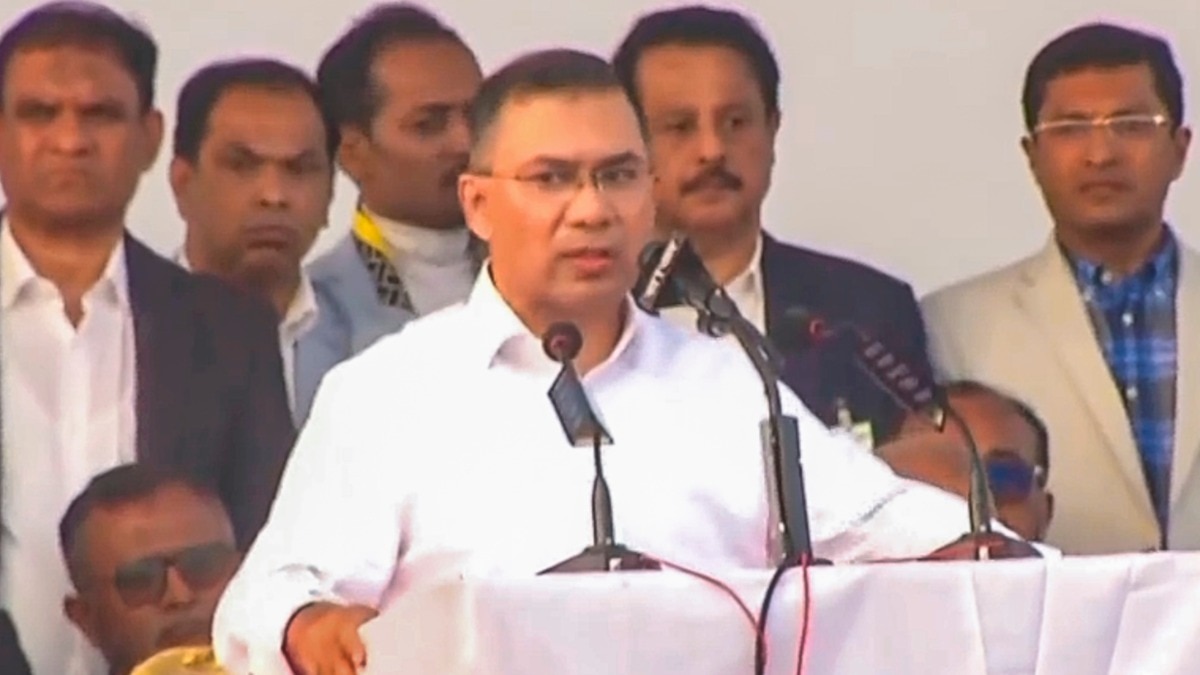
The destination was Purbachal, a rapidly expanding township on the capital’s eastern edge. Hundreds of thousands of people had streamed into Dhaka from across the country in the days leading up to the event. By the time Rahman reached the public reception venue, the scale of expectation was unmistakable. At 3:51 pm, he stepped onto the stage. Six minutes later, he began his address with two simple words: “Dear Bangladesh.”
BNP secretary general Mirza Fakhrul Islam Alamgir formally welcomed him, flanked by the party’s senior leadership and long-time allies. Rahman’s opening remarks were steeped in gratitude and symbolism. He thanked Allah for allowing him to return to his “beloved motherland”, framing his homecoming as an act enabled by prayers and popular support rather than political calculation.
Substance quickly followed sentiment. Rahman drew a long historical arc, linking 1971, 1975, 1990 and 2024 into a single narrative of popular resistance. Independence, he said, had been won through the blood of martyrs. Democratic rights had been reclaimed repeatedly through mass uprisings against domination and autocracy. The student and mass mobilisation of August 2024, he argued, belonged to this same lineage, a collective effort by people to protect sovereignty and reclaim the right to speak.
This framing was deliberate. By placing the 2024 uprising alongside foundational moments in Bangladesh’s history, Rahman sought to legitimise the post-Hasina order while positioning the BNP as its natural political heir. It was also an attempt to transcend partisan boundaries. Farmers, workers, homemakers, women and men, madrasa students, he said, had all stood together regardless of party affiliation. The message was clear: the moment belonged to the nation, not to any single organisation.
His appeal to unity broadened further as he spoke of building a Bangladesh that could hold its many differences together. Hills and plains, Muslims, Hindus, Buddhists and Christians, he said, all belonged to the same national dream. What he offered was the idea of a “safe Bangladesh”, one imagined not as a slogan but as a moral obligation owed to mothers, to future generations, and to those who had died in past struggles.
Yet Rahman was equally conscious of the present-day fractures. Remembering the controversial student activist Osman Hadi, who was shot at on December 12 and died days later, he spoke of economic rights alongside political ones, implicitly acknowledging the depth of popular discontent in a country grappling with inflation, unemployment and a fragile economy. The blood debt of 1971 and of 2024, he argued, could only be repaid by building the Bangladesh people desired, not merely by changing who sat in power.
The most striking rhetorical turn came when Rahman invoked Martin Luther King Jr. Referencing the iconic “I Have a Dream” speech, he paused before adding, “I have a plan.” The contrast was subtle but telling. Dreams inspire, plans govern. By shifting from moral vision to practical intent, Rahman was signalling readiness to move from Opposition politics to the responsibilities of statecraft. He did not detail the plan, but insisted it would require the cooperation of every citizen, an attempt to frame governance as a shared national project rather than a party-driven agenda.
He repeated three times that “we want peace in the country”, a refrain that resonated in a nation where law and order has visibly deteriorated. Mob violence has increasingly replaced institutional authority in parts of Dhaka. The media has come under attack, most notably the offices of Prothom Alo and The Daily Star, while cultural institutions such as Chhayanaut and Pratichi have also faced vandalism and intimidation. These incidents have fed a growing sense that the street, not the state, is setting the rules.
After requesting prayers for the recovery of his mother, former prime minister Begum Khaleda Zia, Rahman closed by promising collective work and collective rebuilding. Shortly before 4:30 pm, he left the venue and headed to Evercare Hospital, where his mother is admitted.
Politically, the symbolism of the day was unmistakable. With Hasina’s Awami League outlawed by the interim government led by Nobel laureate Md Yunus, the BNP stands as the most-powerful political force in the country. Rahman is expected to lead the party into the February elections and is likely to contest from multiple constituencies. Yet the adulation that marked his return masks a far more complex reality.
Inside the BNP, factional tensions are already surfacing. Many senior and mid-level leaders, anticipating tough nomination battles, are reportedly preparing to contest independently if denied party tickets. Managing these ambitions while maintaining organisational discipline will test Rahman’s authority from the outset. Beyond the party, the challenges multiply. Extremist groups are gaining ground, and the Jamaat-e-Islami Bangladesh is steadily reasserting itself as a potent political and street force. Law enforcement institutions remain strained while public trust in state capacity has eroded.
The economic picture is equally grim. Foreign exchange pressures, declining investor confidence and rising costs of living have left little room for easy solutions. Any future government led by Rahman would inherit a fragile economy with limited fiscal space and immense social expectations.
Externally, Bangladesh’s relationship with its most-powerful neighbour, India, is at a low ebb. Years of tension have deepened mistrust, and repairing this relationship will be essential for trade, security and regional stability. Yet doing so without appearing to compromise national sovereignty will be politically sensitive, particularly at a time when nationalist sentiment runs high.
Rahman’s return, then, is not merely a personal homecoming or a party celebration. It marks the beginning of a decisive phase in Bangladesh’s political transition. For the BNP, it offers a unifying figure after years of leaderless struggle. For Rahman himself, it is the moment when rhetoric must give way to responsibility. And for Bangladesh, it raises a larger question: can a leader shaped by exile and opposition navigate a country facing economic stress, social fragmentation, rising extremism and volatile geopolitics?
Subscribe to India Today Magazine
– Ends