
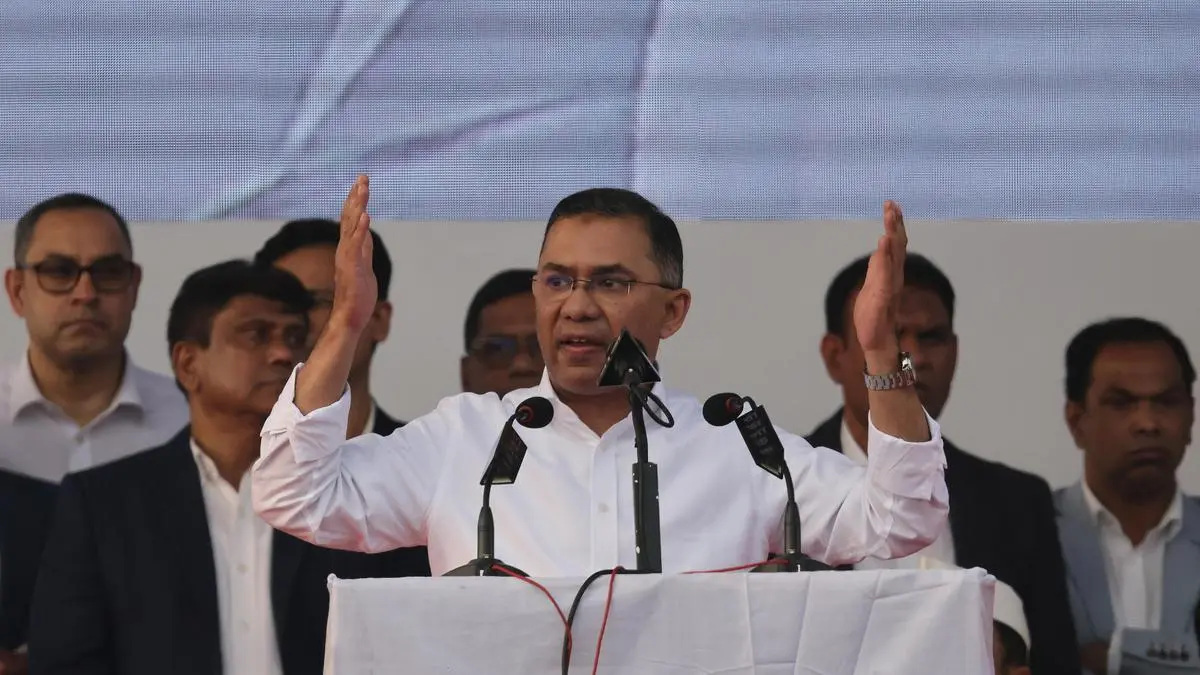
When Tarique Rahman stepped back onto Bangladeshi soil on December 25, 2025, after 17 years in exile, the moment carried far more weight than a personal homecoming. It marked the re-entry of a polarising political figure into a country still struggling to find its footing after the collapse of Sheikh Hasina’s long and authoritarian rule. Bangladesh today is neither fully broken nor fully renewed; it is suspended in an uneasy transition, and Rahman’s return will test what kind of political future may yet emerge.
Since Hasina’s hurried flight to India following the mass uprising of August 2024, the country has drifted without a clear political centre. Institutions remain fragile, law and order tenuous, and public trust thin. An interim calm masks deeper anxieties about legitimacy.
Across party lines, civil society, and parts of the bureaucracy, one conviction has hardened into near consensus: only a credible, inclusive election can restore democratic authority. In that looming contest, the Bangladesh Nationalist Party (BNP), now led directly from home by Rahman, is widely seen as the strongest contender to form the next government.
That reality makes Rahman’s return consequential. It opens a decisive chapter, one that will determine whether Bangladesh’s post-uprising moment becomes a democratic reset or another cycle of disappointment.
A leader judged before he governed
Few politicians in the country’s history have been judged so relentlessly before ever holding executive power. Long before Rahman had the chance to govern, narratives about his incompetence or corruption hardened into conventional wisdom. Across successive regimes, verdicts were delivered in advance, often detached from evidence and immune to revision. Even after Hasina’s fall discredited many of the narratives propagated under her rule, those judgments have largely survived intact.
Rahman does not return without baggage. Indian and Bangladeshi media alike continue to revisit allegations from the mid-2000s, ranging from corruption to militancy, many of which were aggressively amplified during the Awami League’s tenure. Outlets such as OpIndia have revived old epithets and unresolved accusations, presenting his return less as a political development than as the re-emergence of a “dark past”. Yet what often goes unexamined is how many of these cases were pursued, revived, or abandoned within a legal system widely criticised for politicisation under the previous government.
Also Read | Reclaiming pluralism
This does not absolve Rahman or his party of scrutiny. The BNP has struggled with indiscipline among its ranks, and criminality at the local level has at times been real and damaging. But criticism of Rahman himself has rarely focussed on concrete accountability. Instead, his opponents perfected a strategy of substitution: presenting marginal figures, criminal suspects, or rogue activists as the true face of the BNP, while rendering its leader either irrelevant or inherently guilty by association.
Over time, this framing became normalised. Sections of the intellectual left dismissed Rahman as unsophisticated or politically illegitimate. That perception migrated into mainstream commentary and was later amplified by rivals, social media networks, and foreign observers with limited understanding of Bangladesh’s internal dynamics. What emerged was not sustained debate over policy or governance but a politics of caricature, one that replaced democratic evaluation with character assassination.
Rahman’s return disrupts that equilibrium. For years, he led the BNP from exile, constrained by distance and legal uncertainty. Now he enters the political arena directly, confronting expectations that are both inflated and contradictory. He is expected to embody renewal while answering for the failures of an entire political culture. The distance between those expectations and the obstacles before him will shape not only his own fate but the country’s.
A different kind of politician
Part of the confusion surrounding Rahman lies in his mismatch with Bangladesh’s political aesthetics. Power here has long been theatrical. Authority is associated with volume and spectacle. Sheikh Hasina cultivated an image of ruthlessness that supporters mistook for competence. Rahman, by contrast, is soft-spoken and deliberately understated. He avoids grandstanding and resists the posture of a saviour. In a culture conditioned to equate aggression with leadership, this restraint has often been read as weakness.
His personal demeanour deepens that misreading. He shuns ostentation, dresses plainly, and avoids the performative excesses of South Asian politics. In many democracies, such restraint would signal seriousness. In Bangladesh, it has invited suspicion. Leaders are expected to appear elevated, almost monarchical. By remaining unremarkable, Rahman deprives both supporters and critics of spectacle.
Yet this ordinariness may prove an asset in a society exhausted by mythmaking. With Hasina’s fall, Bangladesh has entered a post-narrative moment in which grand stories no longer command automatic loyalty. Many political actors continue to recycle old tropes, but younger voters and a fatigued public increasingly gravitate towards what feels authentic.
During his years in exile, largely erased from sympathetic media platforms, Rahman pursued an unglamorous strategy. He invested in grassroots engagement, speaking more often with local party workers than elite commentators. That work built recognition rather than reverence, legitimacy rooted in familiarity instead of awe. Only now, with his physical return, are the contours of that support becoming visible.
Restraint as political strategy
Emotion has always shaped Bangladeshi politics. Leaders who successfully cast themselves as victims have often converted grievance into power. The previous Hasina regime mastered that craft. Rahman has taken a different path. Despite years of exile, legal harassment, and personal loss, he has refused to foreground his own suffering. Privately, he has argued that countless party workers endured far worse, and that elevating his pain above theirs would be morally hollow. That restraint has quietly reshaped how many citizens perceive him.
His handling of allegations follows a similar pattern. Rather than respond to every claim, he has often chosen silence, allowing narratives to burn themselves out. History has partially vindicated that approach. Many accusations collapsed with the regime that sustained them. More recently, claims that he would never return or face electoral accountability unravelled the moment he announced his homecoming.
Also Read | Where BNP–Jamaat go next
Still, optimism must remain cautious. Rahman’s greatest challenge lies ahead. The BNP must be transformed from a movement of survival into a party of governance. Holding it together through repression was one achievement; reforming it for democratic rule will be far harder. Beyond that lie deeper tests: managing entrenched patronage networks, recalibrating civil-military relations, and navigating a volatile relationship with India amid heightened nationalism and persistent disinformation.
Ultimately, Rahman’s relevance will depend on whether he can transcend partisan identity. To succeed, he must become more than the leader of the BNP. He must articulate a national purpose capable of restoring trust across divides. For Bangladesh, emerging from deception and exhaustion, the difference between another partisan victory and a credible democratic renewal may hinge on that transformation.
Rahman may yet fail. He may falter under pressure. But for the first time in nearly two decades, his fate—and Bangladesh’s—will be decided by performance, not by pre-written verdicts. That alone marks a meaningful departure.
Faisal Mahmud is the Minister (Press) of the Bangladesh High Commission in New Delhi.