

Razib Pervez
Political parties serve as the primary democratic bodies in every democracy. An essential function of party law is the institutionalization of multi-party politics, to which the creation of a stable party system is a necessary condition of democratic governance. Bangladesh’s politics has been shaped by its experience under British and Pakistani rule. On the Indian subcontinent, political parties have traditionally battled for rights, freedom, and justice across society. Party chieftains were once revered for vision, charisma, bravery, and sacrifices for the national cause.
There was significant change and continuity in state power, political institutions, party organization, and leadership dynamics in post-independence Bangladesh. History Since the restoration of parliamentary democracy in 1991, two parties have consistently vied for power through elections by the populace. The main objective of this write up is not to consider the existence or manner of internal party governance but to observe why democracy in political parties remains uninstitutionalized.
The efficiency of any state political system, to a great extent, is determined by the party system’s role. Parties constitute the political setting by fostering political life and socialization. They constitute a national unity transcending cultural, religious, regional, and other social differences. Therefore, socialization is the process of developing widely shared values and beliefs regarding national integration. Political mobilization and participation are key mechanisms to support political parties in making their citizens powerful and keeping the engines of democracy running.
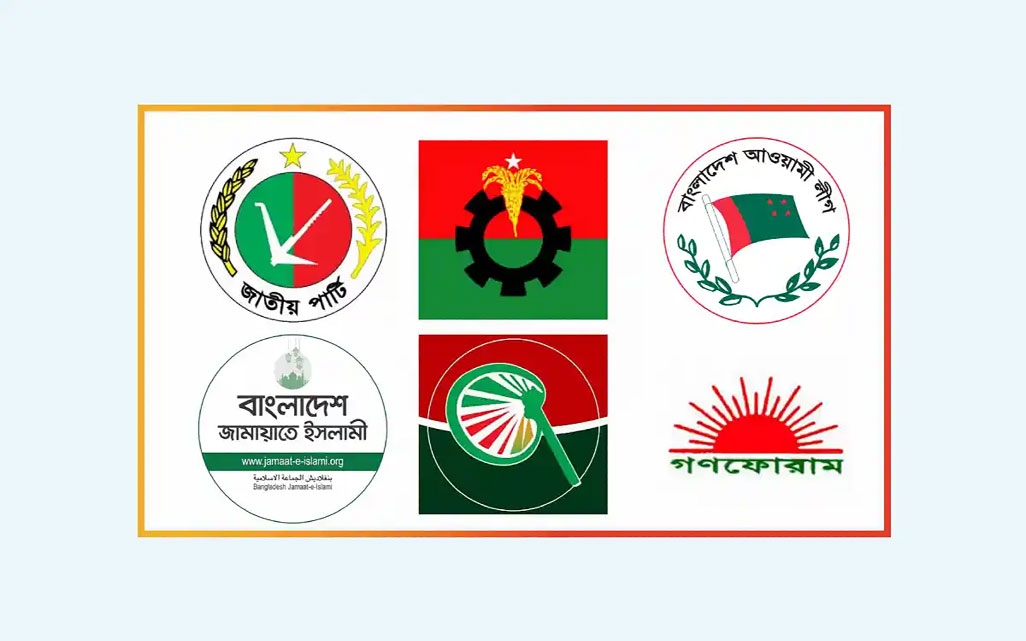
Bangladesh operates under a multi-party-political system, and the number of political parties has been progressively increasing over time. Before the imposition of military rule for the second time on 24 March 1982, approximately fifty political parties were active in Bangladesh. By early 1991, the number had grown to more than one hundred. At present, over 150 political parties exist, encompassing right-wing, left-wing, and liberal ideologies. Among them, the most prominent and influential political parties are: Bangladesh Awami League, Bangladesh Nationalist Party, Jatiyo Party and Jamat Islami Bangladesh. Besides that, Communist Party of Bangladesh, Jatito Samajtantrik Dol, Workers Party, Gonoforum, National Awami Party, Islami Andolon Bangladesh, Khelafat Majlsih etc. like’s organizations are running their existence in countrywide and few specific areas inside the nation. In recent years, Amar Bangladesh Party, Nagorik Oikkyo, Gonoodhikar Parishad, and the National Citizens Party are among the newly formed political parties in Bangladesh’s political landscape.
Bangladeshi political parties are famously top-down, centralized organizations. Power is often concentrated in a few leaders, and members are discouraged from participating and participating at the party level. Then, the political parties in the area are shackled by a totalitarian organizational operation, and the loyalties to the leadership and the respect for tradition appear to be more important than open debate or critical exchange. Still, behind that process, you begin to see hidden pressures, suspensions, expulsions, and a kind of internal terrorist repression that works to maintain such conformity signs largely.
In Bangladesh politics, most of the time political party’s councillors can’t get exercise to select their leader by voting rights. Here traditional procedures always work where few of the top leaders announce that all councillors are united to nominate the party president to select the party leadership. Party councillors raise their hand about the decision that’s why voting options don’t work here. There are no options to accommodate the grassroots-level party members to participate in the particular policy. The primary members and party followers are informed of the new policy after the decision has been taken by the central committee. The consultation process among the party grass root level is absent. In practice, during council sessions, the selection of top-tier party leadership is typically finalized by the party president.
The political organizations exists a significant disparity in the knowledge and skills of party leaders and workers across the country. The party comprises members from diverse educational and professional backgrounds, many of whom lack awareness of governance-related issues. As a result, there is a noticeable gap in the ability of party members to contribute effectively to the promotion and implementation of good governance.
In Bangladesh’s political culture, Party leadership at the centre often overlooks or disregards genuine grassroots leaders those who are widely respected within their communities in favour of nominating individuals with wealth and influence. This preference is frequently driven by the expectation of substantial financial or logistical support during national elections. The fund management system of the party is one of its most complex and opaque aspects. While the party maintains an official account and submits annual financial updates to the Election Commission, the internal policy on fund management remains largely unknown to party members.
The present-day parties’ structure is largely dominated by senior leaders at all levels. The integration of young leaders into key organizational roles is progressing at a notably slow pace. As a result, emerging leaders are often unable to play a meaningful or influential role within the party’s organizational framework. Many of the party’s current senior leaders began their political journey during the Liberation War period or early 1980’s and have since remained in leadership roles without any formal system of retirement. These individuals continue to occupy key positions for extended periods, often spanning decades. At both the central and grassroots levels, some senior party leaders hold their positions for extended periods.
However, in Bangladesh, there is a noticeable absence of a structured leadership training programme within the parties. While a few international agencies conduct leadership workshops where nominated representatives from various parties participate, the party itself lacks a consistent, in-house programme to educate and prepare its members for leadership roles.
A number of central party leaders have been involved in corrupt practices, including the sale of party positions for personal gain and exerting undue influence over government projects. Likewise, several elected representatives have engaged in financial misconduct from the outset of their tenure. Despite facing media reports and allegations from the Anti-Corruption Commission, they have largely ignored accountability and continue to abuse their authority to secure unlawful advantages.
Razib Pervez is Chairperson, Governance
Policy Explore Center. He is based
in Manchester, England and can be
reached at [email protected]
