
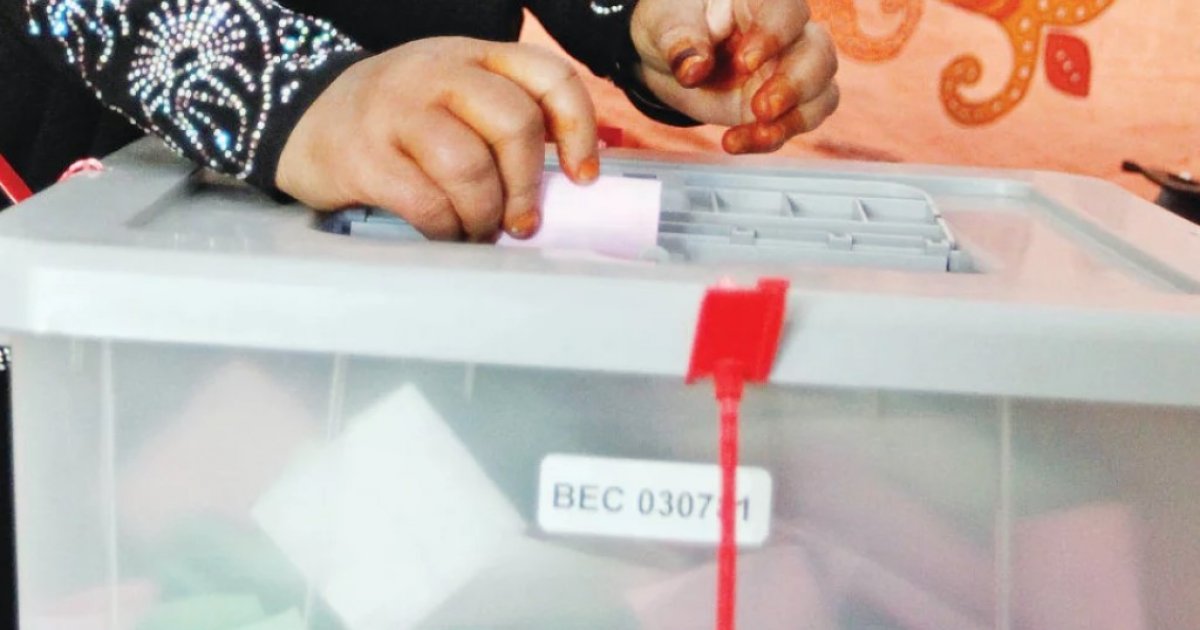
After 34 years, Bangladesh is returning to a political instrument that has historically carried both promise and controversy — the referendum.
On February 12, voters will cast ballots not only to elect the members of the 13th National Parliament, but also to decide on four major constitutional questions linked to the implementation of the July National Charter.
The interim government has described the referendum as a decisive step toward political reform and democratic renewal.
Supporters argue it will anchor reform in popular consent. Critics, however, caution that the structure and conduct of the process raise fundamental questions about neutrality, choice, and the true meaning of democratic participation.
Bangladesh’s own history suggests that referendums have rarely been politically neutral events.
The last referendum in Bangladesh was held in 1991, when voters overwhelmingly supported a return to parliamentary democracy following a mass uprising. That vote is often cited as a rare example of a referendum emerging from popular pressure rather than executive initiative.
The current referendum, by contrast, is being organised by an interim administration led by Chief Adviser Professor Muhammad Yunus, with the explicit goal of securing public endorsement for a package of political and constitutional reforms agreed upon in the July National Charter.
The four questions placed before voters collectively cover issues such as:
- Formation of a caretaker government and reconstitution of constitutional bodies during elections,
- Introduction of a bicameral parliament with an upper house,
- Redistribution of executive and parliamentary powers, including term limits for the prime minister and expanded presidential authority,
- Implementation of broader reforms related to judicial independence, women’s representation, local government, and fundamental rights.
Rather than voting on these issues individually, voters must approve or reject the entire reform agenda through a single “Yes” or “No” choice.
Supporters of the referendum argue that presenting the reforms as a unified package is both logical and necessary. According to this view, the reforms are interdependent and must be implemented together to prevent the re-emergence of authoritarian governance and institutional capture.
Government officials insist that a fragmented or selective approval process could undermine reform momentum and prolong political instability.
However, constitutional scholars see a downside. They argue that bundling complex and far-reaching reforms into a single question restricts voter agency. Citizens may strongly support some reforms while remaining sceptical of others.
Late constitutional expert Professor Emajuddin Ahmed once warned that referendums lose their democratic value when they compress multiple political choices into a single binary answer. “In such cases,” he observed, “voters are not expressing opinion so much as endorsing a political roadmap.”
One of the most contested aspects of the referendum is the interim government’s open advocacy for a “Yes” vote.
Government advisers, special assistants, and affiliated officials have actively campaigned across the country. Promotional messaging has reportedly appeared in government offices, educational institutions, bank branches, NGO activities, religious gatherings, cultural programmes, and official social media platforms.
Chief Adviser Professor Yunus and his administration have framed the “Yes” vote as essential to preventing a return to authoritarian rule and systemic corruption.
Supporters see this as transparent leadership. They argue that governments around the world campaign for policies they believe serve national interests and that neutrality does not require silence.
Critics disagree. Earlier, Legal analyst Barrister Jyotirmoy Barua argues that when state authority aligns overwhelmingly with one option, the ethical foundation of a referendum weakens. “Even if campaigning is legal,” he says, “the unequal weight of state power inevitably narrows the space for dissent.”
The Election Commission has stated that returning officers and election officials are prohibited from campaigning. Yet critics maintain that neutrality cannot be assessed solely at the administrative level when broader state institutions visibly promote a single outcome.
Eventually very recent, Law Adviser Asif Nazrul has publicly stated that citizens are free to campaign for either “Yes” or “No,” emphasising that the government does not intend to restrict opposing views.
In practice, however, organised advocacy for a “No” vote is largely absent.
Almost all major political parties contesting the parliamentary election — including the BNP and the National Citizen Party (NCP) — have declared their support for a “Yes” vote. NCP has gone further, announcing the appointment of “Yes Vote Ambassadors” in constituencies where it has no candidates.
On this regard Political scientist Professor Ali Riaz warns that referendums derive legitimacy not merely from turnout or legality, but from competition of ideas. “When the ‘No’ option exists only in theory,” he says, “a referendum risks becoming an exercise in confirmation rather than consultation.”
Talking to Dhaka Tribune, Md Abdul Alim, PhD, member of the Bangladesh Electoral Reform Commission 2024 and Principal Director (Elections and Political Process) at Democracy International, believes referendums can play a constructive role in democratic transitions — but only under strict conditions.
“A referendum is not simply about counting ‘Yes’ and ‘No’ votes,” he says. “Its democratic legitimacy depends on whether citizens have equal access to information and competing viewpoints. When one option dominates public space through institutional support, even a legally valid referendum can lose public credibility.”
According to him, visible and organised advocacy on both sides is essential for voters to make informed decisions.
Lessons from Bangladesh’s referendum history
Bangladesh’s previous referendums offer mixed lessons.
In 1977, President Ziaur Rahman sought public confidence through a referendum that officially produced nearly 99% support for “Yes.”
In 1985, military ruler HM Ershad used a referendum to legitimise his regime amid widespread opposition allegations of manipulation.
Only in 1991 did a referendum occur under relatively competitive political conditions, helping restore parliamentary democracy.
Historian Professor Muntasir Mamun notes that referendums in Bangladesh have traditionally reflected power dynamics rather than pluralism. “They were designed to demonstrate authority,” he says, “not to measure disagreement.”
International experience underscores both the potential and peril of referendums.
Switzerland’s frequent referendums have strengthened civic participation through institutional neutrality. By contrast, the Brexit referendum in the United Kingdom deepened political polarisation and long-term uncertainty. In Chile, voters rejected a government-backed constitution draft, demonstrating how a genuine “No” option can function as a democratic corrective.
Comparative political analysts agree that referendums are neither inherently democratic nor undemocratic — their value depends on process, balance, and public trust.
On the positive side, the Bangladesh referendum offers an opportunity to legitimise reform through direct public consent, expand civic engagement, and set constitutional limits on future concentration of power.
On the negative side, a one-sided campaign environment risks turning popular consent into a procedural formality. Without visible alternatives, voters may perceive the process as predetermined, undermining long-term trust in democratic institutions.
More than the final tally of “Yes” or “No,” the central question surrounding this referendum is whether citizens truly feel free to choose.
If voters believe their participation matters and that dissent is respected, the referendum could mark a democratic milestone. If not, it may be remembered as another chapter in Bangladesh’s long history of power-driven plebiscites.
How this moment is judged will depend not only on the result announced on election night, but on whether Bangladesh’s return to the referendum after 34 years is seen as an expansion of democracy — or merely its rehearsal.