
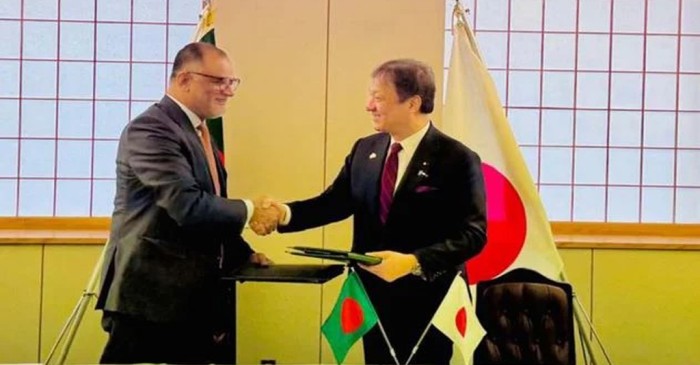

Bangladesh and Japan on Friday officially signed economic partnership agreement in Tokyo to enhance bilateral trade relations, marking Bangladesh’s first EPA with any country.
Commerce adviser Sk Bashir Uddin and Japan’s state minister for foreign affairs Horii Iwao signed the agreement on behalf of their respective government, according to the commerce ministry.
Bashir said that the EPA reflected the long-standing friendship between the two nations.
He said that the agreement reflected Bangladesh’s economic future and the deep mutual trust between the two countries, and expressed optimism that its effective implementation would usher in a new chapter of mutual prosperity.
Commerce secretary Mahbubur Rahman said that the EPA would come into force once the notification was published, which was likely to be issued on Saturday — that is today.
He said that signing Bangladesh’s first full-fledged EPA with a developed country like Japan was a major achievement for Bangladesh.
Bangladesh ambassador to Japan Md Daud Ali and Japanese ambassador to Bangladesh Saeda Shinichi attended the signing ceremony.
Under the EPA, Bangladesh will receive significant advantages in both goods and services trade with Japan. About 7,379 Bangladeshi products, including ready-made garments, will enjoy 100 per cent duty-free access to the Japanese market.
Bangladesh would also reciprocate by expanding market access for Japan, providing duty-free or preferential access to 1,039 Japanese products in a phased manner, the ministry said.
However, imports of automobiles like Toyota and Honda would not be duty-free under the deal, according to commerce ministry officials, a move to encourage Japanese entrepreneurs to invest directly in Bangladesh’s vehicle segment.
A crucial ‘single-stage transformation’ facility has been included for the RMG sector, allowing Bangladeshi apparel to be exported to Japan without complex conditions related to raw materials.
The agreement opens 120 service sub-sectors across 16 categories — including information technology, engineering, education, caregiving, and nursing — for skilled Bangladeshi professionals to work in Japan.
In return, Bangladesh has agreed to open 98 sub-sectors under 12 categories for Japanese service providers.
The EPA is expected to significantly increase Japanese foreign direct investment in Bangladesh, particularly in manufacturing, infrastructure, energy and logistics.
The integration of advanced Japanese technology and investment is also expected to enhance the quality of domestic products, improving Bangladesh’s global competitiveness.
Moreover, the agreement is envisioned as a tool for inclusive economic growth, supporting the development of small and medium-sized enterprises and helping to create a highly skilled workforce, thereby contributing to overall socio-economic development.
Japan is one of Bangladesh’s major trading partners, with bilateral trade of about $3 billion.
In the 2024-25 financial year, Bangladesh exported goods worth $1.41 billion to Japan, of which $1.19 billion were RMG items, along with home textiles, leather and leather goods, according to the Export Promotion Bureau.
On the other hand, Bangladesh’s imports from Japan stood at $1.81 billion in FY24, according to Bangladesh Bank data, although provisional figures indicated that imports fell to $1.51 billion in FY25.
The EPA is the result of seven rounds of negotiations held in Dhaka and Tokyo, covering trade in goods and services, investment and economic cooperation.
According to the commerce ministry, a joint study group submitted its report on December 17, 2023, as the initial step towards signing the EPA.
The first round of negotiations began on May 19, 2024, but was later suspended due to unexpected challenges.
The second round resumed on November 10, 2024 and the seventh and final round was completed on September 12, 2025.
On December 22 last year, the interim government announced the EPA following a telephone conversation between commerce adviser Sk Bashir Uddin and Japanese foreign minister Motegi Toshimitsu, which concluded the negotiations.
The advisory council approved the proposal to sign the EPA on January 22 this year.
Businesses have long been urging the government to sign EPAs, free trade agreements, and preferential trade agreements.
Regarding the EPA with Japan, Mohammad Hatem, president of the Bangladesh Knitwear Manufacturers and Exporters Association, told the New Age that Japan has long been interested in signing an EPA with Bangladesh.
‘This EPA would be a win-win agreement for both countries,’ he said, urging the government to sign similar agreements with other trading partners.
Bangladesh exported more to the European Union, Latin American countries, Russia and several other partners than it imported, he said, adding that agreements with these partners were necessary.
Mohiuddin Rubel, former director of the Bangladesh Garment Manufacturers and Exporters Association, said that the Bangladesh-Japan EPA had been signed within four years.
The rapid conclusion demonstrated that with a clear strategy, strong political commitment and focused negotiations, high-impact economic partnerships can be achieved within a tight timeframe, he said, adding that it sends a positive signal for future agreements and deeper regional integration.
Bangladesh is scheduled to graduate from least developed country status in November this year, prompting businesses to repeatedly urge the government to sign trade agreements with key partners.
Recently, commerce secretary Mahbubur Rahman said that Bangladesh had completed second-round discussions with South Korea and was in negotiations with the European Union, Canada and Australia.