
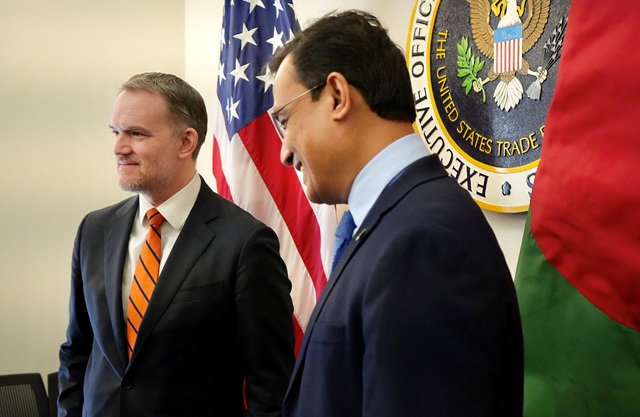
The United States and Bangladesh have signed a landmark trade agreement that lowers US tariffs on Bangladeshi goods to 19% and opens the door to zero-duty access for selected textile and apparel exports. The deal, formally titled the United States-Bangladesh Agreement on Reciprocal Trade, marks a significant shift in bilateral economic ties and positions Bangladesh as the first South Asian country to complete a trade pact with Washington.
Under the agreement, US tariffs on Bangladeshi exports will fall from an initially proposed 37% to 19%, after an earlier reduction to 20%. Bangladesh’s chief adviser, Muhammad Yunus, said the White House had also committed to establishing a mechanism allowing certain Bangladeshi textile and garment products made with US-produced cotton and man-made fibre to enter the US market with zero reciprocal tariffs. The provision is seen as a boost for Bangladesh’s vital garments sector while supporting American raw material producers.
In a statement, the White House said the agreement would give exporters from both countries “unprecedented access” to each other’s markets. In return for lower tariffs, Bangladesh has agreed to grant significant preferential market access to a wide range of US industrial and agricultural products, including chemicals, medical devices, machinery, motor vehicles and parts, soy products, dairy goods, beef, poultry, tree nuts, and fruit.
Bangladesh will also move to ease non-tariff barriers by accepting US vehicle safety and emissions standards, recognising certifications issued by the US Food and Drug Administration, and removing import restrictions on remanufactured goods. US officials said these steps would reduce regulatory friction and create new opportunities for American exporters in one of South Asia’s fastest-growing markets.
The deal includes substantial commercial commitments by Bangladesh over the next 15 years. According to the office of the US Trade Representative, Biman Bangladesh Airlines will purchase 14 Boeing aircraft, with options for additional planes. Dhaka will also increase US imports by around $3.5 billion in agricultural products and an estimated $15 billion in energy purchases, deepening long-term trade and investment links.
US Trade Representative Jamieson Greer said the agreement reflected Washington’s push for trade policies that deliver tangible benefits for American workers and businesses while strengthening economic and security partnerships abroad. He described the pact as a “meaningful step forward in opening markets,” noting Bangladesh’s status as the first country in South Asia to finalise such a deal with the United States.
The agreement was signed in the presence of senior officials from both sides, including Bangladesh’s adviser for commerce, textiles and jute, and civil aviation and tourism, Sheikh Bashir Uddin, Commerce Secretary Mahbubur Rahman, and Assistant US Trade Representative Brendan Lynch.
While Bangladesh’s new tariff rate is slightly higher than the 18% secured by India under an interim arrangement, negotiations for a full bilateral trade agreement between Dhaka and Washington are still under way. For now, the deal signals a deepening of US-Bangladesh economic ties and a recalibration of trade relations in South Asia.