
Bangladesh is at a pivotal point in its development, with rapid industrialisation, modernisation, and increased consumption exerting immense strain on natural resources.
This has resulted in higher waste levels and environmental harm. The traditional linear economic model – focused on production, consumption, and disposal – is becoming less sustainable and cannot support ecological stability or the economy’s long-term ability to produce goods and services that meet global standards.
Therefore, it is essential to evaluate systematically the circular economy approach, exploring its rationale, sector-specific opportunities, and the policy tools needed for successful execution.

Transitioning to a resource-efficient, circular economy can significantly boost environmental sustainability, strengthen company competitiveness, and foster innovation as a key area of development.
By separating growth from resource overuse and waste, circularity paves the way for more sustainable and inclusive development.
Over the past decades, Bangladesh’s economic transformation has been celebrated as a notable success in global development. Robust growth in manufacturing – particularly in the ready-made garments (RMG) sector – alongside notable improvements in human development indicators has positioned the country on a path toward upper-middle-income status.
However, this growth has originated at considerable environmental cost.
Intensifying industrial activity has led to increased atmospheric pollution, ecological stress, inefficient energy use, widespread plastic consumption, and mounting volumes of industrial and municipal waste.
These challenges underscore the urgent need to decouple economic growth from resource consumption, a shift now widely supported globally through circular-economy approaches.
Moving to a circular model has become a necessity rather than a policy option, as it is critical to ensuring long-term sustainability, maintaining global market competitiveness, and bolstering economic stability amid climate change and environmental uncertainties.
Why circularity matters in Bangladesh
From a macroeconomic perspective, circularity enables Bangladesh to frame its development process more inclusively and sustainably.
It is vital because it turns waste into value, fostering innovation across sectors, from RMG to textiles and electronics.
Circular practices help address resource scarcity, support efforts to mitigate the environmental crisis, and strengthen resilience by creating green jobs, lowering production costs, and aligning national development pathways with the Sustainable Development Goals.
From a trade and competitiveness standpoint, Bangladesh’s strong dependence on imported raw materials – including chemicals, petroleum products, plastic granules, machinery, and textile fibers – makes its industrial base vulnerable to global price volatility and supply chain disruptions.
Environmentally efficient and circular production systems can mitigate these vulnerabilities by promoting resource recovery, reducing reliance on imports, and strengthening industrial self-reliance.
At the same time, global markets are increasingly enforcing stringent environmental and sustainability standards.
Compliance with these requirements is essential to maintaining export competitiveness, particularly in manufacturing sectors integrated into global value chains.
From a social and employment perspective, circular economy practices also offer opportunities to create jobs through recycling, repair, remanufacturing, and bio-based industries.
These sectors can create green jobs, especially for women and youth, and formalizing the informal recycling sector can improve occupational safety, income security, and living conditions.
Urban environmental governance offers another compelling rationale for circularity. Major cities such as Dhaka and Chattogram face acute challenges from hazardous industrial effluents, plastic waste, textile residues, and electronic waste.
Circular approaches can enable resource recovery, reduce pollution loads, and ease pressure on landfills, thereby improving urban environmental governance.
Key sectors with circular economy potential:
The case of textiles and RMG
Among Bangladesh’s industrial sectors, the textile and ready-made garments industry holds exceptional potential for circular transformation. The sector generates more than 400,000 tons of textile waste annually, much of which remains underutilised.
Circular opportunities include recycling cotton and fabric waste into new fibers, adopting water- and chemical-recovery systems in dyeing and finishing processes, improving energy efficiency through modern machinery and renewable energy use, and developing closed-loop supply chains in collaboration with international buyers.
These practices can substantially improve resource efficiency in terms of water, energy, and raw material use, while reducing environmental impacts and strengthening Bangladesh’s sustainability credentials in global apparel markets.
Given the sector’s scale and export orientation, progress in RMG toward circularity could catalyse broader economy-wide transformation.
The flowchart demonstrates how 3R principles are applied across key sectors in Bangladesh, emphasising the importance of cross-sectoral circular practices.
At the center is the term “Sectors,” representing broad areas of economic activity where circular methods can be implemented. From this center, major sectors such as agriculture, manufacturing, energy, e-waste, construction, biomedical services, and shipbreaking extend outward.
These sectors are among the most resource-intensive and waste-producing in Bangladesh, making them essential for implementing 3R-based strategies.
The diagram further breaks down the manufacturing sector into specific sub-sectors – ready-made garments (RMG), tannery, paper, and plastics – to highlight their unique waste streams and circularity opportunities.
For instance, the RMG and tannery industries generate significant textile and leather waste, which can be reduced through cleaner production, reused through by-product valorisation, or recycled into secondary raw materials.
Likewise, the paper and plastic industries offer strong opportunities for recycling and material recovery.
By clearly organizing these sectors, the flowchart highlights the need for sector-specific strategies within a unified national circular economy. It also underscores Bangladesh’s need to shift from linear “take-make-dispose” models toward more sustainable, resource-efficient systems.
The case for the plastic and packaging industry
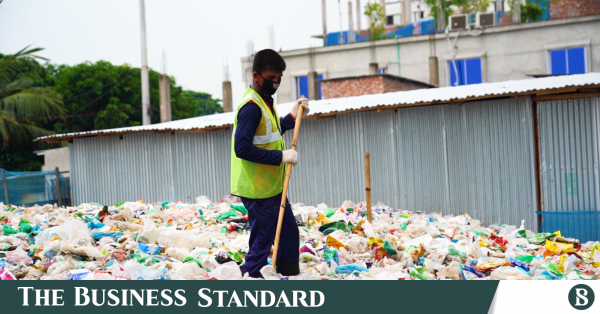
Plastic consumption in Bangladesh has expanded rapidly over the past decade, accompanied by significant increases in manufacturing use and waste generation, raising economic and environmental challenges.
A 2016 report by Emerging Credit Rating Limited noted that, although the country ranked 89th globally in plastic exports in earlier assessments, the plastics sector has since grown to become a more important part of the nation’s manufacturing and export portfolio.
At the same time, the 2021 Waste Concern database reveals that per capita plastic consumption has increased significantly, from over 3.5 kg in 2014 to over 20-22 kg per person annually in recent years.
The latest World Bank data from 2024 shows that urban areas like Dhaka are seeing even higher levels of consumption. Only about 30-36 percent of plastic waste is recycled, leaving much of it mismanaged through open dumping, landfilling, or burning, according to a 2016 study by Moazzem.
Although this represents a notable improvement in plastic recycling performance from earlier estimates of less than 10 percent, much of the waste remains unmanaged.
Hundreds of tons of plastic waste are produced daily in Dhaka alone. A report by the Ministry of Environment and Forests of the Government of Bangladesh on the National 3R strategy for waste management found that a large share of plastic recycling occurs outside the formal sector, where environmental, occupational health, and safety regulations are poorly enforced.
Up to three-quarters of municipal waste could be converted into reusable materials with improved collection and processing technologies, according to estimates by Rahman et al. (2020), thereby creating substantial job opportunities and saving foreign exchange.
However, Bangladesh’s rapidly growing plastic use continues to pose significant environmental, public health, and sustainability challenges in the absence of systematic policy support, technology advances, and the formal integration of informal recyclers.
The case for agriculture and food systems
Agriculture generates large amounts of biomass residues, agricultural by-products, and organic waste, offering significant scope for circular solutions.
Circular models can reduce post-harvest losses through improved storage technologies, turn organic waste into compost and biofertiliser, and utilise crop residues such as jute sticks or rice husks for bioenergy production.
These practices close nutrient and energy loops while enhancing farm productivity.
Wastewater is used to irrigate land in some parts of Bangladesh. This practice dates back to 1976 in Rajshahi.
Farmers opt to use wastewater because it lowers fertiliser expenses and helps address freshwater shortages.
A survey on “Municipal Wastewater Reuse for Agriculture,” conducted by Kumar et al. (2008) in Rajshahi, revealed that 70% of farmers experienced reduced fertilizer costs due to wastewater use.
Most of Bangladesh’s agricultural waste is recycled in rural areas into compost fertiliser, which is then applied to farmland alongside chemical fertilisers, helping to close nutrient loops in the country’s farming system.
The national 3R policy also promotes the use of organic fertiliser. Every day, cities produce 13,332 tons of waste, the majority of which is organic.
Bangladesh generates substantial volumes of organic fertilizer each year, including about 45 million tons of straw, 35 million tons of dung, and 5 million tons of poultry litter, according to estimates by MS Islam (2015).
It is noteworthy that the cattle industry in Bangladesh produces 26.55 million tons of greenhouse gases, equivalent to carbon dioxide.
Evidence from a study by KN Islam et al. (2020) shows that emissions can be reduced by 37.5% through the application of circular economy concepts.
Furthermore, Bangladeshi poultry farmers do not adhere to the 3R strategy.
However, a study by Shamsuddoha et al. (2011) found that raising animals using the 3R technique and the reverse supply chain can increase revenue while reducing environmental pollution.
Together, these approaches demonstrate how circular economy principles can enhance environmental performance while increasing rural incomes.
The case for electronic waste
As digitalisation increases, electronic waste becomes an escalating threat. Structural, technical, and economic factors contribute to a rapid rise in electronic waste nationwide.
Notably, over 80% of e-waste stems from shipbreaking operations that release hazardous chemicals and toxic metals into the environment.
A large share also originates from consumer electronics, with televisions being the primary source, followed by mobile phones and computer accessories.
In 2019, Bangladesh generated approximately 2.7 million metric tons of e-waste, about 0.79% of Asia’s total, a figure that grew to around 600 million kg in 2021. Projections indicate exponential growth by 2050, driven by urbanisation, rising wealth, and shifting purchasing trends.
The country’s inadequate e-waste management is mainly due to limited economic and educational resources. Effective circular strategies could include regulated e-waste collection and recycling, producer responsibility programs, and safe extraction of metals and components.
Urban circularity also requires source separation, resource recovery centers, composting, waste-to-energy facilities, and digital tracking of waste flows.
Policy rationale for Bangladesh’s circular transition
Bangladesh’s push toward a sustainable, resource-efficient economy faces challenges in a fragmented policy environment where waste management, recycling, and cleaner production are handled separately.
The lack of a unified circular economy (CE) framework undermines policy consistency, disrupts inter-ministerial coordination, and diminishes the effectiveness of current measures.
While various national policies (such as the National 3R Strategy, the Solid Waste Management Rules 2021, the Plastic Waste Management Action Plan 2030, and the Industrial Policy) address waste reduction and resource efficiency, their impact is limited without a comprehensive strategy that links production, consumption, and waste recovery across sectors.
Developing this strategy in line with the Sustainable Development Goals, national climate targets, and global market sustainability standards is crucial for boosting international competitiveness and supporting long-term environmental goals.
To achieve circularity, Bangladesh should implement a combination of regulatory, economic, and institutional strategies.
Policymakers are consistently focusing on transitioning toward circularity to tackle growing waste and resource challenges.
Key measures include gradually rolling out Extended Producer Responsibility schemes for major waste categories, deploying fiscal incentives (tax rebates, targeted subsidies, etc.), and green financing to lower barriers to circular investments.
At the same time, Green Public Procurement is promoted as a market-shaping tool to boost demand for circular and resource-efficient products, in line with the European Commission’s recommendations.
Enhancing public-private partnerships, creating eco-industrial zones, investing in advanced waste-management infrastructure, and implementing mandatory source segregation are vital to improving material recovery and enabling industrial symbiosis.
Additionally, establishing a Circular Innovation Fund can promote innovation among SMEs and start-ups.
The social aspect of the transition is equally crucial. Efficiency can be increased, and livelihoods and working conditions improved, by formally recognising and integrating the informal recycling sector through training, the provision of personal protective equipment, and compliance with occupational safety requirements, as recommended by the International Labour Organization.
Additionally, lasting behavioural change requires nationwide awareness campaigns and the integration of circular economy principles into educational curricula.
Collectively, these policies can guide Bangladesh toward environmental sustainability, economic resilience, and inclusive growth through a circular economy.
Md Jahurul Islam is an Assistant Professor in the Department of Agricultural Economics at Khulna Agricultural University, Khulna.
Disclaimer: The views and opinions expressed in this article are those of the author and do not necessarily reflect the opinions and views of The Business Standard.