
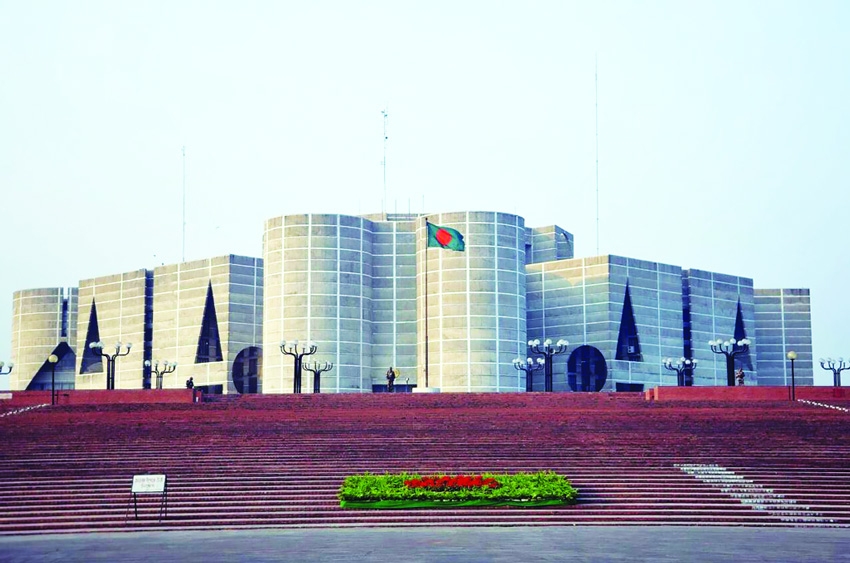
Corruption and poor accountability have long challenged Bangladesh’s political and governance systems. In Spite of constitutional safeguards, anti-corruption laws, and periodic reforms, public trust remains fragile. This raises a difficult but necessary question. Is it possible to meaningfully curb corruption and strengthen accountability by reforming the political structure itself—specifically, by establishing a bicameral (two-stage) parliament?
At present Bangladesh ruled under a unicameral parliamentary system, where a single legislative chamber concentrates on law making, oversight, and political power. Despite this system allowing efficiency, it can also lead to excessive centralization, partisan dominance, and poor scrutiny. A bicameral parliament typically consisting of a Lower House and an Upper House which offers an alternative institutional design that may improve checks and balances if implemented carefully and democratically.
The interim government of Bangladesh has also proposed the formation of a bicameral parliament under the state reform. For this reason, the government has organized a referendum along with the 13th national election. According to the basic principle of a bicameral parliament, there will be a lower house formed by representatives directly elected by the people and an upper house will be formed by 100 representatives elected proportionally with the consent of all political parties. The question is how suitable is this system for Bangladesh?
A Bicameral parliament divides legislative authority between two chambers with distinct roles. The Lower House usually represents the people directly through elections and initiates most legislation, especially budgetary and financial bills. The Upper House often represents non-partisan experts or professional groups and focuses on review, oversight, and long-term national interests. This separation reduces the risk of rushed legislation, partisan capture, and abuse of power. Laws must pass through two layers of scrutiny, making corruption, favoritism, and opaque deals harder to hide.
How Bicameral parliament could reduce corruption:
First, enhanced legislative scrutiny is a key advantage. In Bangladesh, many controversial laws and amendments have passed with limited debate. An Upper House with the authority to review, amend, or delay legislation could demand transparency, conduct public hearings, and require stronger justifications for policies. This slows down rent-seeking behavior and exposes conflicts of interest. Second, institutionalized accountability could be strengthened through specialized oversight committees. An Upper House composed partly of retired judges, economists, former civil servants, and representatives from civil society could independently review government actions, public procurement, and regulatory decisions. Such bodies would be less vulnerable to short-term electoral pressure and party discipline. Third, decentralization of power is crucial. If the Upper House represents divisions or regions, it can reduce Dhaka-centric decision-making and political patronage networks. Regional representation would bring local corruption issues into national debate and make it harder for centralized elites to monopolize resources.
Political accountability beyond elections:
Elections alone have not been sufficient to ensure accountability in Bangladesh. All winner political parties, weak opposition participation, and confrontational political culture often limit effective parliamentary oversight. A Bicameral parliament could create structured, continuous accountability mechanisms that operate between elections.
For example, ministers could be obligated to answer questions in both chambers of parliament. Reports from independent bodies such as the Anti-Corruption Commission could be formally examined by the Upper House, with subsequent actions disclosed to the public. Such transparency would raise the political consequences of engaging in corrupt practices.
Risks and Limitations of bicameral parliament:
However, a bicameral parliament is not a magic solution. Corruption is rooted not only in institutions but also in political culture, enforcement capacity, and social norms. Without genuine political will, a bicameral system could become another layer of patronage, increasing costs without improving governance.
There is also the risk of elite capture. If the Upper House is appointed rather than elected, it may serve ruling interests instead of acting as an independent watchdog. Conversely, if it is elected through flawed processes, it may replicate the same problems found in the Lower House. Therefore, the method of selection is critical. A mixed system—combining indirect elections, fixed quotas for professionals, and strict non-partisan criteria—could reduce these risks.
Another concern is legislative gridlock. If both chambers are dominated by rival political forces without a culture of compromise, policymaking could stall. To avoid this, constitutional clarity on powers, timelines, and conflict-resolution mechanisms is essential.
Complementary Reforms are essential for Bicameral System:
A Bicameral parliament can only succeed if accompanied by broader reforms. Judicial independence must be strengthened so corruption cases are prosecuted fairly and without political interference. The Anti-Corruption Commission must be autonomous, well-resourced, and accountable to parliament rather than the executive.
Political party reforms are equally important. Transparent campaign financing, internal party democracy and asset disclosure by politicians would reduce incentives for corruption. Digital governance, open data, and citizen access to information can further support parliamentary oversight.
If anyone asks that, is It possible? I will say, yes, it is possible but not guaranteed. Establishing a Bicameral parliament in Bangladesh could create stronger institutional checks, improve legislative quality, and enhance accountability. However, its success would depend on careful constitutional design, transparent selection of members, and a genuine commitment to democratic norms.
Al Amin Chowdhury is
Publisher of The Asian Age.