
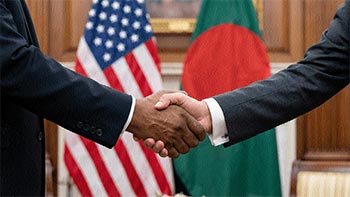
 Bangladesh has secured duty-free access for 2,500 domestic products in the United States, while simultaneously opening its own market to 7,132 American goods under a sweeping reciprocal trade agreement that could redefine the country’s export trajectory – but also expose structural vulnerabilities in its trade and industrial base.
The pact, finalised on 9 February, stands among the most extensive tariff liberalisation frameworks ever negotiated by Dhaka, covering pharmaceuticals, agricultural commodities, plastics, timber and a broad spectrum of industrial inputs across the country’s 7,458 tariff lines. Yet behind the headline gains lies a complex recalibration of supply chains, import dependencies and regulatory alignment with advanced Western markets.
Chief Adviser Muhammad Yunus presented the agreement as a strategic necessity, arguing it will shield Bangladesh’s position in its single largest export destination while anchoring deeper long-term economic engagement with Washington. However, trade analysts caution that the deal represents not just an expansion of market access, but a profound shift in Bangladesh’s external economic orientation.

With immediate effect, 4,922 US tariff lines have entered Bangladesh duty-free – a dramatic leap from just 441 previously. The remaining tariff lines will be dismantled gradually through phased liberalisation schedules extending up to a decade, accelerating market penetration by US goods into key domestic sectors.
Tariffs on 1,538 products will be eliminated within five years, starting with a 50 per cent cut in the first year. Another 672 products will see duties removed over ten years, also beginning with an initial 50 per cent reduction. While this staged approach offers adjustment time for domestic industries, it also raises concerns over competitiveness pressures on local manufacturing and import-sensitive sectors.
The agreement also locks Bangladesh into partial procurement realignment towards US suppliers in strategic areas such as aviation, energy and agricultural commodities. Planned purchases include aircraft from Boeing, alongside increased imports of liquefied natural gas, liquefied petroleum gas, soybeans, wheat, cotton and defence-related equipment.
Officials insist the strategy is designed to preserve Bangladesh’s export dominance in ready-made garments in the US market without significantly increasing overall import spending. In practice, however, the shift signals a gradual reconfiguration of long-standing sourcing relationships, potentially altering Bangladesh’s geopolitical and commercial balancing strategy.
Policy economists increasingly view the agreement less as a traditional free trade expansion and more as a market-insurance mechanism – designed to secure continued preferential entry to the US market at a time when global supply chains are becoming increasingly politicised and protectionist.
Notably, Bangladesh appears to have secured relatively flexible regulatory space compared with some comparable US trade arrangements. The agreement does not require prior US consultation before Dhaka signs digital trade deals with third countries and does not explicitly restrict trade engagement with non-market economies – a clause that could prove strategically significant in future geopolitical trade realignments.
On rules of origin, the absence of rigid domestic value-addition thresholds is likely to simplify compliance for Bangladeshi exporters. This may open new opportunities for textile exports using US-origin cotton and synthetic fibre inputs, potentially deepening vertical integration in the apparel supply chain. However, critics warn this could also reinforce Bangladesh’s concentration in low-to-mid value manufacturing segments.
Beyond tariffs, the agreement embeds far-reaching regulatory commitments, including expanded paperless trade systems, stronger intellectual property enforcement, permanent exemption of customs duties on e-commerce transmissions and deeper reductions in non-tariff barriers. These measures are expected to modernise Bangladesh’s trade infrastructure but may also increase compliance costs for smaller domestic firms.
The framework further accelerates market entry for US medical devices and pharmaceuticals, allowing imports without prior local authorisation if certified by US regulators. Bangladesh will also recognise US sanitary and phytosanitary standards for dairy, meat and poultry – a move welcomed by importers but viewed cautiously by local producers.
The agreement also pushes structural reforms across insurance, energy and telecommunications through foreign equity liberalisation, while strengthening anti-corruption enforcement and labour compliance standards. Bangladesh has also agreed in principle to join nine international intellectual property conventions, further aligning the country with advanced-market regulatory regimes.
In digital trade and technology governance, the pact draws Bangladesh closer to global data protection and privacy frameworks, while embedding economic security cooperation elements that could shape future technology partnerships.