
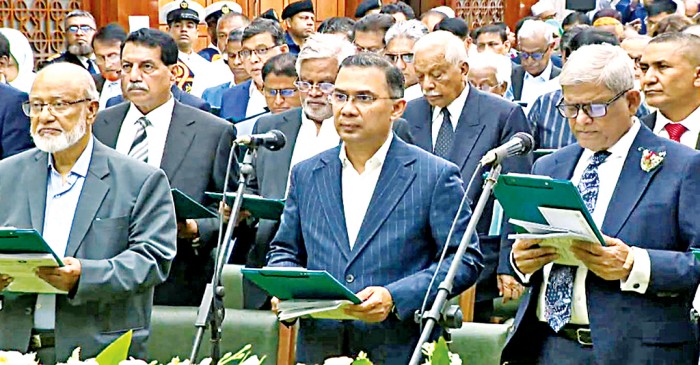

THE 13th National Parliamentary Election of 2026 marks a significant juncture in Bangladesh’s political trajectory. After years of sustained political tension, contested electoral processes, allegations of repression and declining public confidence in state institutions, the latest poll has been widely interpreted as an opportunity for institutional reset. For a considerable segment of the electorate, participation in this election symbolised not merely routine civic engagement but the restoration of agency. The long-standing public question whether individual votes genuinely influenced political outcomes re-entered national discourse with renewed force. Against this backdrop, the election has been presented as a test of democratic resilience rather than a mere transfer of power.
The Bangladesh Nationalist Party has emerged with a parliamentary majority and has formed the government. Bangladesh Jamaat-e-Islami and the National Citizens’ Party, occupy opposition benches. This configuration has generated cautious optimism regarding the potential reactivation of parliamentary scrutiny, legislative debate and institutional accountability. In recent years, critics described parliament as structurally imbalanced, with limited effective opposition. The presence of an elected and numerically viable opposition may, in principle, restore deliberative politics to the legislative arena. Whether this promise materialises will depend less on numerical strength and more on political temperament.
The electorate’s expectations are substantial. Many citizens associate the new administration with the possibility of institutional reform and a departure from patterns they perceived as excessively centralised and politically exclusionary. Allegations of enforced disappearances, administrative overreach, restrictions on expression and partisan use of state machinery have formed part of public debate in recent years. Yet electoral transition, however consequential, does not in itself resolve structural deficiencies. The question now is not whether change has occurred, but whether that change will translate into sustainable institutional recalibration.
The first challenge confronting the new government lies in reconciling electoral legitimacy with inclusive governance. Securing a parliamentary majority confers authority, but it does not automatically generate consensus. Governing in a politically polarised environment demands restraint. If the administration treats its mandate as a partisan endorsement rather than a national trust, it risks reproducing the very dynamics that voters sought to amend. The distinction between party and state must be clearly maintained. Power exercised as stewardship rather than entitlement will determine the tone of the coming term.
Political culture requires deliberate reform. Bangladesh’s history of confrontational party politics has often encouraged winner-takes-all behaviour, patronage networks and cycles of retaliation. If appointments, promotions and institutional responsibilities continue to be distributed on the basis of loyalty rather than competence, public confidence will erode rapidly. Meritocratic standards and transparent procedures are not abstract ideals; they are operational necessities. A government elected on promises of renewal must demonstrate that it is prepared to embed professionalism across public institutions.
Administrative reform represents another critical test. For years, opposition parties and civil society actors alleged that segments of the civil service and law enforcement agencies operated under overt political influence. Re-establishing administrative neutrality will require more than rhetorical assurances. It will necessitate procedural safeguards, clear chains of accountability and a willingness to tolerate bureaucratic independence within lawful boundaries. At the same time, elected representatives must retain strategic oversight. An imbalance in either direction — politicised bureaucracy or unaccountable administrative autonomy — would undermine democratic equilibrium.
The rule of law remains foundational. Judicial independence must be preserved in both principle and practice. Courts cannot function as instruments of political vindication, nor should they become protective shields for entrenched interests. The credibility of the new government will, in part, be measured by its response to politically sensitive cases. A consistent application of legal standards, irrespective of party affiliation, will signal seriousness of purpose. Without effective protection of civil liberties, including freedom of expression and due process, claims of democratic renewal will ring hollow.
Economic management may prove the most formidable challenge. Persistent inflation has constrained household purchasing power. Pressure on foreign currency reserves, rising external debt obligations, irregularities within the banking sector and a longstanding culture of loan default have weakened financial stability. These issues cannot be addressed through short-term populist measures. Structural reform is required. Strengthening regulatory oversight, enforcing loan recovery mechanisms and ensuring transparency in public expenditure are indispensable steps towards restoring macroeconomic confidence.
Investor sentiment will depend on policy consistency. Both domestic entrepreneurs and foreign investors require regulatory predictability. Frequent policy reversals, opaque procurement practices and selective enforcement of financial rules deter long-term commitment. If the government is serious about revitalising growth, it must confront influential defaulters and address systemic weaknesses in financial governance. Economic discipline is inseparable from social development; without stable revenue streams and prudent expenditure, social commitments become fiscally unsustainable.
Social policy presents parallel expectations. Poverty reduction and inequality mitigation remain central responsibilities. Development statistics, while important, must correspond to tangible improvements in living standards. Access to healthcare, education, housing and social protection cannot be contingent on political affiliation. Social safety net programmes require depoliticisation and transparent targeting mechanisms. In a politically competitive environment, the temptation to use welfare distribution as a tool of consolidation is strong. Resisting that temptation will demonstrate maturity.
Educational reform is equally urgent. Infrastructure expansion, though visible, does not automatically enhance quality. Curriculum modernisation, research incentives, teacher training and alignment with labour market needs must receive sustained attention. Youth unemployment, if left inadequately addressed, risks generating social discontent. Integrating technological skills development with industrial policy could mitigate this risk. Without coherent linkage between education and employment, demographic advantage may turn into demographic strain.
Combating corruption will serve as a defining benchmark. Corruption corrodes institutional trust and distorts resource allocation. Effective oversight bodies must operate independently and transparently. Anti-corruption initiatives cannot selectively target opponents while overlooking allies. A credible anti-corruption framework demands impartiality, prosecutorial independence and judicial follow-through. Political will, in this domain, will be closely scrutinised.
Media freedom constitutes another indicator of democratic depth. A government confident in its mandate should not perceive critical journalism as existential threat. Suppression of dissenting voices often conceals systemic problems rather than resolving them. Constructive criticism strengthens governance by identifying policy gaps. The relationship between state and media need not be adversarial, but it must remain autonomous.
Parliamentary cooperation will further shape the political climate. An effective opposition enhances legislative scrutiny and policy refinement. Constructive disagreement, when institutionalised, prevents complacency. If parliamentary procedures are respected and dissenting voices permitted substantive participation, the legislature may regain credibility as a forum for national deliberation rather than partisan confrontation.
Externally, the government must navigate regional geopolitics and global economic volatility with prudence. Bangladesh’s strategic location necessitates balanced diplomacy. Relations with neighbouring states must be managed on the basis of reciprocity and national interest. Simultaneously, integration into the global economy demands export diversification, protection of remittance flows and engagement with emerging markets. Climate vulnerability, energy security and food sustainability will require long-term strategic planning beyond electoral cycles.
Ultimately, the defining challenge may lie in political self-restraint. Electoral victory can generate momentum, but unchecked confidence may lead to repetition of past errors. Democratic consolidation requires institutional humility. If leaders recognise the provisional nature of power and subject their own decisions to scrutiny, institutional resilience will deepen.
The 2026 election has created an opening. Whether it becomes a durable transformation depends on governance choices made in the coming months. The electorate has extended trust; maintaining that trust demands consistency, transparency and restraint. The central question is not merely whether the new government can exercise power effectively, but whether it can redefine the manner in which power is exercised. History will record the outcome not by promises articulated, but by institutions strengthened and freedoms secured.
Sultan Mahmud Sarker is an MPhil researcher at the University of Rajshahi.