
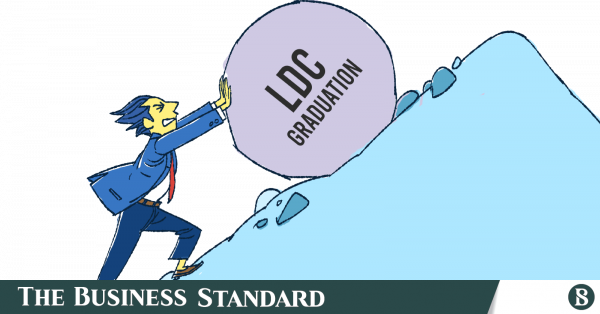
The government has formally requested a three-year deferral of Bangladesh’s graduation from the Least Developed Country (LDC) category.
According to officials at the Economic Relations Division (ERD), a letter signed by Economic Relations Division (ERD) Secretary Md Shahriar Kader Siddiky was sent on 18 February to the United Nations Committee for Development Policy (CDP). The committee is scheduled to meet from 24 to 28 February to review Bangladesh’s request along with related matters.
In the letter, the government noted that the preparatory period granted for LDC graduation was primarily intended to address post-pandemic challenges over a five-year timeframe. However, multiple global shocks have disrupted that plan.

The Russia-Ukraine war drove up global fuel and food prices, while widespread monetary tightening and the impact of a global economic slowdown further strained the economy. Supply chain disruptions in the shipping sector and uncertainty in international trade have also compounded the situation.
Officials said domestic factors, including declining investment, slower revenue growth, and reduced GDP expansion, have limited the expected progress in implementing structural reforms. Although the preparatory period was utilised, the structural adjustment policies required for smooth graduation could not be fully implemented.
The letter also highlighted growing uncertainty in the global trading environment, including concerns over securing GSP Plus benefits. Policy shifts among major trading partners could exert additional pressure on Bangladesh’s competitiveness, necessitating more time to adjust.
In this context, Bangladesh has formally requested a three-year extension along with a “crisis assessment.”
Sources said an initial assessment report may be prepared within two weeks after the February meeting. The CDP will then provide its observations and recommendations, with a final decision expected in September.
ERD officials added that last year, at Bangladesh’s request, the United Nations conducted an assessment outlining the country’s economic challenges but did not issue specific recommendations. Instead, the graduation process was described as “challenging” for Bangladesh.
The final decision will be adopted by the United Nations General Assembly, and the full recommendation and approval process could extend until September or October, officials said.
They noted that the formal review process has now begun, and subsequent decisions will depend on the ongoing evaluation.