
Like a phoenix rising from the ashes, Bangladesh has time and again rekindled the struggle to realise its democratic destiny. But can it move beyond its very divisive history and deliver the “plan” it has promised? Unquestionably, the formation of the 13th national parliament is nothing short of a political miracle, coming as it does after an election following a bitter and bloody struggle that led to its longest-serving Prime Minster fleeing the country and taking refuge in India.
The just-concluded election has been hailed as free, fair, and peaceful by the over 650 foreign observers and media persons. It was not an inclusive election; given the political and social context, the electoral landscape was limited. Many of the unarmed youths who participated in the job quota movement against the government led by Sheikh Hasina’s Awami League in July 2024 were joined by civil society members in the following months. All of them had to contend with the might of repressive security forces.
In the face of Hasina continuing to make political noises from India, without any real expression of regret, the youth anger got no chance to wane. Certainly, it would have suited the Bangladesh Nationalist Party (BNP) to share electoral space with Awami League, but there were no takers for such a move. Apart from emotive reasons, there were electoral calculations involving the Jamaat-e-Islami and others that precluded the return of Awami League.
Immediately after the fall of Hasina, the interim government headed by Muhammad Yunus and a group of advisers took over in an interim arrangement on August 8, 2024. The popular mood was to transform Bangladesh into a democratic, accountable, and transparent nation. But in the fluid political atmosphere, identity questions were revisited, and competing nationalisms became a hallmark of the popular movement.
Sections of the youth spearheading the idea of a new Bangladesh went on to form the National Citizen Party (NCP). They came up with a July Charter that was essentially a pledge to reform. This was signed by several parties, including the BNP, albeit with a note of dissent. In continuation of this vision, the interim government held a referendum for constitutional reforms alongside the parliamentary election which received a majority of “yes” votes.
Passers-by and supporters watch a Jamaat-e-Islami party rally in Dhaka on February 16.
| Photo Credit:
MOHD RASFAN/AFP
With technology on its side, ramped up with CCTV, body camera, and a revamped website, the Election Commission, ably supported by the security forces, enabled a voter-friendly environment that saw a nearly 60 per cent voter turnout across the 42,779 polling stations. The morning of February 12 saw long queues in all the polling centres, in stark contrast to the desolate streets one had seen in the last few elections. Indeed, 51 parties and more than 2,000 candidates took part in the election this time. It also saw a large youth bulge: among those above the voting age of 18, approximately 56 million, or 44 percent, were between ages of 18 and 37. Also, more than 4.2 lakh overseas postal ballots were used.
Fight between the BNP and the Jamaat
While the Awami League, the country’s largest and oldest political party, was banned from contesting, the election saw two large coalitions pitted against each other. In the final count, the BNP, which was leading a 10-party coalition, won 212 seats, with nearly 51 per cent of the votes, a comfortable majority to form government. But a significant breakthrough was made by the once banned Jamaat’s 11-party coalition, which got 77 seats, with nearly 36 per cent support. A political party that has been in the shadows and did not get more than 18 seats in past elections now holds the key to Bangladesh’s future. Only time will tell whether this portends a seismic shift for Bangladesh, with the nation turning firmly rightward and pluralism getting replaced with radicalism, or whether the Jamaat will stay the course and embrace the mainstreaming opportunity its voters have bestowed on it.
The election also saw a close competition. Many seats were won with a margin of less than 2,000 votes. Some were won with as low as 50 votes. The Jamaat managed to gain seats in the north and south-west, along the India-Bangladesh border adjoining West Bengal. One of their many notable successes was winning, for the first time, a seat in Gazipur district. Gazipur is the birthplace of Tajuddin Ahmad, one of the architects of Bangladesh’s Liberation War.
Shafiqur Rahman, Ameer (president), Jamaat-e-Islami, speaks with the media after voting, outside a polling station during the national election in Dhaka on February 12.
| Photo Credit:
Fatima Tuj Johora/Reuters
However, for a nation that has been run by two women leaders since 1991, the absence of women candidates in this election was glaring. Seven women candidates won, one has been appointed as a Minister, and two others as Ministers of State. The 49-member Cabinet now has barely 6 per cent female representation.
The absence of Awami League from the election gave rise to speculations about the voting behaviour of their members and supporters. It appears that some Awami League members decided not to cast their vote while others were persuaded, even coerced, by local leaders to exert their choice. The Jamaat apparently promised support to fend off the legal charges against many of them, especially in Jamaat strongholds.
Reinvention of the BNP and the Jammat
There were not too many Hindu candidates, and only three won. Given their political dilemma, there have been contradictory reports about the political choices of Hindus. Over the past 18 months, the Jamaat has attempted to shake off its violent image and recast itself as a responsible and corruption-free party. Through the consistent delivery of services, such as the running of charities, clinics, schools, and organising relief work, mostly where the state is absent, the party has become a recognised presence. The Jamaat has always followed a strict organisational hierarchy and closely documented its financial statements. This differentiates it from larger, mainstream political parties. Now it has also shown the ability to adjust its strategies to cater to local societal needs.
Shedding its earlier conservatism, the Jamaat is now envisioning national unity, social justice, and transparent leadership. This has resulted in a new generation of supporters, including diplomats and business leaders, voting for it. The Jamaat’s student faction has followed suit, making inroads into university campuses. Previously seen as an oposhakti (violent group), the Jamaat is now showing a viable path for the future to many of its student supporters.
Women queue up at a polling station during the national election in Dhaka on February 12. A huge number of youth voted in the election.
| Photo Credit:
Fatima Tuj Johora/ Reuters
The BNP has also slowly attempted a shift, shunning its rightish moorings to adopt centrist-liberal credentials, emphasising national unity, democratic principles, and the foundational spirit of 1971, to capture the central position left vacant by the Awami League. Ironically, it has also adopted quickly many of the Awami League’s bad practices, resorting to extortion, bribery, and coercion soon after August 2024. Such activities got hundreds of workers expelled from the party when the BNP leadership tried to recover lost ground, especially after the return of Tarique Rahman in December 2025.
Despite this and despite the flattering sound bites and optics, politics in Bangladesh remains murky. Closer to the election date, several unsavoury news items emerged about both the coalitions. When a Jamaat member was caught with enormous amounts of cash, the party’s opponents got an easy stick to beat him with.
For Tarique Rahman, a behind-the-scenes BNP hand who was slammed with 84 cases and banished from his homeland for 17 years, leading the BNP to victory is no less than a new beginning. The BNP certainly touched the right chords by taking up women’s safety, students’ welfare, unemployment among the youth, healthcare and economic development, social schemes for homemakers through direct government support, and similar other issues, but public memory about Rahman’s exile also lingered, as the polling numbers indicate.
BNP supporters pose next to a bulletproof bus of Tarique Rahman during a rally on the final day of campaigning in Dhaka, on February 9.
| Photo Credit:
SAJJAD HUSSAIN/AFP
Attempting to capture the new generations’ mood, both Tarique Rahman and the Jamaat’s Ameer Shafiqur Rahman have urged moving away from the politics of revenge and retaliation. To prove the point, they have had their own meetings. In the past, political rivals in Bangladesh rarely met.
Hurdles on the way
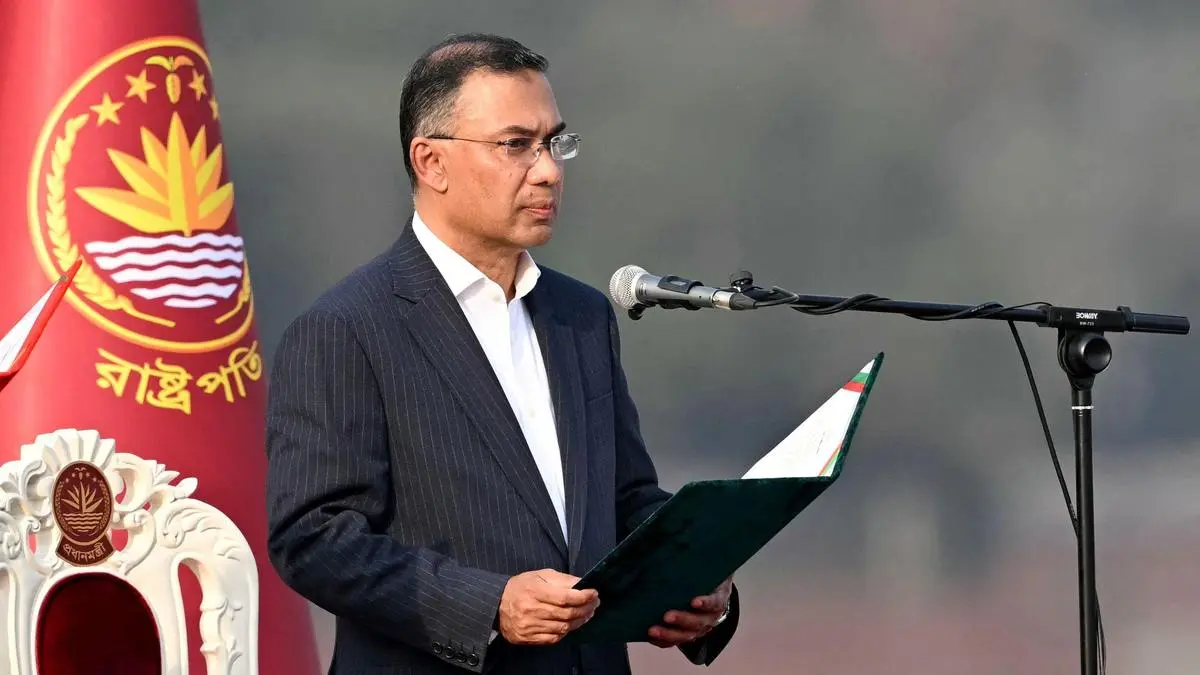
The Cabinet led by Prime Minister Tarique Rahman took oath on February 17. Despite the mature statements by the leaders of the two coalitions, the first cracks became evident at the very outset, during the oathtaking ceremony. While the BNP and seven Independents took the oath for parliament, the Jamaat coalition members took two oaths—one for parliament and the other for the constituent assembly, in line with the July Charter they had signed. Also, the Jamaat coalition chose to stay away from the Cabinet’s oathtaking, showing that wide political fissures still exist. The absence did not make for great optics, pointing to the underlying fractures that need to be addressed at the earliest so that Bangladesh does not fall back into the political quagmire it has just left behind.
Given the level-headed election campaign this time, there is hope that Bangladesh will, after a long time, enjoy a functional parliament. To the credit of the BNP, it did not hold victory rallies, preferring to offer prayers instead to convince the people of their serious intentions to change. The presence of a strong opposition should ensure good governance.
With political stability and economic growth as its top priorities, the BNP does face a challenge. It has to navigate a difficult terrain with the lingering suspicion that it has not transformed enough. It will also have to convince Gen Z of its changed politics. The culture of mobocracy that seems to have a stranglehold over Bangladesh needs to be dealt with. One hopes that the presence of seasoned Jamaat leaders will temper the NCP’s impatience. Bangladesh needs to find stability. It is at a critical turning point now: it should not be made to seek yet another beginning.
Indian and Bangladesh
India-Bangladesh relationship has suffered badly in the past 18 months. Since August 2024, the space has been dominated by misinformed and misplaced narratives spread largely through social media on both sides of the border. Inevitably, it seemed as if Bangladesh was busy making new friends like Pakistan and Turkey while India had no interest in Bangladesh sans Sheikh Hasina.
The few high-level meetings on ground could not change the “complicated” relationship status. The connectivity corridor built over the years by the two neighbours stood unused. The withdrawal of tourist visas and many trade facilities led to trade worth nearly $18 billion between the two nations dwindling to a bare minimum. Apart from many bilateral issues, Hasina’s exile in India continues to be a thorn on Bangladesh’s side. When Delhi enabled a media blitzkrieg by Hasina just before her trial by the International Crimes Tribunal and then allowed two press conferences by former Awami League members in India just two weeks before the Bangladesh election, the events seemed consciously timed.
One hopes that India and Bangladesh will be able to reset ties. New Delhi’s security concerns and red lines need to be properly communicated to Dhaka while Dhaka communicates its concerns and needs as well. Each side has its priorities, which need to be understood. The 30-year Ganga water sharing treaty is up for renewal and, hopefully, as mutually decided, this will not become another contentious issue between the neighbours. In fact, the cobwebs over water-sharing agreements on both sides need to be brushed away as India also considers starting the Teesta water management project.
Rahman has repeatedly expressed his willingness to work with India, but can he walk the talk? Both sides have to discard past baggage, and they need to have low expectations of each other. The onus will be on Delhi to ensure that Dhaka does not move too far away. While Bangladesh considers India its most important neighbour, this Dhaka is not the one India is familiar with. And it would be prudent for Dhaka to remember that today’s Delhi is not the same as that of the past.
A frank, open dialogue involving various stakeholders is crucial for getting each other’s pulse right. India and Bangladesh are closely knit by religious, cultural, and familial ties; they are destined to work together if they want to deliver to their people on both sides. Embracing this path rather than returning to the maze of the past will ensure that they emerge joint winners. The choice is theirs to make.
Sreeradha Datta is Professor, Jindal School of International Affairs, O.P Jindal Global University, India.
Also Read | Tarique Rahman emerges as Bangladesh’s saviour
Also Read | Bangladesh’s secular ballad meets the politics of the grave