
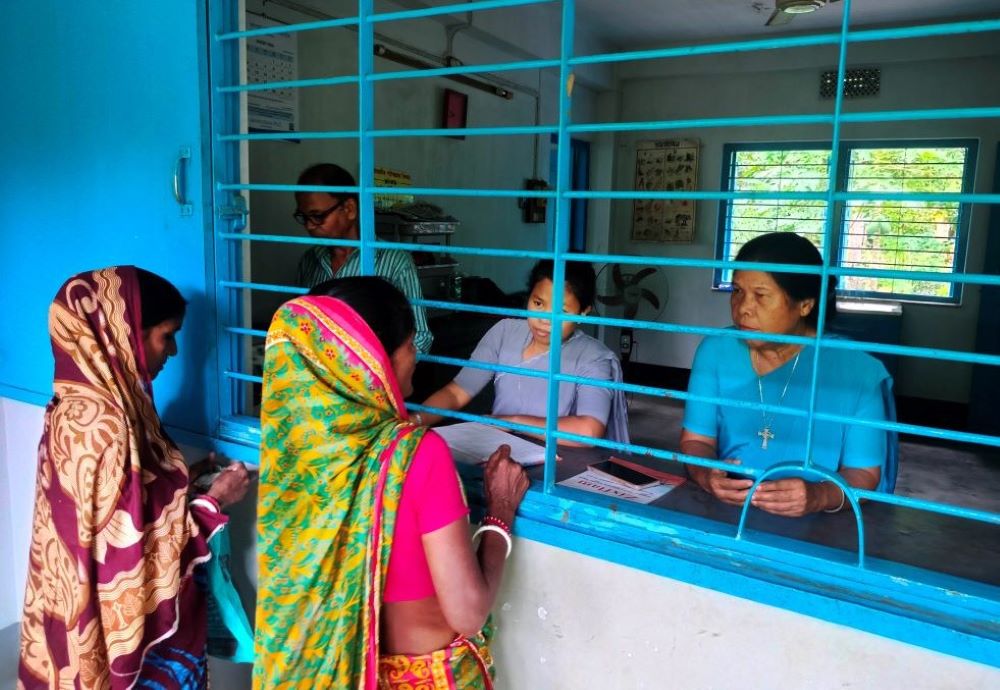
For years, the Holy Cross Sisters have been working in medical and health awareness among tribal peoples, tea plantation workers and low-income communities in the northeastern region of Bangladesh.
These communities, once deprived of health services, do not get health care, but have improved in health awareness and education due to the initiative of sisters and other missionaries.
In 1989, the Holy Cross Sisters started the Holy Cross Health Education Centre in the Lokhipur area of Moulvibazar district in the northeastern part of Bangladesh, where about 550 patients receive treatment and consultation every month.
“Nowadays there are very few patients who come to us, and those who come to us are mostly poor people who are in financial crisis,” Holy Cross Sr. Thecla Dinila Nokrek, director of the center, told GSR.
“Health awareness has increased among people, and [some] have developed economically. As a result, those who can afford it, spend money and go to the city for treatment because we do not or cannot treat many diseases,” Nokrek said “But in the beginning, we did not have time to eat all day under the pressure of patients.”
The sisters established the health education center because many people in the area suffered from malnutrition and the lack of prenatal care, and the nearest health center was about 70 kilometers (44 miles) from Lokhipur.
The Holy Cross Sisters built the center next to Lokhipur Parish. In addition to local community members, Garo and Khasi tribal peoples of Kukijhuri Punjee 20 kilometers (12 miles) away and tea plantation workers visit the site.
Nokrek said that because more importance was given to health education rather than patients’ treatment to reduce disease, the center is called the Preventive Medicare Center.
“They were already deficient in food and then again infested with worms, so it was only natural that they would suffer from malnutrition,” Nokrek said. “We gave them medicine but did not take money. Besides, I used to visit different villages one day a week and show pictures about personal hygiene, waterborne diseases and nutrition.”
The Lokhipur Parish was founded in the Sylhet Diocese in 1985 and the Oblate Fathers took charge. The Holy Cross Sisters were then involved in school management and pastoral work, and they established the health center in 1989.
Holy Cross Sr. Tina Moury Ritchil, who is from Kukijhuri Punjee and is pursuing her master’s degree in nursing, works as a senior nurse at Holy Cross Health Education Center.
“Since childhood, I have been watching the Holy Cross Sisters, Holy Cross Fathers and Oblate Fathers,” Ritchil told GSR. “In our parish, the Holy Cross Sisters carried small medicine bags and gave pastoral work, health education and medicine. Then the sisters would give nutritious food and vitamins to the children who were suffering from malnutrition.”
It takes 45 minutes from the parish by local vehicle and over two hours on foot on the hilly road to Kukijhuri Punjee, where in 2000, only two people completed 10th grade but in 2024, almost 70% of the population had completed 10th grade.
Ritchil, whose mother was often sick, is reluctant to say that even though this center is 35 years old, there has been a great improvement in the health of people in the area.
“I would say that people are not very health conscious. The superstitions that used to exist among people have reduced somewhat. Now people come to the health center at least if they have any complications,” Ritchil said. “Mothers come to us a little more during pregnancy than before for health checkups or consultations. However, they don’t do regular health checkups, which means health awareness, and they don’t eat fruits and vegetables, which are necessary for nutrition.”
Most Garo and Khasi tribal peoples of Punjee work as day laborers or in betel leaf (used as a wrapper for chewing areca nuts or tobacco) cultivation. Cultivating betel does not create much profit. In addition, the tribal peoples are not well connected to the city due to the poor transportation system.
Tea workers near the health center regularly go to the sisters for medical care and counseling, and in special cases they also take food. Sisters give pregnant women nutritious food, rice and milk.
“I used to work in the tea garden but now I don’t have a job due to being overaged. I have no taste for food, I feel weak and have ulcers in different parts of my body, so I came to the sisters for advice and treatment,” said Prabha Goswami, 80.
Referring to the sisters’ contribution in helping people in the area, Goswami said, “We don’t have the money to go to the district or sub-district town for treatment. These sisters are our only hope. If it were not for the sisters, I would have been sick at home.”
Both Ritchil and Nokrek dream of raising enough money to build a hospital to serve the local community and play a major role in eliminating unemployment.
“If there is a complicated problem and we cannot treat it, we refer them to another hospital, which is about 10 kilometers from the parish, and from a few villages, the hospital is around 30 kilometers away. So, if we have a hospital here, they will be able to get treatment safely,” Ritchil said.