
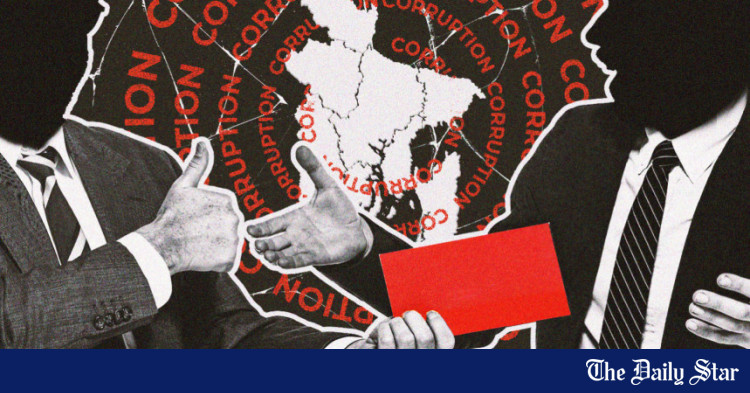

On Transparency International’s Corruption Perceptions Index, Bangladesh has always ranked at the absolute bottom or near the bottom, faring worse than every other country in the world except a mere handful. FILE VISUAL: SHAIKH SULTANA JAHAN BADHON
“>

On Transparency International’s Corruption Perceptions Index, Bangladesh has always ranked at the absolute bottom or near the bottom, faring worse than every other country in the world except a mere handful. FILE VISUAL: SHAIKH SULTANA JAHAN BADHON
A recent survey of eminent economists in Bangladesh ranked corruption as the number one problem the government needs to address. The endemic corruption has crippled the country’s economy, destroyed the social fabric, and even penetrated our schools. Only in Bangladesh is it possible for SSC and HSC students to protest for the right to cheat based on leaked exam papers, as happened in Rajshahi in 2006. Corruption is institutionalised, almost as a sort of mandatory tax, and people actually idolise those with money, regardless of the source of wealth. The Monsoon Revolution has overthrown the kleptocracy at the pinnacle of the corruption pyramid, but it is now up to us to eradicate the disease of corruption from our culture.
From the late Roman Empire (3rd-5th century AD), to China’s Qing Dynasty (18th-19th century), and in more recent history the Weimar Republic in post-World War I Germany, there are numerous examples of how widespread and virtually normalised corruption has led to the downfall of once mighty empires. There is a huge lesson in that for Bangladesh and the revolution has to lead us away from a similar plight.
 For all latest news, follow The Daily Star’s Google News channel.
 Perversely, in a society where corruption is the accepted norm, those who illegally accumulate vast wealth, are virtually worshiped. Instead of focusing on prosecuting the corrupt officials, the embezzlers, or the strong-armed business people who accumulate wealth through force, everyone ends up striving to be like them. This moral bankruptcy leads to a truly Darwinian culture where each and everyone is desperately trying to accumulate wealth through any means possible, with no fear of punishment and more importantly, absolutely no degree of shame. This erosion of shame from our culture is ultimately the root of the endemic corruption. Only when there is no shame can the kleptocrats openly flaunt their wealth as they parade their luxury vehicles and designer jewellery on the way to opulent destination weddings and parties. And only when there is no shame does everyone else look at this not in disgust—at the theft and thuggery that led to this—but ruing the missed opportunity that they themselves have not yet availed themselves of such wealth. Is there even a fix to this?
Several countries have actually successfully eliminated or dramatically reduced corruption. After gaining independence in 1965, Singapore made it a top priority to fight corruption and introduced zero tolerance policies. The Corrupt Practices Investigation Bureau was created as an independent entity with broad powers. They were free to pursue and prosecute corrupt officials without any fear of political interference. Those that were found guilty faced harsh penalties. If there are no penalties or if political connections can get you out of trouble, what is to stop you from being corrupt? Simultaneously with these measures, Singapore began paying competitive salaries to public servants, to reduce the temptation to take bribes.
Similarly to Singapore, Rwanda made a strong commitment to reform its governance systems and eliminate corruption following the 1994 genocide. Independent anti-corruption bodies were set up and the government made a point of publicising corruption cases and the ensuing penalties. Rwanda also took a page out of Denmark’s book in creating a lot more transparency and allowing access to government data. To that end, they embarked on a digitisation process that reduced bureaucratic inefficiencies and opportunities for bribes. Estonia took it a step further by introducing e-procurement systems that make it harder for officials to manipulate contracts. Income and assets declarations of public officials are actually accessible to the public. In fact, in Denmark, as in many European countries, civil society plays a strong role in monitoring government activities. The media plays a critically important role in exposing corruption cases.
In order for all this to work, however, the media needs to be free and the judiciary needs to be independent of the government and politics. In Bangladesh, neither of these two conditions were true. Whenever the media attempted to expose the most extreme cases of corruption and money laundering, they were ordered to cease and desist. As a result, people began wanting to be like the corrupt and indeed, started mimicking them in their own spheres. That is how we built a culture where the ends justified the means. Any path to wealth became acceptable, with no legal or social consequences. Far from it, opulent displays of illicit wealth have become de rigueur. Victims of the corruption cannot be bothered to report it because they are either scared of the thugs or because they know there will be no consequences for the criminal behaviour. Instead of the perpetrator being punished, we have reached a point where the victim is punished for reporting it. Whistleblowers need to be admired, encouraged, and in cases where the dollar amounts are huge, rewarded for their courage and efforts.
The very people who should have been most responsible for enforcing the law and ensuring that corruption did not get out of hand actually become the most complicit, namely the police. This is not without international precedent. After the 2003 Rose Revolution, Georgia went down an ambitious path of police reform because the police had become extremely corrupt. The Georgian government fired most of the police force and rehired a smaller, more efficient, better paid and more professional workforce. Tough times call for tough measures. Since the main function of the police force in Bangladesh had become to enforce the party line of the kleptocracy and to line their own pockets with bribes, it is clearly high time to apply the Georgian approach.
The prevalent belief in Bangladesh is that the model career is one where one accumulates as much wealth illegally as fast as possible and then stashes it overseas through money laundering. Once the money is overseas, citizenships and passports can be bought, and as soon as things heat up at home, one can head overseas for a comfortable and opulent retired life. Clearly, the channels through which money is laundered abroad need to be tightened down. Aside from that, however, it is extremely important for there to be exemplary and severe punishment, just as in the case of all the countries that have successfully fought corruption. In China, Zhang Zhongsheng was handed the death penalty for accepting $160 million in bribes. In South Korea, former president Park Geun-hye was given a 25 year prison sentence, while Najib Razak, the former prime minister of Malaysia, was given a 12 year prison sentence and a $50 million fine. In dollar terms, their crimes were peanuts compared to the estimated $160 billion that was looted from Bangladesh. In the case of the 1MDB scandal in Malaysia, the country was able to get a lot of the money back by collaborating with other governments and agencies. This is critically important so that people cannot think they will be safe if they siphon their money off overseas.
On Transparency International’s Corruption Perceptions Index, Bangladesh has always ranked at the absolute bottom or near the bottom, faring worse than every other country in the world except a mere handful. It is near impossible to attract foreign investors, to inspire confidence, indeed to even convince our own citizens of the future of the country unless we can climb out of these depths. If we cannot start climbing up this ladder, the entire Monsoon Revolution will have accomplished little. All it will do is clear the way for the same story to unfold with new actors. As other countries have demonstrated, there is a path out of this. It seems absurd to even have to say this, but we must begin by reinstalling the basic sense of shame in committing a crime. When a person accumulates wealth illegally, call it out, put it in the media, publicise the prosecution and punishment. Free the media and judiciary, and set up independent anti-corruption teams to move forth with zero tolerance. Let the criminals feel the shame. Otherwise, the only shame will be on Bangladesh.
Dr Shakil Ahmed is a private investor and retired quant hedge fund manager.
Views expressed in this article are the author’s own.
Follow The Daily Star Opinion on Facebook for the latest opinions, commentaries and analyses by experts and professionals. To contribute your article or letter to The Daily Star Opinion, see our guidelines for submission.