
Taher says fair, proper election not yet in sight
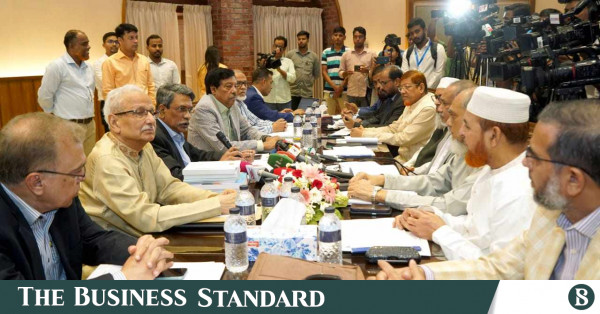
The second phase of talks between Jamaat-e-Islami Bangladesh and the National Consensus Commission began on 18 May 2025 at 11am in the LED Hall of the National Parliament,. Photo: Collected
“>

The second phase of talks between Jamaat-e-Islami Bangladesh and the National Consensus Commission began on 18 May 2025 at 11am in the LED Hall of the National Parliament,. Photo: Collected
The Bangladesh Jamaat-e-Islami has demanded a nationwide referendum to finalise the proposed July Charter, arguing that such an important national document requires legal and popular legitimacy through public endorsement.
Following a dialogue with the National Consensus Commission today (18 May), Jamaat Nayeb-e-Ameer Syed Abdullah Mohammad Taher made the call during a media briefing held at the National Parliament.
“Today’s discussion focused on which issues we agree on, which remain unresolved, and which are critical enough to require legal grounding,” said Taher.

“On behalf of Jamaat, we clearly stated – we want a referendum,” he added.
He said Jamaat wants the referendum to include the July Charter or the National Charter, along with other significant national matters.
He argued that a referendum is the most representative way to capture the views of ordinary citizens. “People must decide. It will give the charter a legal foundation and meaningful impact.”
During the briefing, Taher also raised concerns about the Election Commission’s accountability. Referring to past election failures, he noted that the existing legal framework offers little recourse against electoral misconduct.
“For the last 15 years and even earlier, election commissioners failed to ensure fair elections,” he said.
He added, “One key reason is that the law provides minimal scope for punishing such failures. Currently, only the Supreme Judicial Council can act during their tenure. We proposed amending the law so commissioners remain accountable even after retirement.”
Addressing corruption, Taher said Jamaat proposed forming a watchdog taskforce over the Anti-Corruption Commission (ACC).
“There’s a perception that the ACC itself has become compromised. To regain public trust, we suggested a taskforce that would monitor the commission’s activities and recommend action against any internal corruption,” he said, adding that commission members supported the proposal in principle.
Jamaat also placed strong emphasis on decentralising executive power. Taher reiterated the party’s stance that no individual should hold the positions of both prime minister and party chief simultaneously.
“There are global examples supporting such separation of powers,” he said. “We also believe that no individual should serve as prime minister for more than 10 years in total.”
On the proposed National Constitutional Council, Taher said Jamaat supports the idea in principle, but offered amendments to its structure.
“The proposed format included the chief justice and the head of state as council members. We objected to this. In times of national crisis, people should be able to turn to them for resolution. They must remain above political structures,” he said.
Addressing the upcoming national election, Taher expressed concern over its fairness.
“A completely fair and proper election is not yet in sight. We are seeing various problems… The election date has not even been announced, but already there is competition for occupying areas. Many are analysing that these events are part of a conspiracy to destabilise the country.”
He noted the absence of a clear election timeline is contributing to uncertainty. Taher called for a final decision that considers all factors crucial for political stability.