
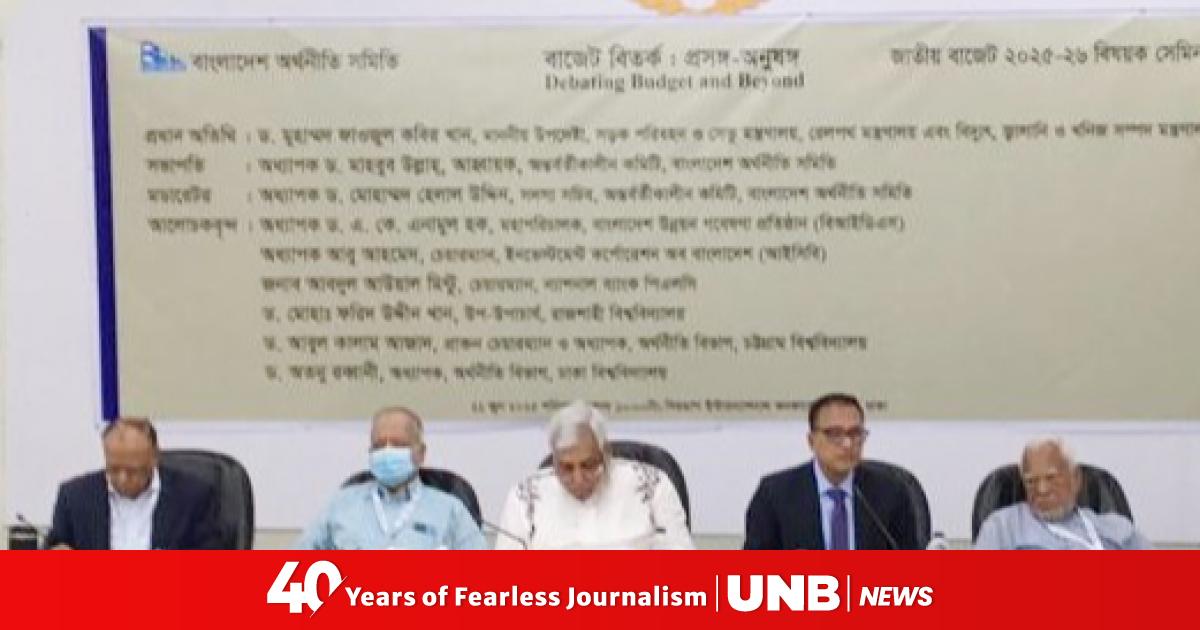
Emphasising the need for good governance, Energy Adviser Muhammad Fouzul Kabir Khan said on Saturday that neither politicians nor bureaucrats in Bangladesh are truly committed to eradicating corruption.
He made the remarks while speaking at a seminar on budget policy debate organised by the Bangladesh Economic Association (BEA) at CIRDAP Auditorium in Dhaka.
The seminar, presided over by BEA Convener Mahbub Ullah, brought together leading economists for an in-depth discussion on the national budget.
The Adviser highlighted the widespread wastage of resources, stressing the interim government’s commitment to preventing such occurrences in the future. “Waste, corruption and inefficiency are major obstacles to Bangladesh’s economic progress.”
Fouzul Kabir cited examples, such as the construction of a power plant six kilometres from its water source solely for the convenience of a minister, unnecessary road development and the mismanagement of state funds.
Regarding the interim government’s mandate, Fouzul Kabir emphasised their aim to set a positive precedent for the future. “We want to leave behind an example where we do not appoint relatives or grant business favours,” he said, underscoring a commitment to good governance.
Focusing on the power sector, he noted the growing reliance on imported LNG due to declining domestic gas reserves, which requires significant government subsidies.
To address this, he said, an initiative has been launched to install solar panels on all government buildings, with the electricity generated intended for the national grid.
He also pointed out the potential for the private sector to contribute at least 2,000MW of electricity by installing solar panels on rooftops.
Budget utilisation in social protection sees steady growth: Report
The seminar featured presentations on nine key budget issues by renowned experts. Sajjad Zahir, Executive Director of the Economic Research Group, underscored the importance of short and medium-term sustainable development, advocating for greater transparency in the government’s domestic and foreign borrowing to address the budget deficit.
Md Gulzar Nabi, Research Director at Bangladesh Bank, expressed strong optimism for the medium and long-term stability of the country’s macroeconomy, citing Bangladesh’s current GDP of $467 billion.
He highlighted self-sufficiency in food production, strong remittance inflows, and the significant contribution of the ready-made garment sector as key drivers.
Professor Saima Haque Bidisha, Pro-Vice-Chancellor and Professor of Economics at Dhaka University, said contractionary monetary and fiscal policies in certain budget sectors could hamper the creation of new jobs.
She also raised concerns about persistently high inflation and its potential to obstruct youth employment in the private sector.
Addressing the health sector, Professor Shafiun Nahin Shimul of Dhaka University’s Institute of Health Economics drew on examples from Thailand, Sri Lanka, and the Philippines, urging a shift in perception from health budget as merely sectoral expenditure to a smart investment in human resource development.
He described the allocated 1.7 percent of GDP for health in the proposed budget as inadequate.
Chittagong Port should be run with domestic resources: GOC
On the education front, Zulfiqar Ali, Research Director at BIDS, emphasised the need for increased investment in science, technology, and technical education to bridge the existing gap between the education and employment sectors.
Referring to India, Nepal and Malaysia, he noted with concern the declining trend in education budget allocations in Bangladesh and called for more funds for teachers and educational resources.
He also expressed disappointment at the government’s ‘failure’ to establish an education commission.
Dr Munshi Sulaiman, Research Director at the BRAC Institute of Governance and Development (BIGD), criticised the insufficient allocation for the social safety net in the budget, particularly in relation to poverty alleviation and income inequality.
He proposed implementing productive social safety net programmes supported by modern technologies.
Professor Sharmind Nilormi of Jahangirnagar University’s Economics Department pointed out a reduction in budget allocation for women’s safety, workplaces and access to government services, suggesting that even a token allocation would have been appropriate.
Kazi Iqbal, Research Director of the Industrial Division at BIDS, criticised the national industrial policy for failing to reflect global trends of deglobalisation and the growing inclination of global economic powers towards domestic industrialisation.
He argued that tariff reduction without specific targets and long-term strategies for export-oriented industries would be ineffective.
Professor Rashed Al Mahmud Titumir of Dhaka University’s Department of Development Studies characterised the national budget as a product of political struggle and advocated for the re-establishment of public ownership over public funds.
Abdul Awal Mintoo, Chairman of National Bank PLC, highlighted the destructive subculture of vested interests capturing and exploiting constitutional, social, and economic institutions.
He stressed the political nature of the budget and warned that investment growth would be unachievable without meeting key preconditions, particularly in light of the tightened monetary policy.
Leading researchers, economists and policy analysts attended the event.