
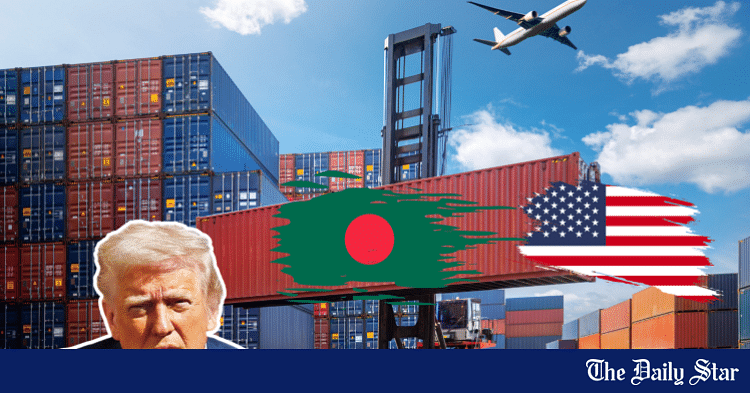
Govt pins hopes on trade negotiations with the Trump administration later this week
A new 35 percent tariff imposed by the Trump administration, set to take effect next month, poses the most formidable challenge in years to Bangladesh’s export-driven economy. Now, the government is scrambling to cushion the impact through urgent, high-stakes negotiations with the US, seeking to protect the nation’s global competitiveness.
The tariff, a slight reduction from an earlier 37 percent rate but still punishingly high, places Bangladesh at an immediate disadvantage against regional competitors in the garment trade.
 For all latest news, follow The Daily Star’s Google News channel.
 Most notably, Vietnam, a primary rival, recently secured a far more favourable 20 percent tariff rate from Washington. This 15-percentage-point gap creates a severe pricing disparity that Bangladeshi exporters will find difficult to absorb.
Amid deliberate unpredictability from Washington, President Donald Trump on Monday extended his deadline to seal country-by-country trade agreements, this time until August 1. The announcement came as a threat in letters sent to 14 world leaders, including Bangladesh’s. Trump declared that their exports would be subject to levies ranging from 25 percent to 40 percent.
“Tariffs will start being paid on August 1, 2025. There has been no change to this date, and there will be no change.”
Addressing Chief Adviser Muhammad Yunus, Trump wrote: “If for any reason you decide to raise your Tariffs, then, whatever the number you choose to raise them by, will be added onto the 35% that we charge.”
About the new deadline, Trump wrote on his Truth Social platform yesterday, “TARIFFS WILL START BEING PAID ON AUGUST 1, 2025. There has been no change to this date, and there will be no change.
“In other words, all money will be due and payable starting AUGUST 1, 2025 – No extensions will be granted.”
A PERFECT STORM
This tariff shock will compound a series of pre-existing vulnerabilities that have already placed the garment industry under immense pressure. According to a recent Bloomberg Economics forecast, Bangladesh’s apparel exports are set for a hit this year from three directions simultaneously: a separate and ongoing trade tussle with neighbouring India, domestic energy shortages that have hampered production, and now, the crushing new US tariffs.
The cumulative effect of these headwinds could be staggering. Bloomberg Economics estimates the damage to garment exports could reach $2 billion in 2025 alone. This is a significant blow for an industry that constitutes the backbone of the national economy, accounting for 81 percent of total exports.
In response to the new tariff, Dhaka is mounting a diplomatic push. Commerce Secretary Mahbubur Rahman, who departed for Washington, DC, to join the negotiating team for meetings on July 10-11, expressed hope that the tariff could be significantly reduced. Rahman will join Commerce Adviser Sk Bashir Uddin and National Security Adviser Khalilur Rahman in Washington, DC.
The core of Bangladesh’s argument rests on the possibility of a preferential rate for least developed countries (LDCs). “I’m hopeful that Bangladesh’s tariff will be a 10 percent baseline as the Trump administration has been working to fix a separate tariff line for the LDCs,” the commerce secretary said.
If that broad LDC benefit doesn’t materialise, he believes, Bangladesh’s rate should still be “much lower” than the 20 percent imposed on the more developed Vietnam.
To sweeten the deal, Bangladesh has put several concessions on the table. Bangladesh offered to boost duty-free imports of American goods, including wheat, cotton, LNG, and soybeans, to help narrow the more than $6 billion trade gap between the two nations. And Washington asked Dhaka to buy US-made equipment, mainly used by law enforcement agencies, according to Rahman.
In Dhaka, Finance Adviser Salehuddin Ahmed said the tariff may be reduced if direct, one-to-one negotiations with the US are successful.
UNCERTAIN FUTURE
Despite the government’s efforts, experts caution that the outcome is shrouded in uncertainty. The impact of the 35 percent tariff is not a simple calculation but depends on a complex web of trade actions by the US against other global players.
“It is difficult to exactly say what will be the impact,” said Mohammad Abdur Razzaque, chairman of the Dhaka-based think tank RAPID. President Trump has not yet announced the final tariff rates for China and India, two titans of the global garment supply chain. “If the Chinese market shrinks due to the tariff measures, Bangladesh may benefit,” he added, suggesting that a crackdown on China could divert orders toward Bangladesh.
Mostafa Abid Khan, a former member of the Bangladesh Trade and Tariff Commission, agreed that the country faces a “challenging time” but stressed that the outcome depends on the corresponding tariffs levied on China, India and Pakistan.
This view was echoed by Fazlee Shamim Ehsan, executive president of the Bangladesh Knitwear Manufacturers and Exporters Association. “If the high tariff is imposed on China and India, the export of garments from Bangladesh to the US will increase significantly,” he predicted.
Mahmud Hasan Khan, president of the Bangladesh Garment Manufacturers and Exporters Association, warned of a “negative impact” on the 20 percent of the country’s apparel trade destined for the US.
He described a two-tiered crisis. At the national level, overall exports will decline. But at the micro-level, the damage will be acute. “The factories which export nearly 90 percent to the US will be hit hard,” he said, adding that many small and medium enterprises will face immense trouble.
Furthermore, Khan warned of dangerous ripple effects. If exporters are forced to divert their focus away from the US and toward other markets, such as the European Union, it will create a glut of suppliers. “There will be many players in the same markets and there will be an unfair price competition,” he said. “The buyers will take the chance of a price cut.”
Some top exporters argue the 35 percent figure is a negotiating tactic rather than a final decree. AK Azad, chairman of Ha-Meem Group, a major exporter to the US, believes the rate is simply too high to be sustainable. “The 35 percent tariff rate will not be finally executed,” he said, viewing the proposal as a “chip of negotiation” and expressing hope that the Trump administration will review the rate.
Uncertainty has left many in limbo. Ramzul Seraj, managing director of Elite Garments Ltd, which ships nearly 65 percent of its products to the US, said his buyers have yet to respond to the news. He acknowledged that exports will “face challenges” if the new rate is finalised, but also pointed to potential silver linings.
“If the tariff is fixed at 55 percent on China, Bangladesh may benefit,” he said, adding that Vietnam, despite its lower tariff, cannot absorb a large volume of new orders.
“Bangladesh has a lot of production capacity, which is a plus point for this country,” he said.