

After the Awami League government fell in August 2024, a new era began in Bangladesh’s politics. Following the government’s collapse, which happened due to widespread public involvement in the anti-discrimination student movement, many political parties tried to take credit. It was as if they were the ones who pulled down the 15-year-old established government from its strong position. So, the question remains- where were those parties and their supporters all this time? Why did their leaders and workers change colors and merge under the shelter of the former powerful regime? Why didn’t they protest for the government’s downfall earlier?
After the Awami League government fell on August 5th, an interim government was quickly formed, with Nobel laureate Dr. Muhammad Yunus as its Chief Advisor. Six months later, on February 28, 2025, a new political party called the National Citizen Party (NCP) was launched, formed by members of the anti-discrimination student movement and the National Citizen Committee.
Since its launch, the party hasn’t shown much political activity. Instead, there have been accusations of various wrongdoings and corruption against its top leaders. One of the party’s joint member secretaries was even removed due to financial corruption.
However, very recently, the party’s central leaders have started a countrywide march. They’ve already held public meetings in different districts. They are visiting the homes of July warriors and July martyrs, checking on their families. They are also making various promises to recruit members and gain wider acceptance.
While carrying out this program, on July 16th, the party faced strong opposition in Gopalganj district, a known stronghold of the Awami League. In Gopalganj, the birthplace of Sheikh Mujibur Rahman, Awami League members and their associated organizations set fire to a police vehicle before the NCP meeting started, attacked and then burned the Upazila Nirbahi Officer’s (UNO) car in Sadar Upazila. Just before the NCP meeting began, they vandalized the meeting place and detonated crude bombs.
Following this incident, there were repeated clashes between law enforcement and the attackers across the entire district. Meanwhile, the NCP’s central leaders finished a short meeting and were leaving when Awami League supporters attacked their car procession. Later, joint forces joined the police to bring the situation under control.
Since Sheikh Hasina’s fall and flight, Gopalganj has seen attacks on the army, the killing of a central leader of the Volunteer Party, and assaults on police stations and officers. It’s a reasonable public belief that Awami League leaders, activists, and criminals who couldn’t escape to India have taken refuge in Gopalganj. People expected the government to take effective steps to bring these criminals to justice while ensuring human rights.
However, the government hasn’t taken significant action. Since effective measures weren’t taken to improve the situation in Gopalganj, the government should have known what kind of situation could arise during the NCP’s program in that district.
A terrible situation unfolded in Gopalganj centering on the NCP’s program. Couldn’t the government have known about such a potential situation in advance through intelligence agencies? If not, this is an unimaginable failure that could jeopardize our nation’s internal security. And if, even after knowing, the NCP wasn’t stopped from touring this district for now, the question arises- why did the government knowingly allow this situation to happen? The question also came up- why did the NCP, which aimed for a nationwide ‘padyatra’ (march), go for a ‘march’ in Gopalganj?
Anyway, in that day’s clash, five people were killed by gunfire and over a hundred were injured. With the help of the army, the NCP leaders were rescued from the violence that day. Although they failed in Gopalganj, the very next day, a massive surge of public support was seen for the NCP’s ‘padyatra’ programs in Faridpur and Manikganj districts. However, on July 19th, the party’s leaders again faced resistance in Cox’s Bazar district. Despite these obstacles, the party has announced that it will continue this ‘padyatra’ program throughout July.
However, whether the party can achieve a single majority through these programs remains to be seen. It’s doubtful whether the NCP can gain widespread public support across the country by the election deadline announced by the Chief Advisor, which is April or June 2026.
Because after August 5th, Jamaat-e-Islami, a political party once banned in Bangladesh, is now actively working at the grassroots level. This party, marked as a war criminal in 1971, was never openly active in politics on its own. Although they were once active in politics allied with another large Bangladeshi political party, the Bangladesh Nationalist Party (BNP).
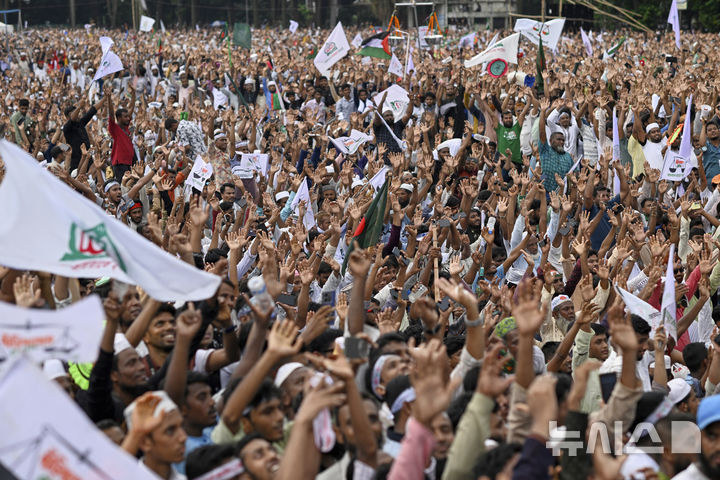
However, this time they are moving forward independently. Besides working at the grassroots, the party has invigorated its leaders and activists. While their strength at the field level wasn’t visible before, they have been quite well-organized internally. Their grand rally on July 19th at the historic Racecourse Maidan proves this. Several lakh people gathered at this rally.
In the rally called to achieve their seven demands, Jamaat’s Ameer Dr. Shafiqur Rahman stated, “Everything old must be reformed. If we try to do anything without reform, it will be the same as before. The constitution must be rewritten. The July genocide must be brought to justice.”
Jamaat-e-Islami held this national rally with seven demands, including ensuring a level playing field for a free, fair, neutral, and peaceful national parliamentary election. The demands are –
Justice for all genocides committed on August 5, 2024, and at other times; Essential fundamental reforms at all levels of the state; Full implementation of the historic July Charter and Declaration; Rehabilitation for the families of those martyred and injured in the July uprising; Organizing national elections using the PR (Proportional Representation) method to truly reflect public opinion; Taking specific measures to ensure the voting rights of expatriates (Bangladeshis living abroad) and Ensuring equal opportunities and a ‘level playing field’ for all political parties and candidates.
At one point in his speech, the Amir of Jamaat said, “There was a fight against fascism, and there will be another fight against corruption. The first proof that Jamaat will build a corruption-free society is…” He fell ill on stage before finishing his sentence. However, he later got up and started speaking again. After a short while, he lost consciousness and fell again. Subsequently, he finished his speech while sitting on the stage.
Leaders from the National Citizen Party (NCP), Islami Andolan, Gono Odhikar Parishad and some other parties accepted the invitation and attended the rally. Only those parties that largely agreed with Jamaat’s various demands, including the proportional representation (PR) election system, were invited. However, their long-time ally BNP was not invited to the rally. Neither were AB Party nor the left-wing political parties. So, has a new wind really started blowing in Bangladesh’s politics?
Maulana Ataur Rahman Gazi, Joint Secretary General of Islami Andolan Bangladesh, who attended the rally as an invited guest, said, “We, who were from different parties there, all supported the seven-point demands. We also believe that if elections are held without fundamental reforms, no change will come.”
He added, “Through this rally, the polarization in future politics has become clearer. This started right after August 5th, and now it is gradually increasing. In essence, those of us who prioritize fundamental reforms, want a level playing field and desire a new political arrangement, have united. Besides Islamic parties, there are youth parties like NCP here. Some political parties want to get into power by holding an election without fundamental reforms, no matter what. They are not with us. They were not seen at our rally either.”
This hint is actually directed at Bangladesh’s largest and oldest political party, the BNP. This is because after August 5th, BNP activists started thinking of themselves as the next government. They want a quick election. In the meantime, they have become involved in various crimes including extortion, murder, and rape. Other political parties believe that due to their aggressive attitude, they are losing public support.
Yet, when the party’s acting chairman, Tarque Rahman, met with Chief Advisor Dr. Muhammad Yunus in London on June 13th, people thought the party might support the changed system, meaning the reforms being talked about.
In reality, the party’s main focus appears to be on a quick election rather than reforms. They are pressuring the interim government to hold elections without reforms. However, Jamaat-e-Islami Bangladesh and NCP are holding a strong position, demanding no elections without reforms.
Political analyst Dr. Zahed Ur Rahman says, “All parties want reform. But when it comes to a level playing field, law and order, election environment, and PR method elections, Jamaat and NCP are speaking in unison.”
He explains, “Jamaat has always wanted to form a united opposition, with Islamic parties as the main force. So, they are pulling closer to the Qawmi Madrasa-based parties with whom they previously had disagreements. Besides this, they want to bring in other parties like NCP. And through the rally, Jamaat announced its position.”

However, Jamaat-e-Islami faces accusations of opposing Bangladesh’s Liberation War in 1971 and collaborating with the Pakistani army’s genocide against Bangladeshis. Before being overthrown in the 2024 public uprising, Sheikh Hasina’s Awami League government, through the International Crimes Tribunal of Bangladesh, convicted several top leaders of Jamaat, including its then-Amir Ghulam Azam, for crimes against humanity. Some were even executed.
Senior journalist and political analyst Masud Kamal, in an interview with Deutsche Welle stated, “Jamaat has never acknowledged responsibility for its role in ’71. We evaluate Jamaat differently. We say Jamaat was an accomplice to the Pakistani government. Jamaat, Razakar – they were accomplices in the Pakistani government’s injustices. But that’s not actually the case. They weren’t just accomplices to injustice; they committed injustices themselves. They were part of the East Pakistan government at that time. Four ministers in the East Pakistan government were from Jamaat- the Industry Minister, Commerce Minister, Education Minister. They were all from Jamaat. They were part of the government. Jamaat must bear responsibility for all the injustices committed by the East Pakistan government at that time.”
Due to his stance that “Jamaat should apologize for its role in ’71,” Muzibur Rahman Monju, former president of Islami Chhatra Shibir (Jamaat-e-Islami’s student wing), was expelled from Jamaat in 2019. The following year, he formed the ‘Amar Bangladesh Party’ or ‘AB Party’. Several leaders and activists from Jamaat-e-Islami and its student organization Islami Chhatra Shibir joined the AB Party.
Although the AB Party now supports the ‘PR’ method of election, the party was not invited to Jamaat’s rally. Its chairman, Muzibur Rahman Bhuiyan Monju, said, “We also want PR method elections. But for some reason, we were probably not invited.”
So, what exactly is the PR method in elections? Often, in traditional voting systems, a party might win most seats with limited votes, while a party with more overall votes gets no seats. As a way to overcome such disparity, many countries worldwide have adopted the Proportional Representation (PR) or proportional representation-based electoral system.
In this method, political parties or alliances get seats in parliament in proportion to the votes they receive. This creates a balanced and fair representative parliament. This electoral system is a method where voters’ decisions are reflected according to the percentage of votes political parties get.
Many countries, including Bangladesh, currently use the ‘First Past the Post’ (FPTP) system. In this method, the party that wins the most seats forms the government, not the total percentage of votes. Currently, among 170 democratic countries worldwide, 91 hold PR-based elections.
The Bangladesh Nationalist Party (BNP) wants to go to elections using the country’s current ‘First Past the Post’ method. They do not prefer the PR method. This has created a difference of opinion with their former alliance partner, Jamaat. Jamaat did not even invite the BNP, their electoral ally for 24 years, to their grand rally.
Regarding this method, Salahuddin Ahmed, a member of the BNP’s standing committee, said at a rally on July 18, “Those who want PR method elections and local elections have dishonest intentions. Those who want to delay the election through confusion want local and PR method elections. What is the PR method? No one understands.”
It’s notable that while the BNP has announced its intention to resist PR method elections, one of the main demands of Jamaat’s rally was for the next parliamentary election to be held under the PR method.
Analysts say that through this rally, Jamaat demonstrated its political strength for forming a new alliance. Their entire speech was essentially an election speech. However, a part of this speech repeatedly highlighted the contributions of the martyrs of the public uprising, which is a natural thing to mention.
After the 1980s, this is the first time Jamaat has held such a large rally and managed to gather such a massive crowd. According to analysts, this sends a big message in politics. They say Jamaat has been able to show its political strength and support base here. Jamaat is also hinting at forming a new front or alliance with other parties.
In contrast to this changing political tide, it’s still unclear whether the BNP will contest the upcoming election alone or with allies. However, the BNP currently does not want to hold any rally in Dhaka as a counter to Jamaat-e-Islami’s rally. The party believes that a counter-program would only highlight its own weaknesses and increase the opponent’s importance. Therefore, there’s no need for a counter-rally.
As their reasoning, they believe there’s nothing new to prove about the BNP’s political and organizational capability. The BNP is Bangladesh’s largest and most popular political party. In past movements to restore democracy, the party has played a role at every turn and continues to do so. Whenever a program is needed on the path to bringing democracy to the country, the BNP has provided it and will continue to do so in the future.
According to party sources, the BNP is currently busy with programs commemorating the anniversary of the public uprising. As the final event of the party’s 36-day program remembering July-August, the largest victory procession will be held in Dhaka on August 6th. While party preparations haven’t fully begun, the BNP plans to turn this program into a grand rally. The party aims to gather the largest crowd in Dhaka’s history for the victory procession, which will far surpass the recent rallies of Jamaat-e-Islami and Islami Andolan Bangladesh.
Through this, the BNP will also aim to indirectly put pressure on the interim government for the national election promised for February. This is because, with no specific dates announced, the party still fears a conspiracy to prolong or even derail the election.
Essentially, Jamaat-e-Islami’s return to politics after more than a decade of suppression under the Hasina government has complicated the country’s current political situation. This party, burdened by its past stance against independence, has returned to active politics, intensifying divisions in the electoral field. Let’s see where this new political wind takes Bangladesh.