Close Menu
  • Home
  • Editorial
  • Politics
  • Economic
  • Sports
  • Religion
  • Contact us
  • About Us
Donate
Hand picked for you
  • Bangladesh’s political reset and the regional ripple effect
  • Jamaat chief flays Bangladesh president for interview, exposing political fault line again
  • Six seats, big goals: What’s next for Bangladesh’s student-led NCP party? | Bangladesh Election 2026 News
  • Is Bangladesh ready for environmental democracy?
  • Economic recovery still fragile: MCCI

Subscribe to Updates

Get the latest news from raznitee.

Reach out to us
  • Facebook
  • Twitter
  • Pinterest
  • Instagram
  • YouTube
  • WhatsApp
Facebook X (Twitter) Instagram
raznitee
Contact us
  • Home
  • Editorial
  • Politics
  • Economic
  • Sports
  • Religion
  • Contact us
  • About Us
raznitee
Facebook X (Twitter) Instagram
Contact us
Home»Economic»‘Unlike India and Pakistan, Bangladesh’s growth in the 1980s-90s came from the grassroots’
Economic

‘Unlike India and Pakistan, Bangladesh’s growth in the 1980s-90s came from the grassroots’

August 29, 2025No Comments3 Mins Read
Facebook Twitter Pinterest LinkedIn Tumblr Email
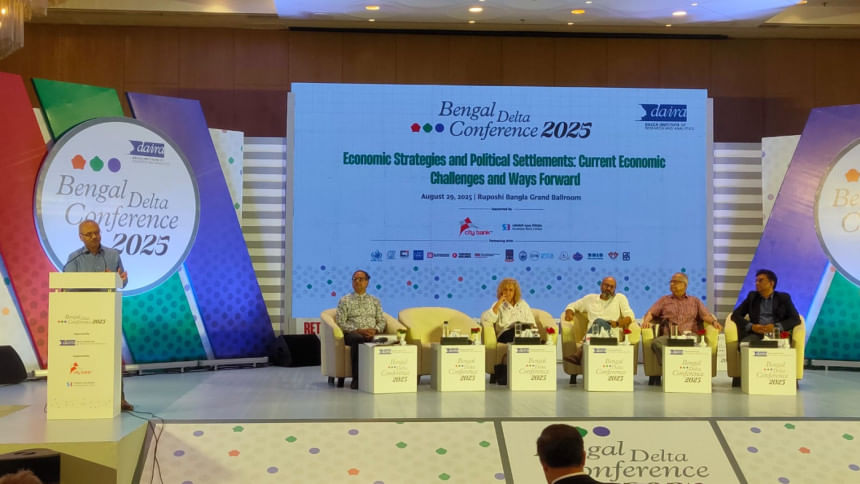
Whatsapp Image 2025 08 29 At 8.10.25 Pm.jpeg
Share
Facebook Twitter LinkedIn Pinterest Email

Fri Aug 29, 2025 08:08 PM
Last update on: Fri Aug 29, 2025 08:13 PM

SOAS professor says oligarchs fuel growth but fail to create jobs



Star Business Report

Fri Aug 29, 2025 08:08 PM Last update on: Fri Aug 29, 2025 08:13 PM

Photo:Collected

“>


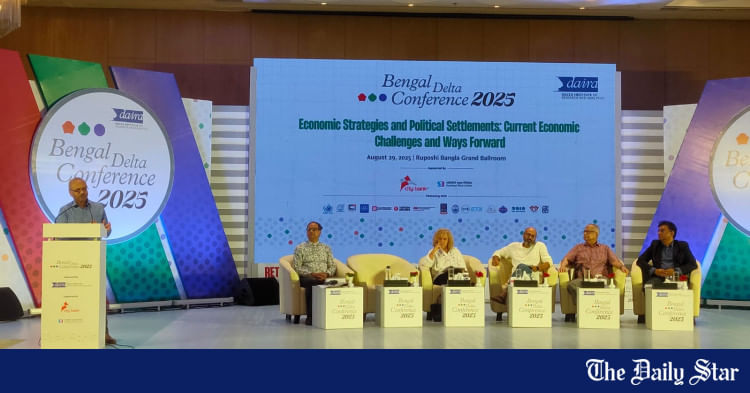
Photo:Collected

Bangladesh’s economic strategy must be freed from the grips of a few oligarchs, bureaucrats, and a narrow capitalist elite to achieve broad-based growth and job creation, Mushtaq Khan, professor of economics at SOAS University of London, said today.

“When power is concentrated in the hands of oligarchs, bureaucrats, and a narrow capitalist elite, economic growth may occur, but it fails to create jobs to some extent,” he said.

Google News LinkFor all latest news, follow The Daily Star’s Google News channel.

Prof Khan made the remarks while delivering the keynote at the two-day international event, “Bengal Delta Conference 2025: Bangladesh at the Crossroads,” being held at the InterContinental Dhaka.

The conference has been organised by the newly-formed think tank, Dacca Institute of Research and Analytics (DAIRA).

The economist said the political settlement shifted again from the middle class to the elite-dominated class during the period of the Awami League government, from 2009 onwards.

Khan said, during the time, there was a “growth for the oligarchs through theft and capture”.

Infrastructure and roads were built at two or three times the cost, power plants at 50 percent higher prices than competitors, “all hidden behind unsustainable subsidies, bank looting, and corruption,” he added.

Khan, however, said Bangladesh’s early success in manufacturing and job creation after independence was rooted in a broad-based capitalist class. Unlike India or Pakistan, where narrow elites controlled industry, Bangladesh in the 1980s and 1990s saw entrepreneurs rising from the grassroots.

“Thousands of garment factories, small industries, and medium enterprises emerged. At that time, Bangladesh was creating more jobs per unit of growth than India,” he noted.

At the event, Prof Selim Raihan, executive director of the South Asian Network on Economic Modeling, said that over the last 15 years, business groups realised that influencing bureaucrats or politicians was not enough — they sought power by becoming MPs themselves.

“This trend reinforced the deals-based system, making it more entrenched and more extractive,” he said.

Bangladesh’s political legitimacy eroded after three flawed elections, prompting the then ruling party to rely on development legitimacy through big infrastructure projects, Selim said.

“Initially, these projects created an image of progress, but because they were based on closed and disordered deals, many of them were delayed, poorly executed, or failed to deliver,” he said.

“Even today, we are struggling with the consequences of those choices in mega projects,” Selim added.

Share. Facebook Twitter Pinterest LinkedIn Tumblr Email

Related Posts

Economic recovery still fragile: MCCI

February 23, 2026

Ambitious Growth Targets Mask Deep Economic Risks

February 23, 2026

Government’s Plan to Seek at Least 3-Year LDC Deferment | How logical is LDC graduation deferment?

February 22, 2026

Bangladesh US Trade Deal | A costly trade gamble

February 22, 2026
Add A Comment
Leave A Reply Cancel Reply

Subscribe to Updates

Get the latest news from raznitee.

We are social
  • Facebook
  • Twitter
  • Pinterest
  • Instagram
  • YouTube
  • WhatsApp
Latest Posts

Bangladesh’s political reset and the regional ripple effect

February 27, 2026

Jamaat chief flays Bangladesh president for interview, exposing political fault line again

February 27, 2026

Six seats, big goals: What’s next for Bangladesh’s student-led NCP party? | Bangladesh Election 2026 News

February 27, 2026
Follow us on social media
  • Facebook
  • Twitter
  • Pinterest
  • Instagram
  • YouTube
  • WhatsApp
Categories
  • Corruption (409)
  • Culture & Society (114)
  • Economic (1,904)
  • Environment (1,314)
  • Foreign Relations (359)
  • Health & Education (70)
  • Human Rights (5)
  • Politics (2,176)
  • Uncategorized (2)
Facebook X (Twitter) Instagram Pinterest Vimeo YouTube
  • About Us
  • Contact us
  • Disclaimer
  • Privacy policy
© 2026 Designed by raznitee.com

Type above and press Enter to search. Press Esc to cancel.