
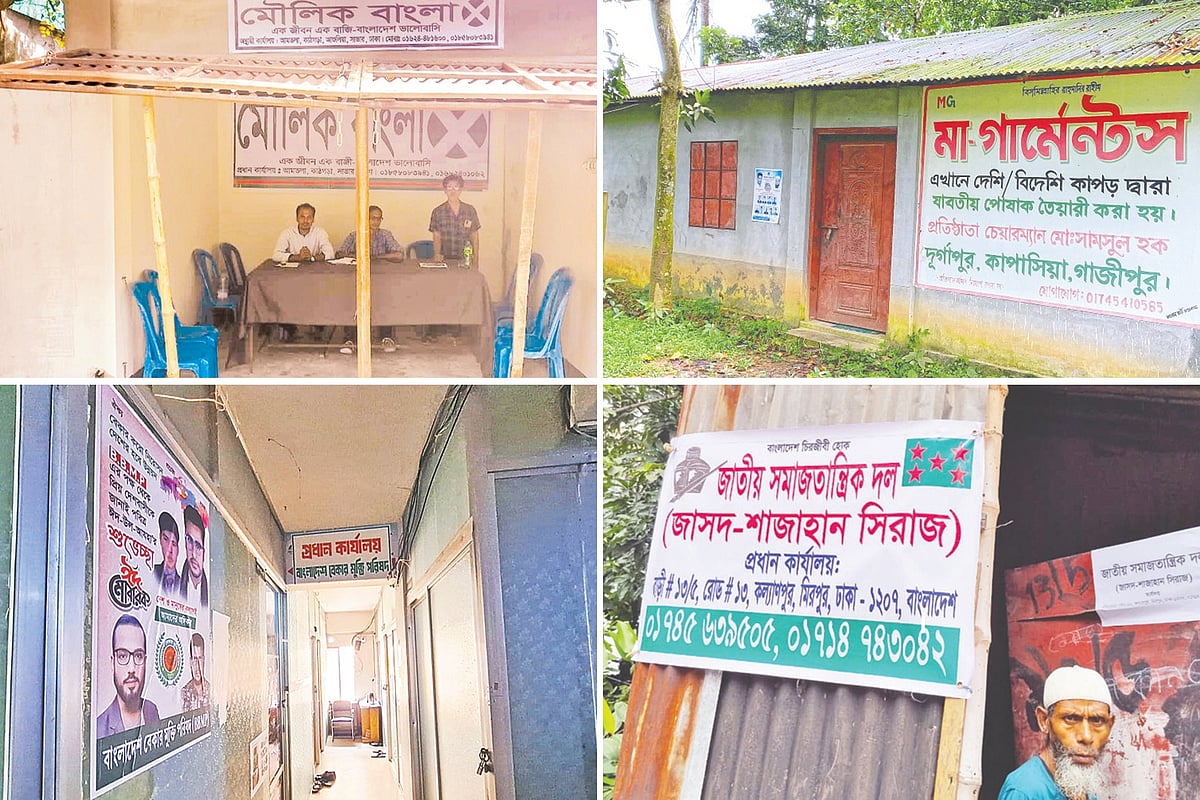
At the end of a narrow alley stand several small, old, rusted tin-shed houses. Each is a single-room unit. These modest dwellings—locally known as chapras—are rented by low-income workers to support their families. However, one of these rooms is different: it now serves as the central office of the Jatiya Samajtantrik Dal (JASAD-Shajahan Siraj), one of the 22 political parties deemed eligible in the election commission’s preliminary scrutiny for registration.
This party operates its political activities from that tin shed on Road No. 13 in Kallyanpur, Dhaka. Another party considered eligible for registration, the Bangladesh Solution Party, has listed its central office as a small, now-closed clothing factory in a village in Kapasia, Gazipur. Meanwhile, the Bangladesh Bekar Samaj (BABES) listed an address as their central office which, in reality, is the residence of the party president’s son.
From 23 to 25 August, Prothom Alo conducted on-the-ground verification of the 22 parties that were deemed eligible by the election commission. The newspaper visited each address listed as the central office in their registration applications. Of the 22 parties, 19 have their central offices in Dhaka, while the other three are based in Savar, Keraniganj, and Kapasia (Gazipur). The investigation involved three staff correspondents and two correspondents from Prothom Alo, who inspected the offices, interviewed party leaders, and gathered relevant data.
Of the listed addresses, 4 central offices are located in residential buildings or private homes. These belong to the Bangladesh Bekar Samaj (BABES), Bangladesh Justice and Development Party, Jatiya Samajtantrik Dal (JASAD-Shajahan Siraj), and Janatar Dal.
Two parties could not be traced at the addresses they provided. For instance, the Notun Bangladesh Party listed an address in Malibagh Chowdhurypara, but no one in the building was aware of such a party. When Prothom Alo contacted the party’s chairman, retired Major Sikdar Anisur Rahman, he explained that the office had been rented through a party worker without informing the building owner that it would be used for political purposes. When the landlord objected, the office was shifted to a building near the ECB Square. He claimed the election commission was informed of the change via letter.
On the other hand, Bangladesh Jatiya League listed its central office as being located in “Tanpara Ati, Keraniganj.” However, a field visit to various nearby areas of Ati—such as Daripara, Badshar Mor, Panchdona, and Tebargram—found no trace of any place called “Tanpara Ati.” Multiple locals stated they had never heard of such a location.
On 23 August, Prothom Alo contacted Mahbubul Alam, chairman of the Bangladesh Jatiya League, by phone regarding the issue. At the time, he stated that the party office was located somewhere around the Ghatarchar area of Keraniganj, but he could not provide a specific address. He then disconnected the call.
Later, on the night of 28 August, Prothom Alo again reached Mahbubul Alam by phone. This time, he said the party’s central office had been relocated to Mazar Road in Mirpur, Dhaka, and claimed that the election commission (EC) had already visited and inspected the office.
Among the 22 parties deemed initially eligible for registration, 12 have their central offices in commercial buildings. These parties are: Forward Party, Amjonotar Dal, Bangladesh Sangskarbadi Party (BRP), Bangladesh Nezami Islam Party, Bangladesh Samajtantrik Dal (Marxist), Janata Party Bangladesh, Bangladesh Aam Janagon Party, National Citizen Party (NCP), Bhasani Janashakti Party, Bangladesh Bekar Mukti Parishad, Bangladesh Communist Party (Marxist) – CPB(M), Jamiat Ulema-e-Islam and Nezami Islam Party
Among the remaining 4 parties, the Moulik Bangla Dal provided an address in Savar. Upon visiting the location, it was found to be a semi-concrete single room from which the party is operating. Nearby is a house, a rickshaw garage, and a grocery shop.