

Climate change widens production uncertainties. Analyst projections place potential yield loss at 14 percent for rice and 76 percent for wheat by 2050. FILE PHOTO: STAR
“>
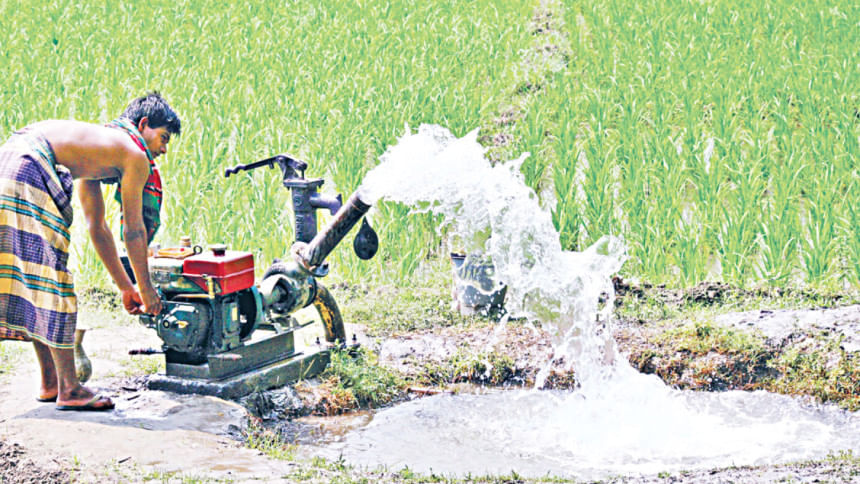
Climate change widens production uncertainties. Analyst projections place potential yield loss at 14 percent for rice and 76 percent for wheat by 2050. FILE PHOTO: STAR
Bangladesh’s agriculture sector, which employs 40 percent of the society and generates 11 percent of GDP, now stands at a crossroads. With growing global economic instability, climatic stresses piling up, and the nation poised to graduate to Least Developed Country (LDC) status in 2026, agricultural policy sustainability is under unprecedented pressure. Budget increases and high-profile global programmes demonstrate government resolve, but further analysis exposes structural deficits that continue to endanger food security and rural livelihoods against growing economic pressure.
FY2025-26 budget outlay has allocated Tk 39,620 crore (approximately $3.5 billion) to agriculture, food, fisheries, and livestock—a 3.6 percent year-over-year nominal increase over FY25. But that expansion is offset by rising input prices and inflation. Worse, sectoral contribution to the overall Annual Development Programme (ADP) has fallen from 5.0 percent in FY25 to 4.7 percent in FY26. The severe underfunding of areas essential for long-term productivity, such as research and mechanisation, directly contradicts the government’s stated strategic priorities. In the view of Naziba Ali of LightCastle Partners, such steps are “insufficient to drive transformative change.”
 For all latest news, follow The Daily Star’s Google News channel.
 Internal weakness includes industry vulnerability to volatile global and domestic fiscal pressures and ubiquitous markets. The US tariff policy imposing 20 percent additional duties worsens an already strained trade scenario. While garment exports bear the immediate brunt, secondary pressure lands on farm producers. Bangladesh imported $2.2 billion worth of US goods (including cotton and grains) against $8.4 billion export proceeds in 2024. Such a deficit forebodes coercion-indexed opening up of markets to subsidised US farm produce that can overrun non-price-competitive domestic producers. Locally, agriculture is also funded, as 46 percent budget deficit is covered by bank borrowings at the expense of crowding out funding of smallholders and liquidity-starved Agri-SMEs.
At the same time, climate change widens production uncertainties. Analyst projections place potential yield loss at 14 percent for rice and 76 percent for wheat by 2050, and prices for staple foods are being revealed to be extremely volatile, particularly for rice—the linchpin of food security. Despite increased production, Bangladesh is among 45 nations still requiring external food aid. Policy inconsistency and weak market watchfulness cannot insulate these shocks, making nutritional availability vulnerable.
Keeping these challenges in mind, various kinds of work are in motion. The most ambitious is the “Technical Support to Sustainable and Resilient Investment Towards Agriculture Sector Transformation Programme (AsTP)” with unprecedented tripartite support of $25 million involving the Government of Bangladesh, Food and Agriculture Organization (FAO), and the Gates Foundation, signed in July 2025.
Under this programme, evidence-based planning aims to leverage FAO’s Monitoring and Analysing Food and Agricultural Policies (MAFAP) programme to improve monitoring of public expenditure and policy alignment.
To relieve near-term pressures, steps are being taken to cut advance income tax (AIT) paid by raw commodities to agro-processors, slash withholding tax paid by major crops (paddy, wheat, potatoes, jute) from one to 0.5 percent, and exempt cold store plant and equipment from duties to minimise post-harvest losses.
However, there are still critical contradictions. Despite VAT exemption for LNG, the power and industry sector competes with the agriculture sector for limited gas. Restrictive supply directly jeopardises fertiliser production and prices, driving direct outputs from crops into already-high food inflation. Policy campaigns fail to consider the feasibility of lobbying for agro-processing zones. An 89 percent market share is achievable with affordable Indian/Chinese machinery; large, expensive US machinery has poor spare networks and is ill-suited to smallholder farms. Diminishing ADP investment overlaps with other successful high-return investment prospects—the seed industry target of 25 percent certified production by 2030, and 5.64 percent GDP per annum contributed by horticulture.
Bangladesh’s agricultural policies have shown predictions about upcoming storms, but are not strong and integrated enough to remain resilient. Budget allocations are weakened by inflation and minimised development expenditures. The AsTP model shows promising future horizons, leveraging on key international expertise, but is vulnerable in the face of tumultuous political transition and a weak banking sector.
Renewable energy targets (20 percent by 2030) must explicitly prioritise decentralised solar power for irrigation and cold chains, moving beyond fossil fuel dependence. In addition to production hikes, implementing real-time price monitoring and strategic stocks, along with import policies, can reduce fluctuations.
As Dr Marco V. Sánchez of FAO’s MAFAP programme asserts, transformative change requires not just spending more, but “optimizing this government spending, so that every taka is spent more effectively.” Whether policy will advance from fragmented response to holistic resilience will come into focus in the forthcoming years.
K.M. Arshad is an undergraduate student of the Department of Economics at the University of Dhaka.
Views expressed in this article are the author’s own.
Follow The Daily Star Opinion on Facebook for the latest opinions, commentaries and analyses by experts and professionals. To contribute your article or letter to The Daily Star Opinion, see our guidelines for submission.