
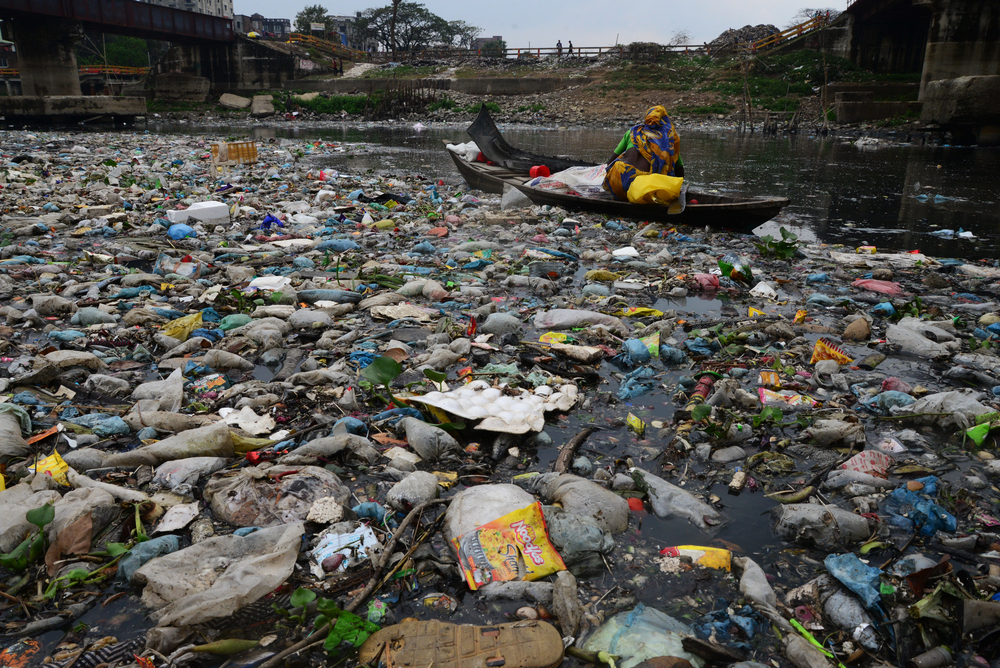
Plastic pollution is one of the most pressing environmental issues in Bangladesh, threatening ecosystems, public health, and urban hygiene. Experts agree that the crisis stems more from its irresponsible use and widespread mismanagement than from plastic production itself. Plastic’s low cost and convenience, combined with a lack of viable alternatives, have made it the default material across households and industries.
By Rizwana Akhter
Despite having over 5,000 plastic-producing industries, Bangladesh has fewer than 300 mostly informal recycling plants, leaving it ill-equipped to handle the 400 tons of daily plastic waste, including 646 tons from Dhaka alone. Of the estimated 87,000 tonnes of single-use plastic consumed annually, only 37% is recycled. Methane from open dumpsites worsens air quality, while 63% of plastic waste clogs drainage systems and contaminates rivers, forests, and coastal ecosystems. These cumulative impacts have caused Dhaka to frequently rank among the dirtiest cities in the world.
Addressing this crisis requires action across the entire plastic lifecycle—from production to disposal. A five-pronged strategy can help tackle root causes and enable sustainable, inclusive solutions.
- Reducing Plastic Production at the Source
The most effective way to reduce plastic waste is to limit its generation from the outset. One powerful intervention is the promotion of refill systems for everyday consumer goods. Products like shampoo, cooking oil, detergent, and cleaning agents don’t need new plastic containers every time.
By scaling up refillable packaging models, we can:
- Minimize demand for virgin plastic
- Shift both consumer and industry behaviors
- Reduce the volume of plastic entering the environment
- Promoting Biodegradable Alternatives
Biodegradable and compostable options such as jute-based packaging or maize-stalk extract bags must become more available, affordable, and mainstream. Investing in local innovation and the production of sustainable materials is key.
To scale these alternatives:
- Public-private partnerships and government incentives are needed
- Regulatory infrastructure (e.g., Bangladesh Standards and Testing Institution (BSTI) certification technology and systems) must be improved to standardize quality and safety
- Support for research and development can position Bangladesh as a global leader in sustainable packaging, building on our historical strengths in jute production.
- 3. Recycling and Upcycling: Turning Waste into Wealth
Plastic waste can be transformed into valuable products through recycling and upcycling innovations, such as:
- Pyrolysis: Converting plastic into reusable fuel (pyrolysis oil)
- Shredded plastic products: Manufacturing household goods, furniture, bricks, or tiles
- Putting waste workers at the center of waste management and social entrepreneurship: Engaging waste workers directly in the recycling value chain enhancing their income, dignity, and role in the circular economy
However, barriers to scaling these solutions include:
- Lack of standards and quality certification
- Regulatory challenges
- Market competition with imported fuels (e.g., diesel)
Strategic investment and policy reforms are essential to unlock the full potential of these technologies.
- Applying the 3Rs: Reduce, Reuse, Recycle
Although Bangladesh adopted a National 3Rs Strategy in 2010, its implementation remains limited even after a decade and a half. The absence of waste segregation at source continues to hinder recycling efforts.
To strengthen the 3Rs approach:
- Nationwide awareness campaigns on plastic pollution and responsible plastic use are needed
- All formal and informal facilities (households and commercial entities) must have waste bins for at least three waste categories
- Infrastructure for household-level segregation must be developed
- Targeted interventions should focus on informal and semi-urban areas, where systems are weakest
- Driving Behavioral Change
Behavioral shifts are central to any sustainable waste management strategy. For example:
- While many urban consumers use cloth or jute bags at supermarkets, single-use plastics still dominate informal marketplaces
- Promoting the use of reusable containers for daily essentials can reduce packaging waste
- Tackling the social stigma around refilling and reuse is critical to making circular models viable
- Incorporating plastic pollution and responsible plastic use into the school curriculum is essential for long-term change
Behavioral change is not only about awareness, but it also requires accessible systems and incentives that make sustainable choices easier for individuals and businesses alike.
Cross-Sector Coordination Is Key
Tackling plastic pollution in Bangladesh is a complex but solvable challenge, and success depends on strong coordination across sectors, especially among key government actors:
- The Ministry of Local Government, Rural Development and Cooperatives (LGRD): through LGED and city corporations; manages waste collection and disposal
- The Ministry of Environment, Forest and Climate Change (MoEFCC) leads on policy and regulatory frameworks
- The Ministry of Health and Family Welfare plays a vital role in medical waste management
Beyond government, stronger, long-term collaboration is essential among NGOs (e.g., Practical Action, BRAC, Arannayak Foundation) and corporates (e.g., Bangladesh Petrochemical Company Ltd.(BPCL), Unilever) leading projects on waste worker empowerment, plastic recycling, and circular economy models. By sharing insights, aligning goals, and supporting one another, these actors can create broader, more lasting impact. Together—with the right mix of policy reform, community engagement, innovation, and inclusive partnerships—we can move closer to a circular economy that serves both people and the planet.
Support from governments, donors, innovators, and allies is also crucial—not just to protect the environment, but to restore dignity, income, and opportunity for communities most affected by plastic pollution. NGOs must actively seek funding, forge strategic alliances, and tell powerful stories that highlight both the resilience of waste workers and the transformative promise of circular solutions.
Rizwana Akhter is an environment enthusiast and development professional with over 23 years of experience. This article is based on her personal research and professional insights, does not reflect the views of any organization.