
The Bay of Bengal, long seen as Bangladesh’s maritime gold mine, is under siege. It faces a silent but accelerating crisis—one driven not only by overfishing but by the creeping threats of acidification and plastic pollution
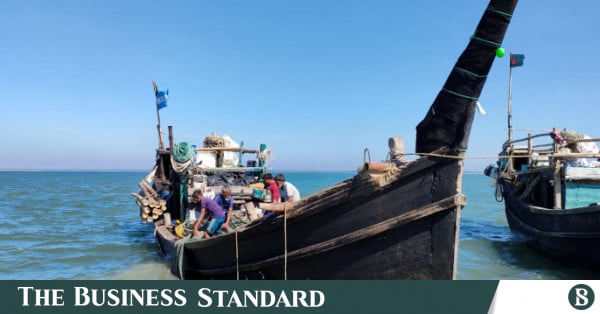
Bangladesh’s marine fish harvest hit a nine-year low of 628,622 tonnes in FY 2023–24, with deep-sea catches down 21% and artisanal yields plunging 70% over two decades. Photo: TBS
“>

Bangladesh’s marine fish harvest hit a nine-year low of 628,622 tonnes in FY 2023–24, with deep-sea catches down 21% and artisanal yields plunging 70% over two decades. Photo: TBS
The Bay of Bengal has long been the engine of Bangladesh’s blue economy—a vast, resource-rich frontier that sustains millions of people and generates vital export earnings.
Bangladesh’s Exclusive Economic Zone (EEZ) spans 121,110 square kilometres and is rich in fish, shrimp, plankton, and corals.
For generations, coastal families from Cox’s Bazar to Khulna have depended on these waters for their livelihoods. In 1971, the Bay hosted 475 species of fish; today, only 394 remain, according to the Department of Fisheries.
This decline tells a troubling story: the marine ecosystem that once sustained our prosperity is now faltering.

Bangladesh’s total marine fish harvest fell to 628,622 tonnes in FY 2023–24, the lowest in nine years (Department of Fisheries – Annual Report 2024). Deep-sea trawler catches declined by 21% year-on-year (FAO), while catch per artisanal boat has dropped nearly 70% over the past two decades—from 13 tonnes in 2000 to barely 4 tonnes in 2020 (World Bank Fisheries and Aquaculture Review).
This downturn is more than ecological; it is social and economic. Around 20 million Bangladeshis depend directly or indirectly on marine resources (World Bank; Department of Fisheries), and seafood provides nearly 13% of the nation’s protein intake (FAO Nutrition Profile of Bangladesh).
The decline, therefore, undermines not only biodiversity but also nutrition, employment, and national income.
Overfishing and IUU (Illegal, Unreported, and Unregulated) fishing are well-known problems. But two largely untold reasons lie behind this steady deterioration: acidification and plastic pollution—silent yet powerful forces that destabilise the marine ecosystem.
Acidification: An invisible enemy beneath the waves
The ocean has long served as Earth’s greatest climate regulator, absorbing nearly one-third of all carbon dioxide (CO₂) emitted by human activities (IPCC, 2023). While this process helps slow global warming on land, it comes at a devastating cost beneath the surface.
When CO₂ dissolves in seawater, it forms carbonic acid, lowering the ocean’s pH and disrupting marine chemistry.
In the early 1980s, Bay of Bengal surface waters averaged a pH of 8.3 (Indian Ocean Research Consortium). Today, coastal and estuarine zones measure between 7.9 and 8.0, with some readings as low as 7.73 (UNEP South Asia Marine Assessment). This 0.2–0.3 drop in pH represents nearly a 30% increase in ocean acidity over five decades (NOAA; IPCC).
trengthening fisheries governance is critical, through enforcing seasonal bans, regulating destructive trawling, and deploying digital vessel monitoring to curb IUU fishing. At the same time, restoring marine ecosystems by expanding Marine Protected Areas, rehabilitating mangroves and coral reefs, and promoting community-based restoration can help revive the Bay’s natural resilience.
This chemical shift threatens corals, shellfish, and plankton—species that form the foundation of the marine food chain. Acidic waters weaken their ability to form calcium carbonate shells and skeletons, leading to slower growth, thinner shells, and higher mortality.
As these foundational species falter, so too do the fish that feed on them. The result is a slow unraveling of marine ecosystems, reducing productivity and pushing fish stocks toward long-term decline.
Ocean acidification is an invisible crisis—one without dramatic visuals or immediate effects—but its consequences are profound and lasting. It is changing the very chemistry of life beneath the waves.
Plastic: The floating curse
If acidification is invisible, plastic pollution is all too visible—and equally devastating. Every year, 8–12 million tonnes of plastic enter the ocean globally (UNEP, 2023; Ocean Conservancy), the equivalent of a garbage truck dumping waste into the sea every minute.
The Bay of Bengal is among the most affected regions on Earth. Fed by the Ganges, Brahmaputra, and Meghna—three of the world’s most densely populated and waste-laden river systems (World Bank South Asia Environment Report; UNEP)—Bangladesh’s coastal waters are inundated with plastic debris.
Key contributors include urban waste flowing untreated through rivers and canals; ghost nets—abandoned or lost fishing gear that continue to entangle fish, turtles, and dolphins; and microplastics now detected in fish sold in Bangladeshi markets.
Unlike organic waste, plastic does not biodegrade; it only breaks into smaller fragments. These fragments accumulate in the marine food web, poisoning plankton and fish—and ultimately the humans who consume them.
Plastic pollution has become a food safety and public health concern. Studies worldwide, and increasingly in South Asia, detect microplastics in seafood, salt, drinking water, and even human blood. For Bangladesh, a seafood-dependent nation, the risk is escalating.
A web of ecological disruptions
The combined effects of acidification, plastic pollution, and overexploitation are reshaping the Bay of Bengal’s ecosystem. These pressures are compounded by emerging threats: dead zones with dangerously low oxygen levels make parts of the water uninhabitable, while jellyfish blooms are replacing traditional schools of fish.
Climate phenomena such as El Niño and La Niña disrupt breeding and migration patterns, and the loss of mangroves and coral reefs weakens the natural coastal defenses. Together, these forces chip away at ecological stability, pushing the Bay toward a tipping point where recovery may become increasingly difficult.
The human and economic fallout
For coastal families in Patuakhali, Barguna, Khulna, and Cox’s Bazar, the ocean is not an abstract resource—it is life itself.
According to the Export Promotion Bureau, Bangladesh’s marine export earnings dropped by approximately 8% in FY 2023–24 compared with the previous year. Declining catches mean reduced income for fishing communities, increasing debt burdens and triggering rural-to-urban migration (World Bank Social Impact Study).
A shrinking fish supply also reduces dietary protein and drives up prices for consumers. Without intervention, this environmental decline could easily escalate into a humanitarian and food-security crisis.
The way forward
Bangladesh has long stood as a voice for climate justice. Now, our leadership must extend to protecting our own marine frontiers. Saving the Bay of Bengal is not a luxury—it is a national necessity.
Strengthening fisheries governance is critical, through enforcing seasonal bans, regulating destructive trawling, and deploying digital vessel monitoring to curb IUU fishing. At the same time, restoring marine ecosystems by expanding Marine Protected Areas, rehabilitating mangroves and coral reefs, and promoting community-based restoration can help revive the Bay’s natural resilience.
Reducing land-based pollution requires investments in wastewater treatment, stricter regulation of agricultural runoff, and measures to prevent plastic leakage into rivers.
Tackling plastic pollution at its source is equally important, including banning single-use plastics, incentivising recycling, and improving coastal waste management. Sustainable fishing practices must be promoted, discouraging destructive gear, encouraging selective trawling, and supporting eco-certified fisheries.
Finally, investing in science and monitoring is essential to build national capacity for tracking pH levels, plastic concentrations, and the health of fish stocks—ensuring that interventions are informed, targeted, and effective.
Protecting the Bay of Bengal is no longer an environmental choice—it is an economic and moral imperative. For Bangladesh, saving the sea means saving ourselves.
The author is the CEO of Rancon Sea Fishing Division and Rancon FC Properties Ltd.