
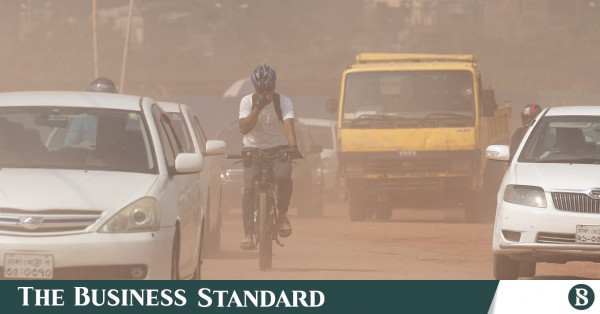
A 2021 study by the Chemistry Department of Dhaka University found that vehicles powered by fossil fuels account for 50% of the contributors to air pollution in Dhaka. Photo: TBS
“>

A 2021 study by the Chemistry Department of Dhaka University found that vehicles powered by fossil fuels account for 50% of the contributors to air pollution in Dhaka. Photo: TBS
Every year, 102,456 people, including 5,258 children, die prematurely in Bangladesh due to the effects of air pollution, according to a report by the Center for Research on Energy and Clean Air (CREA).
The report titled “Public Health Impact of Fine Particulate Air Pollution in Bangladesh” was unveiled at a press conference jointly organised by Center for Atmospheric Pollution Studies (CAPS) and CREA at the National Press Club in Dhaka today (18 January), reads a press release.
According to the report, Bangladesh could prevent over 81,000 premature deaths each year and avert significant economic losses by reducing its air pollution.

Data-driven analyses were presented at the event on the health risks posed by air pollution in Dhaka and other major cities across the country.
According to CREA analysis, PM2.5 is responsible for roughly 102,456 deaths annually related to ischemic heart disease, stroke, chronic obstructive pulmonary disease, lower respiratory infections, and lung cancer.
Children under five are especially vulnerable, with 5,258 deaths annually attributed to PM2.5-related lower respiratory infections, it said.
Besides, the air pollution is leading to thousands of premature births, low birth weights, and childhood deaths each year.
These outcomes stressed the need for targeted interventions to protect those who are least able to protect themselves.
Addressing Bangladesh’s air pollution needs an investment in both public health and the domestic economy, said CREA Air Quality Analyst Dr Jamie Kelly.
By enforcing stricter controls and adopting cleaner energy solutions air pollution levels can be dramatically reduced, said CREA Southeast Asia Analyst and Lead Author Daniel Nesan.
CAPS Chairman Dr Ahmad Kamruzzaman Majumdar said the level of air pollution in Dhaka city has increased to such an extent that it is not only affecting the human body but also disturbing the mental health.
Therefore, if effective measures and policies are not taken to monitor and prevent pollution from this moment, the present and future generations will have to face a lot of health risks, he added.
First Secretary (Environment and Climate Change) of Swedish Embassy in Dhaka Nayoka Martinez-Backstrom said policies and incentives to promote clean production and energy efficiency measures are important to mitigate the negative impact.
Tapan Kumar Biswas, additional secretary (Environmental Pollution Control and Law wing) of the Ministry of Environment, Forests and Climate Change, said PM 2.5 has undoubtedly become a major threat to public health in Bangladesh.
The government is working with maximum capacity to reduce air pollution, he added.
Adil Muhammad Khan, president of Bangladesh Institute of Planners, said a major change is imperative in the development philosophy of the Bangladesh government.
“Public health should be prioritised in the development plans in cities. For this reason, strict enforcement along with reform of the law is necessary,” he added.
“To protect ourselves and our community, we should use a face mask outdoors always, we should use reduce the use of mechanical vehicles and for sustainable modes of transport like bicycles, we need more walkways and dedicated bicycle lanes to encourage this shift,” said Dr Mahbubul Islam, former associate professor of Respiratory Medicine at Shaheed Suhrawardy Medical College.
Syed Mahbubul Alam Tahin, secretary of the Center for Law and Policy Affairs (CLPA), said through amending the Environmental Court Act, it is possible to reduce air pollution, and the public must be given the right to express their opinions directly which will contribute significantly to reducing overall pollution.
Dr Ayesha Akhter, deputy director of the 250-Bed TB Hospital, said health risks are highest due to air pollution. “Children, women, pregnant women, and the elderly are the most vulnerable to air pollution. Specific measures must be taken to reduce pollution.”
According to CREA’s analysis, comparing different air quality standards, Bangladesh’s current standards, and the WHO guidelines for 2005 and 2021, even small improvements in PM2.5 levels can bring significant health benefits at the national level.
Significant reductions in air pollution levels can be achieved through the implementation of strict controls and the adoption of cleaner fuels.
An interactive dashboard was also launched at the event offering all stakeholders the ability to monitor real-time pollution data and its associated health impacts in cities and districts.