
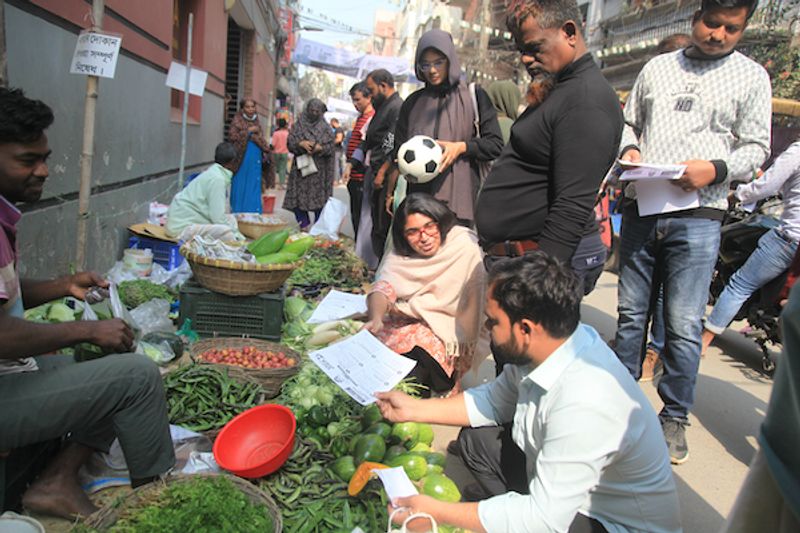
For many, Tasnim Jara’s candidacy alone suggests that the uprising of 2024 has not entirely faded – and that a different kind of politics, however fragile, is still struggling to take root in Bangladesh.
On the traffic-clogged streets of Dhaka, where election season announces itself with blaring loudspeakers, convoys of motorcycles and slogans sharpened for confrontation, Tasnim Jara moves differently.
Her procession is small, almost quiet, a handful of volunteers walking beside her as traffic swells and recedes. There is no roar of party anthems or choreographed chants. In a city – and a nation – on edge ahead of a fiercely contested national election on February 12, her calm presence seems almost out of place.
Her rivals from Bangladesh’s dominant political parties prefer spectacle. Their rallies are massive, their language combative. Jara, draped in a simple single-colour shawl and peering through thin-rimmed glasses, neither possesses the financial muscle nor the inclination to compete on that terrain.
Instead, she knocks on doors, stops at tea stalls, listens more than she speaks, and asks residents of Dhaka-9 what they need rather than what they believe.
The modest scale of her campaign masks a stubborn resolve that has carried the 31-year-old Oxford-educated physician into one of the country’s most unforgiving arenas.
Until less than 24 hours before the deadline for submitting nominations, her candidacy itself seemed improbable. Jara was then a senior joint member secretary of the National Citizen Party, or NCP, a fledgling political force born from the mass uprising of August 2024 that ended 16 years of Sheikh Hasina’s iron-fisted rule.
But hours before the cutoff, she resigned.
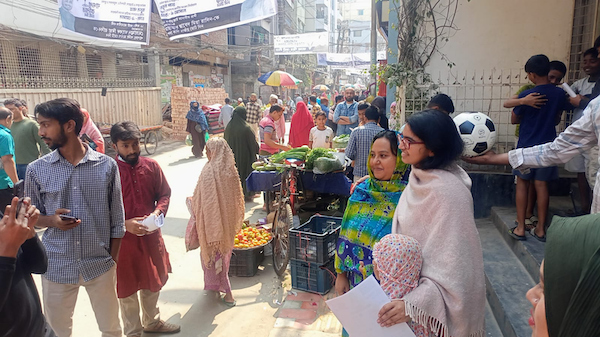
Campaigning on her own in Dhaka-9, Tasnim Jara has told voters that her politics will be rooted in service rather than slogans. Photo: Nazmul Islam.
Her departure followed NCP’s decision to enter an electoral alliance with Jamaat-e-Islami, Bangladesh’s largest Islamist party and one of the two main contenders for power alongside the Bangladesh Nationalist Party (BNP).
While NCP leaders defended the move as electoral pragmatism, Jara publicly disagreed. Religion-based politics, she said, did not align with her political philosophy. Walking away from a party she had helped build meant forfeiting its organisational machinery, and its symbol. As well as its protection in Bangladesh’s highly confrontational politics.
Running as an independent posed an immediate logistical hurdle. Election rules required her to submit at least 5,000 voter signatures from Dhaka-9 in under 30 hours (because of the impending deadline). Jara stood by a busy roadside in the constituency, clipboard in hand, and asked passersby to sign.
Her seven-million-strong Facebook following proved decisive. Volunteers mobilised, word spread quickly, and by the deadline she had collected the signatures. The Election Commission later validated her candidacy.
Only 18 months earlier, Jara had been working as an internal medicine specialist at Cambridge University Hospital in the UK. When Hasina’s government collapsed, many Bangladeshis began speaking of “Bangladesh 2.0,” a country newly open to reform after years of repression.
For Jara, the moment offered a chance to scale up the work she had long pursued: public health. She and her husband, Khalid Saifullah, a law graduate, left their comfortable life in Cambridge and returned home.
They were part of a broader reverse migration. Doctors, engineers and technology executives returned to Bangladesh in the aftermath of the uprising, drawn by a sense of civic duty and a desire to guide the Generation Z activists who had led the revolt.
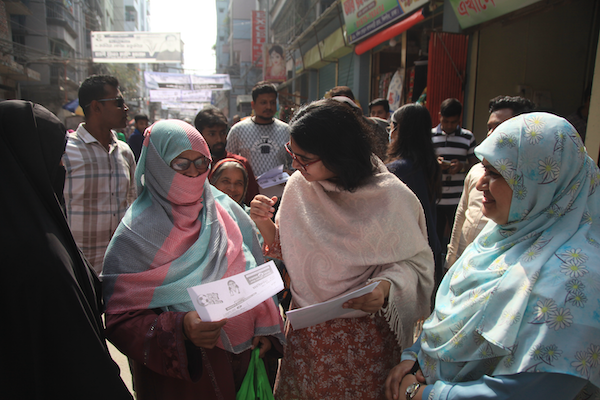
For NCP, Western-educated, articulate and reform-minded, Tasnim Jara appealed both to urban elites and to rural voters eager for credible leadership. Photo: Nazmul Islam.
When the NCP took shape, Jara joined its leadership and quickly became one of its most recognisable faces during a nationwide outreach campaign marking the first anniversary of the uprising in mid-2025.
Her credentials helped. Jara had risen to national prominence during the Covid-19 pandemic, when her Bengali-language videos explaining public health measures spread widely online. Her social media following grew into the millions.
In Britain, her work earned recognition from the government, and her appearances on the BBC, Sky News, ITV and Financial Times made her a familiar figure well beyond the Bangladeshi diaspora. Alongside her husband, she also co-developed Shohay Health, a Bengali-language public health app designed to make medical information accessible to ordinary users.
For NCP, Jara embodied the promise of a break from Bangladesh’s entrenched political class. Western-educated, articulate and reform-minded, she appealed both to urban elites and to rural voters eager for credible leadership. Rumi Ahmed, a Texas-based physician of Bangladeshi origin, wrote at the time that Jara’s presence gave him “hope that the party would prioritise informed and thoughtful governance.”
That promise now stands apart from party affiliation. Campaigning on her own in Dhaka-9, Jara has told voters that her politics will be rooted in service rather than slogans. She speaks of ending discrimination and insists that citizens deserve tangible returns for the taxes they pay.
Her platform focuses on the everyday failures that frustrate residents: broken roads, unreliable utilities, flooding streets and overcrowded hospitals.
She has pledged a strict “no service, no bill” policy so households are not charged for gas they do not receive, along with firm deadlines for contractors repairing roads and year-round maintenance of drainage systems to address chronic water logging.
Drawing on her medical training, she has promised to upgrade the local hospital into a modern, well-staffed facility, establish community-level mini-hospitals and create a permanent dengue task force to destroy mosquito larvae before the monsoon season.
Public safety and education also feature prominently. Jara talks about reclaiming streets from drug syndicates through improved lighting and surveillance cameras, and about abolishing corruption in school admissions. In its place, she argues for investing in science laboratories, artificial intelligence training and coding education to prepare students for a global economy.
Perhaps her most pointed critique is reserved for the style of politics she calls “migratory”. Too many lawmakers, she says, appear only during elections and vanish afterward. She has vowed to keep a permanent local office open in the evenings and to launch a digital dashboard that would allow residents to track the status of their complaints in real time.
So far, the reception has been encouraging. Voters say they are weary of grand promises from established parties that rarely translate into change. Jara’s calm demeanour and concrete proposals, some say, feel like a departure from politics as usual.
Still, the contest is steep. She faces heavyweight opponents: Habibur Rashid Habib of the BNP and Kabir Ahmed of Jamaat-e-Islami, both backed by seasoned party machines.
Whether Jara can overcome those odds remains uncertain. But in a political landscape long dominated by dynasties and political patronage, her quiet march through Dhaka’s streets has already altered the tone of the race.
For many, her candidacy alone suggests that the uprising of 2024 has not entirely faded – and that a different kind of politics, however fragile, is still struggling to take root in Bangladesh.
Faisal Mahmud is the Minister (Press) of Bangladesh High Commission in New Delhi.
This article went live on January thirty-first, two thousand twenty six, at thirty minutes past five in the evening.
The Wire is now on WhatsApp. Follow our channel for sharp analysis and opinions on the latest developments.