
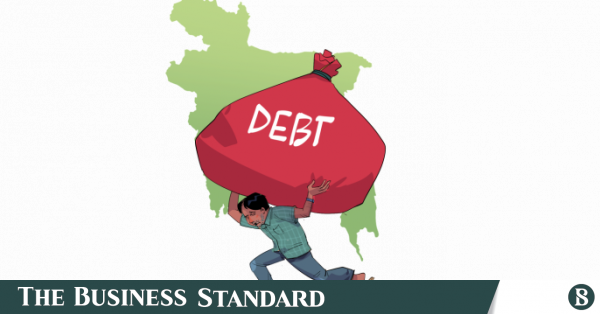
Rising debt is a genuine worry, as it erodes repayment capacity and limits access to global credit markets. Among smaller economies, conflict-ridden Sudan tops the global list with a staggering 261% debt-to-GDP ratio
Illustration: TBS
“>

Illustration: TBS
Highlights:
- No single debt-to-GDP ratio guarantees economic sustainability globally
- Rising debt strains repayment capacity and limits global credit access
- Rich nations borrow heavily for social programs, defence, ageing populations
- Political pressures worsen deficits, fueling debt supercycles and inflation
- Bangladesh’s debt rising steadily, external payments and interest pose risks
- Growth, investment, and productive infrastructure crucial for debt sustainability
There is no single debt-to-GDP ratio that guarantees sustainability for an economy. Still, the IMF and World Bank offer benchmarks to assess debt health for low-income countries—classifying them as weak, medium, or strong depending on whether external debt ranges between 35% and 75% of GDP.
For countries like Bangladesh, that ratio is a lifeline to creditworthiness. Rising debt is a genuine worry, as it erodes repayment capacity and limits access to global credit markets. Among smaller economies, conflict-ridden Sudan tops the global list with a staggering 261% debt-to-GDP ratio.

But the concern over ballooning public debt and persistent inflation is no longer confined to the developing world. In Asia, Japan’s debt ratio stands at 236%, Singapore’s at 174%, and even Germany—long the G7’s fiscal disciplinarian—carries about 64%. The United States, meanwhile, reported general government debt at 122% of GDP last year.
While much of the rich world’s debt is domestic, their anxieties lie elsewhere—not in repayment capacity, but in managing the social and political fallout of living perpetually beyond their means.
Infograph: TBS
“>

Infograph: TBS
Why the rich borrow the most
Wealthy nations have long been enthusiastic borrowers, often to finance expansive social programmes and global responsibilities—from foreign aid and environmental commitments to defence spending.
Ageing populations have strained public finances in Europe, Japan, and the US, forcing governments to divert younger taxpayers’ money to fund pensions and elderly care. This has fuelled resentment among younger generations, particularly in France and the UK, where governments face criticism for “taxing the young to comfort the old.”
Russia’s invasion of Ukraine has added yet another fiscal burden. European nations have rearmed at unprecedented pace, with the European Defence Agency estimating defence spending to reach $446 billion this year, up from $402 billion in 2024—leaving fewer resources for social and green transitions.
Elections compound the problem. Politicians routinely promise tax cuts and higher social spending—pledges impossible to honour without expanding deficits. As The Economist notes, such “irresponsible budgeting” has become a political routine, feeding what investor Ray Dalio calls a “vicious debt supercycle.” Inflation is often used to erode the real value of debt—but it quietly punishes households through higher living costs.
The Covid-19 pandemic marked a turning point. To avert economic collapse, advanced economies unleashed massive fiscal stimulus, injecting trillions into households and businesses. Then came the Ukraine war and Western sanctions, which sent energy and food prices soaring. European governments again reached for subsidies—this time to cushion citizens from energy shocks—deepening fiscal imbalances.
TBS Infograph
“>

TBS Infograph
The political price of fiscal stress
Now, the developed world faces a double blow: stubborn inflation and deteriorating public finances. Leadership changes in France, Japan, and the UK reflect mounting public frustration as taxes rise, benefits shrink, and borrowing costs climb.
Britain has already implemented major tax hikes. In the US, fiscal fragility looks even more severe. The federal deficit now equals 6% of GDP, while public debt has surpassed $38 trillion. Interest payments—$4 trillion over the past decade—are projected to triple to $14 trillion within the next ten years. High interest rates are crowding out both public and private investment, making home ownership an increasingly distant dream.
Donald Trump’s “Make America Great Again” campaign faces a funding dilemma: his pledge not to raise taxes leaves tariffs as the main fiscal lever. Yet tariffs function as hidden taxes on American consumers, driving inflation rather than relief.
The Federal Reserve has hinted at possible rate cuts amid mounting unemployment concerns. Harvard economist Gregory Mankiw warns that the US has only five painful exit routes: deep spending cuts, major tax hikes, extraordinary growth, large-scale money creation, or outright default. Each, he says, carries heavy political and economic costs—tests no administration, including a potential Trump one, is likely to survive.
Across Europe, governments are also wrestling with swelling defence budgets, rising borrowing costs, and unsustainable welfare spending. Fiscal tightening remains an option—but a politically perilous one. Cutting pensions or raising taxes has historically spelled electoral disaster.
In Washington, gridlock deepens as Congress struggles to pass a spending plan, precipitating yet another government shutdown. Lawmakers remain divided over extending healthcare tax credits and funding elderly medical aid.
Argentina’s austerity experiment offers a sobering case study. Inflation has cooled, but fiscal stress persists. A $20 billion bailout from the US recently helped President Javier Milei survive a critical election cycle—proof that even the most disciplined reformers often rely on external debt lifelines.
Bangladesh’s delicate balance
For Bangladesh, the story is more precarious. The country’s debt-to-GDP ratio remains below the IMF’s 55% sustainability threshold, but that comfort risks breeding complacency. Over the past decade, the ratio has climbed steadily from 27% in FY15 to nearly 38% in FY24—with no sign of stabilising.
Stagnant tax revenues, mounting interest payments, and slowing repayment capacity raise an uncomfortable question: how long can Bangladesh sustain this trajectory when debt is rising faster than economic returns?
External debt continues to swell, and annual interest payments have tripled in just three years—reaching $1.3 billion in FY24. Global lending rates have surged fivefold compared to three years ago, further straining the national balance sheet. Although Bangladesh’s external debt ratio—about 17% of GDP as of June 2024—remains below the 40% “comfort” line, economists warn that comfort is a moving target.
Inflation has stayed stubbornly above 8% for four consecutive months. While export earnings have rebounded and remittance inflows have stabilised the foreign exchange market, private investment remains at a historic low. Credit growth to the private sector hovers around 6%—a clear sign of business caution.
A recent Planning Ministry report blames high interest rates and political uncertainty for the weak investment climate. The result: slower job creation and mounting social pressure, particularly as Bangladesh’s young population floods the labour market.
At the World Bank’s Annual Meetings on 17 October, President Ajay Banga warned that over the next 10–15 years, 1.2 billion young people will enter the workforce seeking just 400 million jobs worldwide. With 90% of employment coming from the private sector, he urged developing nations to channel resources into five key growth engines: infrastructure and energy, agribusiness, healthcare, tourism, and value-added manufacturing—including critical minerals.
For Bangladesh, that message resonates deeply. Per capita external debt has surged from less than $7 half a century ago to over $455 today. The country’s debt sustainability now depends on whether it can translate expensive infrastructure investments into productive economic gains—driving growth, jobs, and the ability to repay.