
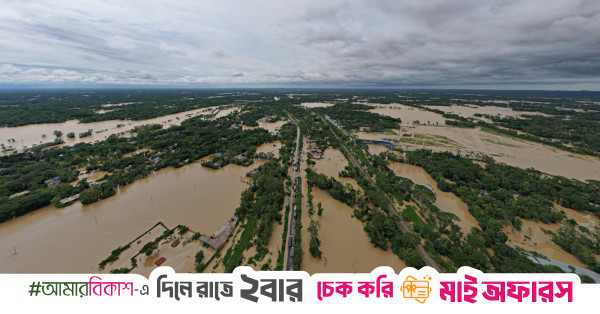
The index gave Bangladesh a risk score of 65.37 out of 100, projected to rise to 65.63 by 2031, placing the country in the “High Risk” category. Despite contributing less than 0.5% of global emissions, Bangladesh now carries one of the highest per-capita climate debts of $79.6.
Representational Photo: TBS
“>

Representational Photo: TBS
Bangladesh has emerged as one of the most climate-indebted and vulnerable countries in the world, according to the Climate Debt Risk Index (CDRI-2025) released by Change Initiative in Dhaka today (20 September).
The index gave Bangladesh a risk score of 65.37 out of 100, projected to rise to 65.63 by 2031, placing the country in the “High Risk” category. Despite contributing less than 0.5% of global emissions, Bangladesh now carries one of the highest per-capita climate debts of $79.6.
According to the report, the country’s Debt-to-Grant ratio stands at 2.7 – nearly four times the LDC average of 0.7 – while its multilateral loan ratio of 0.94 is almost five times higher than the LDC standard (0.19). Adaptation efforts remain heavily underfunded, with the Adaptation-to-Mitigation ratio at 0.42, less than half of the LDC average.

Photo: Courtesy
“>

Photo: Courtesy
“For every ton of CO2e emission, Bangladesh is compelled to take a loan of $29.52, which directly violates the ‘Polluters Pay Principle’,” the report notes. CDRI findings were presented by Tonmay Saha, research associate of Change Initiative at the round table.
The CDRI findings highlight how international climate finance – promised as reparations under the Paris Agreement – has turned into a “climate debt trap.” More than 70% of climate finance arrives as loans, forcing vulnerable countries like Bangladesh to pay twice: first through recurring climate disasters and then through rising debt repayments.
Between 2000 and 2023, climate hazards displaced or affected 130 million people in Bangladesh and caused losses worth $13.6 billion, the study said. Yet adaptation financing remains scarce, while households shoulder around Tk10,700 ($88) annually on self-financed protection – amounting to $1.7 billion nationwide.
According to the report, “Energy absorbs more than half of climate finance but is overwhelmingly debt-driven, with a loan-to-grant ratio of 11.99:1. Transport and storage are nearly total debt-based (1123:1), while water supply carries a ratio of 7.78:1 despite being adaptation-focused. Agriculture, disaster preparedness, health, and industry remain severely underfunded relative to risk and need. Alarmingly, 18.84% of Bangladesh’s reported “climate” finance has been misattributed to fossil fuel projects, carrying a loan-to-grant ratio of 28.8.”
The report urged a pivot towards grant-first finance, debt exits and swaps, direct local access to funds, multilateral development bank reform, and the creation of an Earth Solidarity Fund capitalised by carbon pricing. Nationally, it proposed transforming the Bangladesh Climate Change Trust Fund into the Bangladesh Natural Rights Fund (BNRF).
Dr Farhina Ahmed, secretary of the Ministry of Environment, Forest and Climate Change, stressed that biodiversity protection could reduce climate impacts but global forums like COP “often fail to deliver results.”
Dr AK Enamul Haque, director general of the Bangladesh Institute of Development Studies (BIDS), said: “Grants are limited, loans risky, and overreliance on the private sector heightens financial strain. True resilience demands systemic change – incremental fixes are not enough.”
M Zakir Hossain Khan, chief executive of Change Initiative, warned that without firm pledges, the $1 billion Climate Finance Action Fund launched at COP29 “risks remaining an ambition, not a lifeline.”
Nayoka Martinez-Bäckström, First Secretary and Deputy Head of Development Cooperation, Embassy of Sweden in Dhaka; Dr Fazle Rabbi Sadeque Ahmed, Deputy Managing Director, Palli Karma-Sahayak Foundation (PKSF); Shirin Lira, Cooperation Officer, Embassy of Switzerland; Faria Hossain Ikra, Greenspeaker, Greenpeace South East Asia; Dr Saimun Parvez, Special Assistant to Chairperson, BNP; and Dr Kazi Shahjahan, Joint Secretary, Economic Relations Division were present at the programme.