
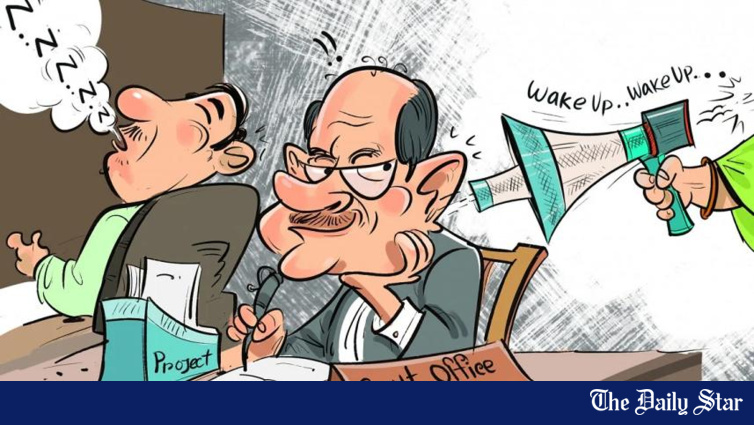
As Bangladesh approaches the pivotal February 12 election, a singular, urgent demand resonates from tea stalls to boardrooms: the dismantling of a bureaucratic apparatus that has strangled national progress for decades. The 2024 uprising was never merely about changing faces in parliament; it was also a revolt against a labyrinthine administrative system that treats citizens as supplicants rather than stakeholders.
In a recent address, Law, Justice and Parliamentary Adviser Asif Nazrul said that bureaucrats in Bangladesh are “inherently resistant to reform.” Recently, a proposal was made to increase government employee compensation by over Tk 1 lakh crore. This comes at a time when the national budget sits below Tk 8 lakh crore, and the broader economy grapples with job losses, a banking crisis, and stagnant exports.
To honour the mandate of the people, the administration must move beyond “gradual” change. Reformers are calling for five systemic shifts. The Public Service (Amendment) Ordinance, 2025, must be enforced. Officials who obstruct service or solicit bribes should face summary removal rather than the departmental proceedings that historically act as a shield for corruption. The new government must establish citizen review boards with real power to terminate bureaucrats who fail performance standards.
Moreover, human gatekeepers are the primary source of “informal fees.” While moving land registration, business licensing, tax filing, and permit approvals online are works in progress, the process must be adopted fully and flawlessly. When human interaction is unavoidable, it must be recorded and auditable.
Five-year renewable contracts should be introduced for all positions above the entry level, with renewal contingent on measurable performance metrics: processing times, citizen satisfaction scores, and audit results. Furthermore, a regular system for “lateral entry” from the private sector is essential to inject modern expertise into a closed system.
Starting a business currently requires a marathon through trade, environmental, fire, and tax departments, each guarded by separate departments that refuse coordination. A unified one-stop centre for some cases appears to be on the cards of the interim government; a legally mandated 15-day approval window is no longer a luxury—it is a necessity.
The upcoming government must establish sting operations and anonymous reporting systems with financial rewards for exposing bribery demands. More importantly, the need for bribes must be removed by setting clear, published timelines for every government process. If an application exceeds the timeline, automatic approval should be granted, and the responsible officials should be suspended pending investigation.
While external reserves reached a respectable $33.19 billion in December 2025, the real economic tragedy lies in the “unborn” businesses strangled by red tape. The banking sector, currently metastasising with non-performing loans, is a direct victim of bureaucratic capture. Experts argue that the Bangladesh Bank must gain total operational independence. Similarly, the energy sector’s decision structures cost the nation billions in unnecessary capacity charges. Banking licenses should not be political favours, but merit-based awards evaluated by independent panels. The interim government was able to take some measures to prevent this sector from collapsing.
The public expects a lot from the next elected government, and they want it soon. These include the launch of online portals for the 20 most utilised government services, public announcement of performance metrics for all departments, with monthly reporting, the removal of counterproductive senior officials with documented records of incompetence, legislative passage of administrative reform with strict implementation timelines, and establishment of citizen oversight boards in all levels of local government.
Dr Sabbir Ahmad is a researcher, mentor and leader in project delivery and engineering. He can be reached at [email protected].
Views expressed in this article are the author’s own.
Follow The Daily Star Opinion on Facebook for the latest opinions, commentaries, and analyses by experts and professionals. To contribute your article or letter to The Daily Star Opinion, see our guidelines for submission.