
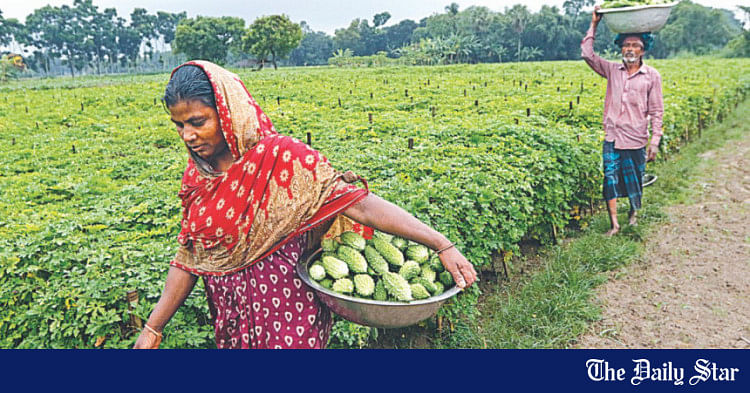
In the heart of Bangladesh’s rural belt, a silent revolution is underway. While global leaders debate climate action, 1.65 crore Bangladeshi farm households are already battling its impact in the forms of flash floods, prolonged droughts, salinisation, and invasive pests. Between 2000 and 2023, climate-related disasters caused over Tk 1,200 crore in agricultural losses. Yet, amid this turmoil, farmers are pioneering grassroots solutions: floating gardens in flood-prone haors; drought-resistant crops in Rajshahi; and saline-tolerant rice in coastal Satkhira. These innovations—low-cost, climate-smart, and scalable—are quietly transforming survival into resilience. Farmlands in this country are becoming global classrooms for adaptation in a warming world.
Climate volatility has transformed Bangladesh from a fertile delta to a battleground for survival. According to the World Bank’sGroundswell Report (2021), nearly 1.33 crore Bangladeshis may be displaced by climate-induced stress by 2050, most of them in rural areas. Agriculture, which employs over 40 percent of the workforce and contributes 11.2 percent to GDP (BBS, 2023), bears the brunt.
 For all latest news, follow The Daily Star’s Google News channel.
 Cyclones Sidr (2007), Aila (2009), and Amphan (2020) alone caused combined agricultural losses exceeding Tk 150 crore. Salinity intrusion, now affecting over 10 lakh hectares in the coastal belt (Soil Resource Development Institute, 2022), is pushing farmers out of traditional rice production. In the northwestern Barind Tract, rainfall variability has reduced monsoon intensity, undermining rainfed farming.
Even more troubling is the collapse of seasonal predictability. Crop calendars that once guided sowing and harvesting have become irrelevant now, making traditional farming knowledge less reliable with each passing year.
Yet, this is not a tale of despair; it is one of ingenuity. Across Bangladesh, farmers are transforming adversity into opportunity through grassroots innovations. In Satkhira, Rahima Begum, once unable to grow rice due to salinity, now cultivates BRRI Dhan67, a salt-tolerant rice variety developed by the Bangladesh Rice Research Institute (BRRI). This variety tolerates up to eight dS/m salinity and yields 4.5 tonnes per hectare, a lifeline for over 250,000 coastal farmers (BRRI Annual Report, 2022).
In haor (wetland) areas of Kishoreganj and Sunamganj, floating agriculture is making a comeback. Revived with modern composting techniques, these bamboo-based dhap platforms, first documented in the 17th century, are enabling year-round vegetable cultivation on floodwaters. A pilot project by FAO in 2021 found that floating gardens increased household nutrition scores by 35 percent and provided women-led income streams.
In the dry zones of Rajshahi, alternate wetting and drying (AWD) methods, promoted by the International Rice Research Institute (IRRI), are helping conserve water by 25-30 percent while maintaining yield. In these drought-prone areas, where groundwater tables are falling by three to four centimetres annually (Barind Multipurpose Development Authority, 2023), AWD adoption is a game changer.
Similarly, farmers are switching to short-duration varieties like BINA Dhan-7 and BINA Dhan-17, which mature in 100-105 days, helping them harvest before floods. Integrated Pest Management (IPM), using pheromone traps and biopesticides, is reducing pesticide costs by 40 percent in pilot districts like Jashore and Natore (Department of Agricultural Extension, 2022).
Women play a critical but under-recognised role in climate adaptation. According to a 2024 study by the International Food Policy Research Institute (IFPRI), farms managed or co-managed by women in Bangladesh show 28 percent more crop diversity and 20 percent higher adoption of adaptive techniques.
In Khulna, Fatema Khatun and her group of 35 women farmers transitioned to saline-tolerant vegetables and crab-fattening units. In the north, women-led nurseries and vermicomposting units are diversifying household incomes and ensuring seed availability at local levels. These initiatives often outperform top-down interventions due to their contextual knowledge and community trust.
However, access barriers persist. Only 3.5 percent of women own agricultural land (BBS Gender Statistics, 2023), and fewer than 10 percent receive formal agricultural training. Addressing these gaps is essential to unlocking their full potential in climate resilience.
What Bangladesh’s farmers are pioneering are not isolated tactics; they are scalable, cost-effective models for climate adaptation. Floating farms, saline-resistant crops, and community-based irrigation are being studied by global platforms like the CGIAR Initiative on Climate Resilience and FAO’s Scaling-Up Agroecology Initiative.
The IPCC Sixth Assessment Report 2022 cites Bangladesh’s adaptive agricultural strategies as case studies in successful local adaptation. These strategies align with principles of agroecology, ecosystem-based adaptation, and low-emission development, all vital for meeting the Paris Agreement targets.
Bangladesh’s updated National Adaptation Plan (NAP 2023-2050) recognises these innovations, calling for Tk 850 crore in investments in climate-resilient agriculture, research, and early warning systems. The roadmap exists. What’s needed now is execution.
Three priority areas demand immediate action. First, climate finance must reach the grassroots, yet as of 2023, only eight percent of international climate funds in Bangladesh reached local communities, according to Climate Finance Transparency Initiative. Second, gender-responsive investments are critical: women farmers must gain access to land rights, finance, and training to scale their contributions. Finally, research and extension services need urgent revitalisation. Institutions like BRRI, Bangladesh Institute of Nuclear Agriculture (BINA), and Department of Agricultural Extension (DAE) require consistent investment to develop and deliver climate-smart technologies that can safeguard livelihoods and secure future harvests.
As the world waits for COP30 in November, Bangladesh offers not just dire warnings but grounded wisdom. Its farmers, living on the frontlines of climate disruption, are pioneering solutions that are shaping a new blueprint for survival. These innovations are not theories from labs, but tested tools from the soil: resilient, scalable, and deeply rooted in lived reality.
This is not a story of despair but of determination. Adaptation is already happening in fields, not forums. But to grow this momentum, global leaders must act where it matters most. Because the future of climate resilience won’t be built in air-conditioned halls; it will be grown, seed by seed, in fields.
Dr Shahrina Akhtar is specialist (technical) and research adviser at Krishi Gobeshona Foundation. She can be reached at [email protected].
Views expressed in this article are the authors’ own.
Follow The Daily Star Opinion on Facebook for the latest opinions, commentaries and analyses by experts and professionals. To contribute your article or letter to The Daily Star Opinion, see our guidelines for submission.