
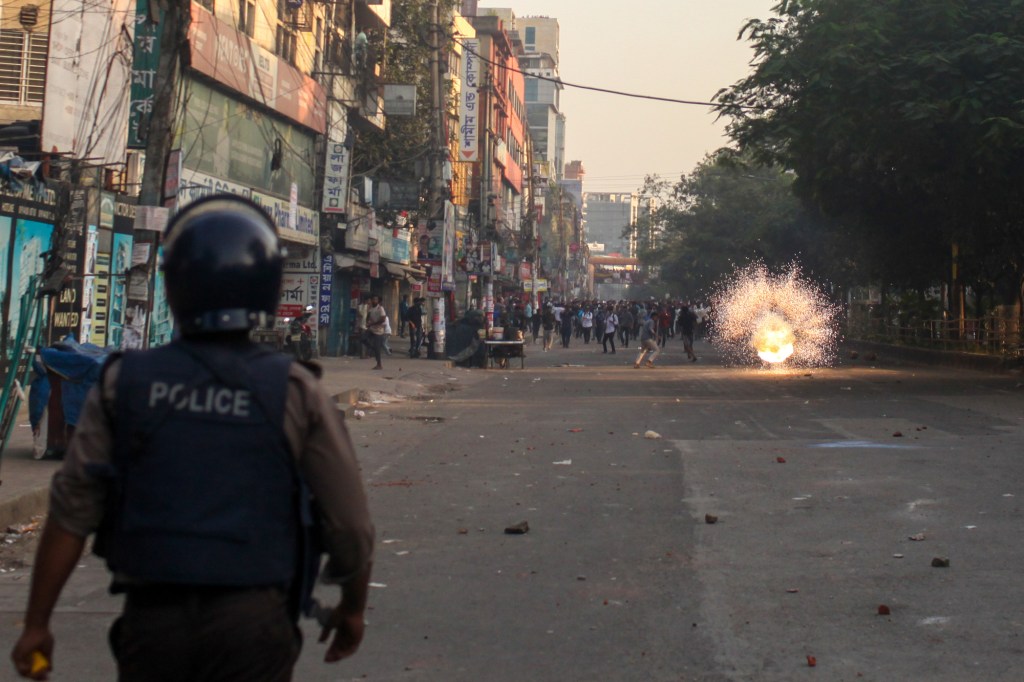
With former prime minister Sheikh Hasina handed a death sentence on charges of crimes against humanity in Dhaka late Monday afternoon, businesses are bracing for heightened risks, which several exporters told Sourcing Journal, could well last until the national election that is expected to be held in February 2026.
The trial found the former prime minister guilty of being “the mastermind and principal architect” behind last year’s suppression of mass demonstrations in which 1,400 people were killed.
Violence already erupted in the city on Sunday, in anticipation of a negative judgement—and on Monday the city has been on high alert after the hunger for revenge re-emerged—with students who led the uprising in July 2024 still incensed by the “oppressive and authoritarian Hasina regime.”
The interim government under noble laureate Muhammad Yunus is now faced with the task of keeping the peace, getting neighboring India to extradite Hasina, and provide the “free and fair promised election” while providing the business community the support it so desperately needs.
“Add to this the fact that we are worrying about the global buyer sentiment, that even a brief political unrest can disrupt our production lines or ports, stop our workers from being able to reach factories – along with this difficult situation where global brands are trying to add additional labor monitoring into the existing safeguards for factory safety through the RMG Sustainability Council (RSC),” an apparel manufacturer from the Ashulia area told Sourcing Journal, asking not to be named.
Manufacturers and buyers have been caught in a whirlpool of hard conversations over the past week, after the RSC announced that the complaints mechanism of the Accord country program in Bangladesh being carried out by the RMG Sustainability Council (RSC)would be expanded to issues beyond safety and health, following a decision by the RSC Board of Directors of the body that governs the Bangladesh program, on October 20.
The Bangladesh Garment Manufacturers and Exporters Association (BGMEA) has denied being a party to this agreement.
As emotion intertwines with economics, how many more disruptions can the industry take before losing their hold on the much coveted orders from global brands, and there is a quick focus being redrawn to understand how the Monday verdict will trigger trade disruptions, upset regional geopolitics, and further strain relationships, especially with neighboring India, where Hasina has taken refuge since the student-led uprising that ousted her in 2024.
Trade between India and Bangladesh has already been on hiatus, suffering strained relationships. In the past years, there was a robust exchange between borders with India supplying fabrics, yarn, and a range of inputs to Bangladeshi apparel makers, while Bangladesh exports large volumes of finished garments to global markets, often using Indian inputs or trans-shipment routes.
Even as the exchanges between the two countries post-verdict were being carefully watched—India was summoned to “immediately hand over Sheikh Hasina and former Home Minister Asaduzzaman Khan, who has also been sentenced to death, as per the extradition treaty between the two countries.” According to a statement from the Bangladesh Foreign Ministry, any other country granting asylum “would be a grave unfriendly act and a contempt of justice.”
The Indian government was quick to comment on Monday—that it has “taken note” of the verdict and “remains committed to the best interests” of Bangladesh’s people.
Meanwhile, Hasina’s response too, has been characteristically defiant.
“The verdicts announced against me have been made by a rigged tribunal established and presided over by an unelected government with no democratic mandate. They are biased and politically motivated. In their distasteful call for the death penalty, they reveal the brazen and murderous intent of extremist figures within the interim government to remove Bangladesh’s last elected prime minister and to nullify the Awami League as a political force,” she said.
While the interim administration has moved to project calm, business leaders say the verdict is likely to deepen uncertainty in the coming days. International buyers and compliance auditors said they are on alert, monitoring how the situation unfolds given the need for stability and the importance of human rights and labor standards.
The immediate operational consequences for manufacturers are familiar from previous years, when political violence disrupted business, affecting supply chains, workers’ lives, transport systems, and prompting global buyers to diversify sourcing to mitigate geopolitical risks.
“The focus remains on how well the caretaker government can manage the situation, quell violence, and engage with other countries in the region to ensure no damage to exports and trade,” said another manufacturer from the port city of Chatogram.
Worker leaders are equally on edge.
“Everyone is waiting for the national election,” said Babul Akhter, vice president of the IndustriALL Bangladesh Council. “We do not know what will happen next—whether in the day or the night, and this uncertainty hampers our business, our plans, and our administration. Many factories have already shut down, causing significant job losses. Others have closed due to trade issues, policies, or worker unrest.”
But he is also uneasy about the standoff between brands and manufacturers, and hopeful that the decision announced last week will indeed come to pass.
“The RSC announced that its expanded Worker Complaints Mechanism would begin on November 16 in more than 1,000 factories and then scale up, and we are excited that the RMG Sustainability Council (RSC) has broadened its mandate from strictly occupational safety and health (OSH) to include labor-rights and other non-OSH workplace complaints,” Akhter said, explaining how the BGMEA instructed member factories not to respond to RSC communications about the new process until further notice.
A stern statement by the Clean Clothes Campaign (CCC) on Saturday noted:
“This latest incident follows the same pattern of delays and obstruction by employer organizations on the RSC board as described in a memo published by witness signatories to the Accord earlier this year. This includes delaying the life-saving boiler program and the undue use of influence as board members to further their business interests, instead of prioritizing the RSC’s mission.”
“The employer pushback against the expansion of the complaint mechanism is supported by grievances about low purchasing prices and the workload caused by brands’ multiple audit mechanisms. These are valid concerns for employers—and brands can and should engage on them. It is, however, entirely unjustified to use these as grounds not just to delay but to try to reverse a decision that provides meaningful remedies to workers in areas where justice has often been denied. The fact that employer organizations put their own interests above the goals and decisions of the organization damages the credibility of the RSC and the Accord. Brands would do well to rethink business practices while standing firmly by the expanded mandate of the complaint mechanism, which enables them to fulfill their due diligence obligations.”
“Accord signatories entrust and fund the RSC to implement the Accord agreement. Developments this month demonstrate the essential need to rethink and reset the RSC’s governance structure, ensuring factory owners do not exercise undue influence over the day-to-day operations of the safety programme,” the CCC noted.
The BGMEA has denied being a party to the agreement.
“This shows blatant disregard for good governance principles and calls into question what can be expected of those holding board positions in an organization dedicated to ensuring workers’ safety,” the CCC stated. “The expansion of the complaint mechanism’s mandate is positive: over the years, workers have routinely filed complaints about unpaid wages, unjust dismissals, or discrimination, which the mechanism can now address. This also enables garment brands to fulfill their obligations through a proven and binding program, rather than establishing voluntary systems from scratch.”
Babul Akhter put it plainly, telling Sourcing Journal that if there is resistance to allowing additional mechanisms for worker rights at the RSC, unions might take the extreme step of withdrawing from the RSC and letting the factory safety programs in Bangladesh operate under the aegis of the International Accord.
“This is arrogant and negative for workers’ rights,” he said firmly.
Yet, all sides are hoping for dialogue as an answer and are clear that they are not giving up on that as the best solution.
“This would have to happen over another board meeting, which is being called urgently,” said Akhter. “Even stopping the pilot cannot happen without an agreement with the board meeting.”
As Nazma Akhter, president of the Shommilito Garments Sromik Federation put it, “We are happy and hope all those additional things will come up in this format. Even if manufacturers don’t want it, as worker representatives, we absolutely do.”
Meanwhile, the fallout from the verdict continues to grip the country—with the specter of violence, the hope of revenge with a death sentence for a leader in power for the best part of the last 15 years, and an industry that is the second largest apparel exporter in the world, looking for safety and ensuring growth.