
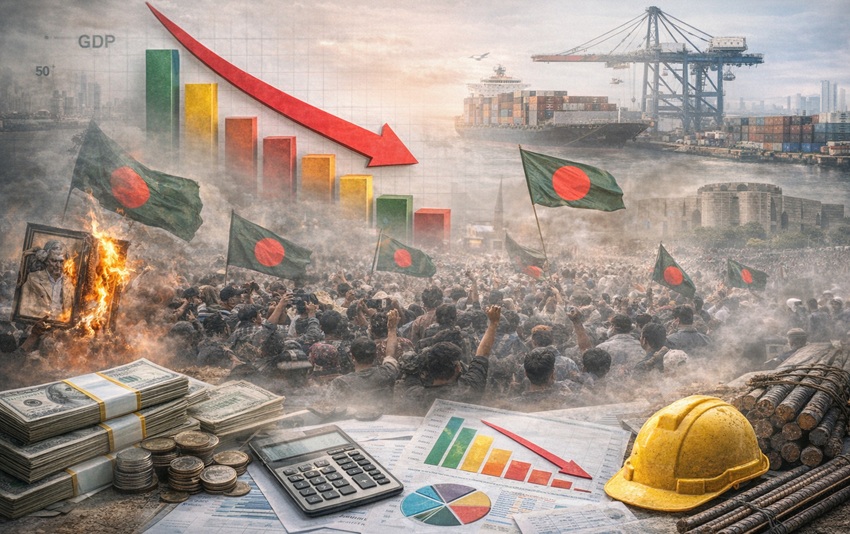
The mass uprising of July 2024 marked a decisive political rupture in Bangladesh. While the movement was rooted in governance and democratic accountability, its economic consequences have been substantial and measurable.
Bangladesh’s economy experienced a short-term shock, partial stabilization through external inflows, and now faces a challenging but recoverable near-term outlook shaped by structural constraints rather than political change alone.
Industrial production declined as factories reduced shifts or temporarily closed, particularly in urban and export-oriented zones. Private investment weakened as firms delayed expansion amid political uncertainty. These disruptions compounded pre-existing macroeconomic pressures, including high inflation, foreign exchange shortages, and weakened consumer demand.

Inflation remained elevated, hovering above 10 percent in the post-uprising months. Food inflation was particularly persistent, indicating that political transition alone did not resolve supply-side bottlenecks, import costs, or energy price pressures. Real household purchasing power continued to erode, limiting domestic consumption.
Despite domestic instability, Bangladesh’s external sector provided critical short-term stability. Remittance inflows increased significantly after July 2024, reaching approximately USD 21–22 billion within nine months, compared to USD 16–17 billion during the same period a year earlier. This surge helped support household income, stabilize the exchange rate, and ease pressure on foreign exchange reserves.
Merchandise exports also showed resilience. Export earnings recorded double-digit year-on-year growth in several post-uprising months, driven primarily by the ready-made garment sector. The sector’s integration into global supply chains allowed it to maintain orders despite domestic unrest. However, garments continue to account for over 80 percent of total exports, underscoring limited diversification and vulnerability to external demand shocks.
Foreign exchange reserves improved modestly, providing short-term external stability. Nonetheless, reserve adequacy remains sensitive to import demand, debt servicing obligations, and global financial conditions.
Foreign direct investment (FDI) data presents a mixed picture. While headline FDI inflows rose by nearly 20 percent year-on-year in fiscal 2024–25, this increase was largely driven by reinvested earnings and intra-company loans rather than new equity investment. Equity-based FDI declined, reflecting investor caution amid political transition, regulatory uncertainty, and banking sector weaknesses.
Domestic private investment also remained subdued. High interest rates, tight credit conditions, and a high volume of non-performing loans constrained lending. These structural issues predated the uprising but were amplified by the uncertainty it introduced.
Labor market indicators remain a significant concern. Youth unemployment and underemployment persist at elevated levels, particularly among urban graduates. Job creation in manufacturing and services slowed following the uprising, raising risks of prolonged labor market stress if growth does not accelerate.
Multilateral institutions project a gradual recovery rather than a rapid rebound. GDP growth is forecast to recover to around 5–6 percent in the next fiscal year, contingent on political stability and policy continuity. Inflation is expected to moderate but remain above pre-pandemic averages, reflecting ongoing supply constraints and energy costs.
The near-term outlook remains challenging. Fiscal space is limited due to weak revenue mobilization and rising subsidy burdens. Public debt remains manageable but leaves little room for expansionary fiscal policy. Monetary policy remains constrained by inflation and exchange rate pressures.
Bangladesh’s economic recovery will depend on progress in several areas: restoring investor confidence, strengthening banking sector governance, improving revenue administration, and supporting employment-generating sectors. Without reforms, remittances and exports alone will be insufficient to sustain long-term growth.
The July 2024 uprising did not fundamentally derail Bangladesh’s economy, but it delivered a measurable short-term shock and exposed underlying vulnerabilities. The post-uprising period has demonstrated resilience in the external sector, particularly through remittances and exports, while highlighting weaknesses in investment, employment, and inflation control.
Bangladesh now stands at an economic inflection point. In the near term, stabilization appears more likely than acceleration. Over the longer term, the direction of the economy will depend less on the uprising itself and more on whether political transition translates into institutional reform and credible economic management. The coming years will determine whether July 2024 becomes a temporary disruption or a turning point toward more resilient and inclusive growth.