
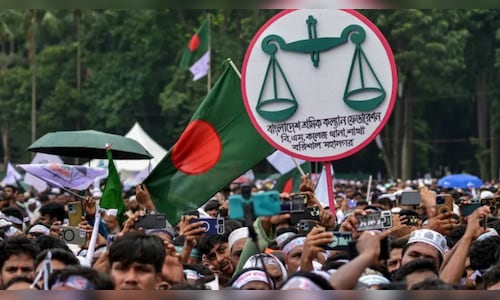
The Bangladesh Jamaat-e-Islami first formally joined a governing coalition and held cabinet positions following the general election of 2001. While the party had participated in previous parliaments and provided support to other governments earlier, its official entry into the cabinet occurred through a four-party alliance led by the Bangladesh Nationalist Party (BNP).
“We envision transforming Bangladesh into a $2 trillion economy by 2040, with per capita income reaching $10,000. To achieve this, priority will be given to technology-driven agriculture, smart manufacturing, ICT, education, healthcare, and the financial service sector,” said Jamaat-e-Islami supremo Shafiqur Rahman, while launching the manifesto in the swish Sheraton Hotel in downtown Dhaka.
The Jamaat-e-Islami party got banned by the then Prime Minister of Bangladesh Sheikh Hasina on August 1, 2024. She even put a ban on the political activities of Jamaat’s student wing Islami Chhatra Shibir, citing involvement in terrorist activities during the “July Revolution”. However, following the fall of the Hasina government, the interim administration reversed the ban on August 28, 2024.
According to Rahman, if the BJI comes to power then it will ensure that Bangladesh achieves steady economic growth clocking a GDP growth rate of 7%. “We will also ensure that an investment-friendly environment gets created through institutional reforms and the removal of systemic bottlenecks, with strong emphasis on encouraging private investment,” he said.
Today, Jamaat-e-Islami is one of the main contenders in Bangladesh’s upcoming polls which is going to be held on February 12. The other contender is the BNP, currently the country’s largest political party. Bangladesh will also be voting for a referendum that seeks to overhaul the country’s governance structure.
Read more: US DEA says it shut down more than 200 illegal online pharmacies linked to India-based syndicate; four arrested
Before this, BJI had been operating in Bangladesh’s political landscape as one of the key allies of the BNP. But this time both parties have decided to contest the polls separately even as Awami League remains barred from contesting the polls due to ban on their political activities.
With a target of elevating Bangladesh’s economy from the 35th position to 20th in the global index, the party said, it will undertake necessary structural reforms, simplification, and expansion of the tax base. Rahman also said revenue collection will be increased to 14% of GDP, while gradually reducing dependence on borrowing.
Increased public revenues will be allocated to priority sectors such as education, healthcare, food security, housing, employment generation, social protection, renewable energy, and transport and communications infrastructure, said the Ameer of BJI. “The budget deficit will be strictly maintained below 5% of GDP and corporate tax rates will be gradually reduced to below 20%,” said Rahman.
A new pay scale will also be introduced for government officials and employees. According to the manifesto, “Barriers to Foreign Direct Investment (FDI) will be removed, and Bangladesh will be positioned as an effective partner in the global supply chain.”
Exports are a big component in Bangladesh’s economy, particularly export of ready-made garments, which remains the backbone of the country’s economic growth. On this the manifesto said, the country’s trade policy will be reformed. “A world-class, modern trade policy will be established within five years. Foreign Direct Investment (FDI) will be increased to $15 billion within this period,” it said.
The Jamaat said in its manifesto that if they form the next government, then it will go for import substitution and domestic value addition. “Dependence on major imported goods will be reduced by 30% within five years through domestic production and value addition,” the manifesto said.
Defence and foreign policies of Jamaat-e-Islami
The Jamaat said it will seek to maintain a “constructive, peaceful, friendly and cooperative” relations with all its neighbouring countries, including India, Bhutan, Nepal, Myanmar, Sri Lanka, Maldives and Thailand.
Interestingly, there was no mention of how the party will steer its relationship with China and Pakistan. The manifesto said “constructive and mutually beneficial relations” will be fostered with countries such as the United States, United Kingdom, European Union, Japan and Canada.
Read more: US spy chief’s office investigated voting machines in Puerto Rico
In defence, the Jamaat has made some big-ticket announcements such as formulation of a National Defence Policy and the development of a new military doctrine that will supplement that policy. “Taking into account contemporary global realities and evolving defence challenges, a modern and comprehensive National Defence Policy will be formulated in coordination with all national defence stakeholders,” the manifesto said.
“In line with the National Defense Policy, the existing Vision 2030 will be modernized and updated, and a forward-looking Vision 2040 will be formulated,” it added.
This story is written by Nayanima Basu.