
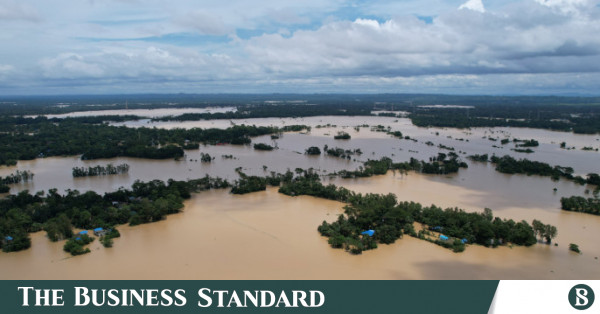
Vast areas of Chattogram and Feni submerged in flood water on 23 August 2024. Photo: Mohammad Minhaj Uddin/TBS
“>

Vast areas of Chattogram and Feni submerged in flood water on 23 August 2024. Photo: Mohammad Minhaj Uddin/TBS
Extreme floods, droughts, storms, and heatwaves cause an average annual loss of nearly $3 billion in Bangladesh.
Additionally, over 6.3 million people are affected by these disasters each year.
These findings come from the environmental organization Germanwatch’s “Climate Risk Index 2025” report published on 13 February.

The report highlights that over the last 30 years, Global South countries have been particularly impacted by extreme weather events.
According to the report, between 1993 and 2022, more than 9,400 extreme weather events worldwide led to nearly 800,000 deaths and economic losses totaling $4.2 trillion.
Since 1993, Dominica, China, and Honduras have been among the most affected countries by floods, storms, and heatwaves, with Bangladesh ranking 31st on the list.
The Climate Risk Index analyzes how extreme weather events affect countries, ranking them based on economic and human impacts, including fatalities, injuries, and homelessness.
The report also states that an intense heatwave from March to May 2022, reaching a record 49.5°C in Nawabshah, Pakistan, was immediately followed by severe flooding.
The extreme temperatures spread to India and Bangladesh, causing over 90 deaths across the three countries.
A real-time study by the World Weather Attribution project found that climate change made this heatwave 30 times more likely, emphasizing the growing threat of compounding climate events.
Despite being highly vulnerable to climate change, Bangladesh has successfully reduced disaster-related deaths through effective climate adaptation and disaster risk management. The report highlights Bangladesh as a global example in this area.
Due to effective risk prevention and adaptation, cyclone-related mortality in Bangladesh has dropped more than 100-fold in the last 40 years—falling from 500,000 deaths in the 1970 cyclone to 4,234 in 2007.
The report also notes that while China, India, and the Philippines suffer from recurring extreme events, Dominica, Honduras, Myanmar, and Vanuatu are most affected by exceptional extreme weather disasters. Additionally, Italy, Spain, and Greece are among the top 10 most affected countries worldwide over the past 30 years.
Call for more climate finance
Laura Schaefer, Head of International Climate Policy at Germanwatch, warns that the climate crisis is becoming a global security risk, requiring bold multilateral action. The Global South is disproportionately affected, and incomplete data may underestimate the true impact. Increasing instability and conflicts signal a critical and unpredictable phase of the crisis.
David Eckstein, senior advisor for Climate Finance at Germanwatch, emphasizes that insufficient climate action has severe consequences, even for wealthy nations. He highlights that $4.2 trillion in losses over 30 years is equivalent to Germany’s entire GDP, warning that delaying mitigation will lead to even greater human and economic costs.
The upcoming Brazil Climate Summit must address the lack of climate finance for vulnerable nations.
Lina Adil, Policy Advisor for Adaptation and Loss & Damage at Germanwatch, stresses that limited resources worsen the struggles of affected countries. She urges stronger mitigation efforts to stay near the 1.5°C global warming target.
The Climate Risk Index highlights that some extreme weather events cause economic losses exceeding an entire country’s GDP.
Vera Kuenzel, senior advisor for Adaptation and Human Rights at Germanwatch, called for stronger climate risk management and greater support for the most vulnerable nations to minimize human and economic losses.