
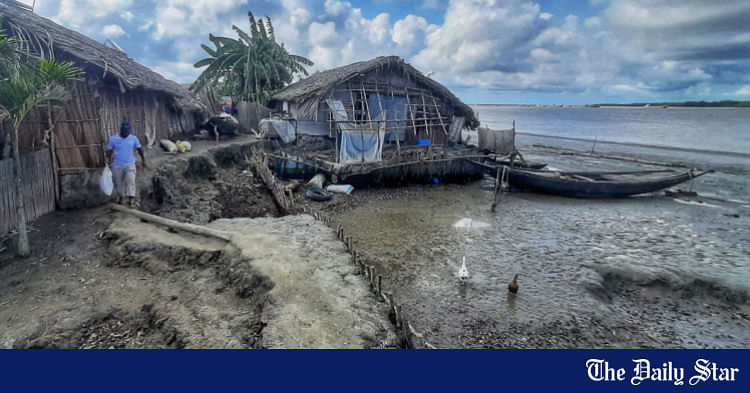
Disaster-induced displacement, both temporary and permanent, has long been a feature of the country, owing to its low-lying topography. FILE PHOTO: HABIBUR RAHMAN
“>
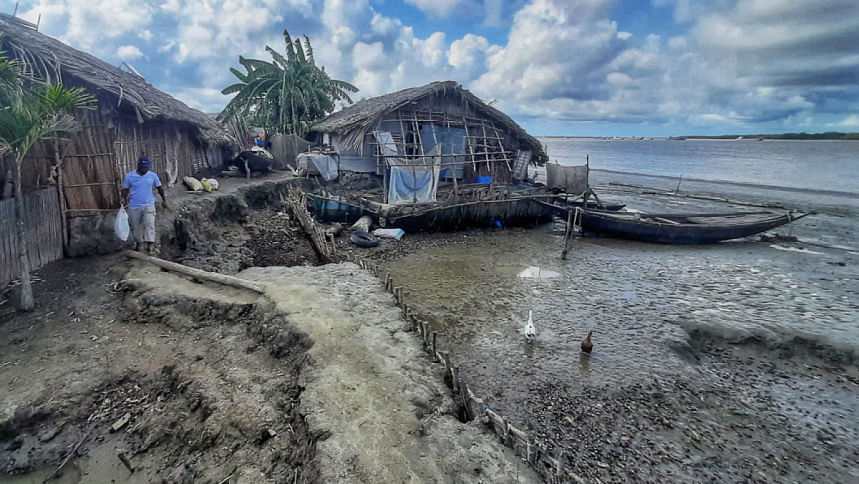
Disaster-induced displacement, both temporary and permanent, has long been a feature of the country, owing to its low-lying topography. FILE PHOTO: HABIBUR RAHMAN
Much has been made of Bangladesh’s perceived vulnerability to climate change—it consistently ranks among the countries projected to suffer the worst human, economic and cultural losses. In response, Bangladesh has taken a policy-driven approach to tackling the problem, developing a labyrinth of climate change policies and engaging vociferously on the global stage to lead negotiations at the Conference of the Parties (COP) on issues such as Nationally Determined Contributions and the Fund for Loss and Damage.
Relatively less focus, however, has been paid to the issue of developing a domestic legal framework that complements Bangladesh’s global ambitions and commitments. Significantly, the issue of climate-induced displacement and autonomous mobility linked to climate change has flown under the radar in the face of in-situ adaptation and mitigation efforts by the state.
 For all latest news, follow The Daily Star’s Google News channel.
 Bangladesh is no stranger to displacement. Disaster-induced displacement, both temporary and permanent, has long been a feature of the country, owing to its low-lying topography. Climate change exacerbates this displacement risk by amplifying the intensity of sudden-onset events such as cyclones and tidal surges, while also creating new streams of pre-emptive mobility through slow-onset changes such as prolonged droughts and salinity intrusion caused by sea-level rise.
As of the end of 2024, there were 585,000 internally displaced persons (IDPs) in Bangladesh. This figure excludes those who have been obliged to move, often in anticipatory fashion, due to how climate change has affected their livelihoods, assets and way of life. Add to this the fact that, ceteris paribus, Bangladesh is projected to lose between 12.34 and 17.95 percent of its coastal landmass due to sea-level rise-induced flooding by 2100, the estimation that by 2050 one in every seven people in the country will be displaced due to climate change does not seem far-fetched.
Within this context, how prepared are urban spaces to deal with the ongoing influx of those who autonomously relocate or are forcibly displaced? Data highlights that Dhaka is taking in a significant number of new arrivals each day, many of whom realistically fall into the categories described above. Rapid and spontaneous urbanisation has given rise to a sprawling mosaic of informal settlements across urban and peri-urban spaces.
Within these informal settlements, communities live under constant threat of eviction and in deteriorated conditions, as though abandoned by the state. It is important to consider two key questions: first, is the current urban planning and climate change response framework capable of effectively accommodating these communities and providing them with adequate housing and services? Second, is there a coherent legal framework through which distressed and displaced individuals can hold policymakers accountable?
Bangladesh’s Climate Change Strategy and Action Plan (BCCSAP), the guiding document, outlines the scope of government activities to address climate change and to fund projects through the Bangladesh Climate Trust Fund, established by the Climate Trust Fund Act 2010. Unfortunately, it fails to address human mobility in its social protection and disaster management programmes. As a result, people who move forcibly or autonomously in the face of climate change are largely left to fend for themselves.
The absence of a mobility and displacement narrative in the BCCSAP is even more puzzling when read alongside the National Strategy on Internal Displacement Management, which insists upon durable solutions for IDPs in line with the United Nations Guiding Principles on Internal Displacement.. The disconnect between these two government documents highlights a broader disconnect between ministries and policymakers.
Having exhausted avenues under the climate change paradigm, we turn to the normative legal framework to identify mechanisms for ensuring durable solutions for climate-displaced communities. Article 15 of the Bangladesh constitution guarantees access to basic necessities, including housing, for all citizens, but this is judicially unenforceable.
Although fundamental human rights to equality before the law, equal protection and treatment, and the right to life are guaranteed, these do not amount to immediate housing provision or durable solutions for the displaced. Moreover, Article 18A does not establish any corresponding rights for displaced people or those at risk of displacement due to environmental failures. As such, the absence of explicit constitutional provisions for climate-displaced persons severely limits legal enforcement.
The Non-Agricultural Khas Land Management and Settlement Policy 1995 allows for the long-term settlement of Khas lands for climate-displaced people and their rehabilitation on unused government land. However, there is a legal prohibition against such settlements within major metropolises such as Dhaka, Chattogram, or the municipality of Narayanganj.
As a result, many climate-displaced communities end up living in informal settlements, with insecure tenure and in environmentally hazardous areas, facing further displacement due to evictions, fires, or disasters like floods.
The inadequate legal framework to ensure tenureship for displaced communities in urban areas is borne out of faulty logic and an aversion to data. In the absence of viable livelihood opportunities elsewhere, displaced people inevitably relocate to cities. By failing to decentralise development away from urban centres—while also restricting the possibility of tenureship for the displaced—the state has consigned a significant portion of its population to a life of precarity and uncertainty.
While emergency litigation to halt slum evictions has taken place in the High Court, these interventions have not structurally altered the existing barriers to durable solutions for climate-displaced individuals. It is essential for the state to make fundamental changes to its approach to climate change adaptation by recognising the phenomena of climate displacement and autonomous, climate-induced mobility, and ensuring that these communities have access to durable solutions.
This also entails acknowledging the high concentration of such displaced communities within urban spaces and developing secure livelihoods and tenure solutions accordingly. While urban density should rightly be a concern for the government, the problem cannot be solved through exclusionary policies or anti-poor governance.
Decentralised urbanisation processes must go hand in hand with ensuring durable solutions for displaced and floating communities who are struggling to survive in metropolitan spaces today.
Ahmad Ibrahim and Mahbuba Kamal work at the Bangladesh Legal Aid and Services Trust (BLAST) and are members of the Dhaka North City Corporation Local Experts Advisory Committee.
Views expressed in this article are the author’s own.
Follow The Daily Star Opinion on Facebook for the latest opinions, commentaries and analyses by experts and professionals. To contribute your article or letter to The Daily Star Opinion, see our guidelines for submission.