
Bangladesh’s debt sustainability challenge is no longer just fiscal — it is increasingly climate-linked and structural, according to a new report released on Saturday (18 October).
Without a shift toward grant-based climate finance, stronger domestic resource mobilisation, and smarter debt management, the country risks being trapped in a cycle of debt-driven climate vulnerability, the report warns.
The study, titled “Navigating Debt, Development and Disasters: Making Debt Sustainability Analysis Work for Bangladesh,” was jointly prepared by the Centre for Policy Dialogue (CPD) and the Task Force on Climate, Development and the International Financial Architecture (TCDIFA) — a global consortium of experts. It was unveiled at a high-level dialogue on “Achieving Debt Sustainability in the Face of Climate Change” held at the BRAC Centre Inn in Dhaka.

Domestic financing mechanisms through carbon pricing, and the polluter-pays and beneficiary-pays principles should be adopted while mainstreaming climate sensitivity across all public spending and investment.
Sadiq Ahmed, vice chairman, Policy Research Institute
The session, chaired by Fahmida Khatun, executive director of CPD, was attended by experts, academics, and journalists. Afrin Mahbub, research associate at CPD, presented the findings.
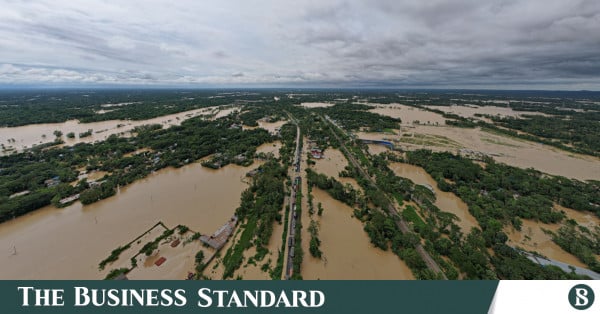
The report highlights that climate shocks are intensifying, with economic losses and damages soaring from Tk 18,400 crore during 2009–2014 to Tk 179,200 crore during 2015–2020 — a nearly tenfold increase. These recurring disasters, it says, erode income, output, and public revenue, forcing the government to borrow more for recovery and adaptation, thereby creating a vicious cycle of debt, disaster, and delayed recovery.
It also points to a significant climate financing gap, which continues to push Bangladesh toward greater external borrowing, heightening long-term debt distress.
Offering his perspective, Sadiq Ahmed, vice chairman of the Policy Research Institute (PRI), cautioned against overreliance on foreign loans for climate action.
“Mobilise more resources domestically — waiting for global funds will not work,” he said.
He noted that domestic debt, not external debt, poses the main fiscal and liquidity challenge for Bangladesh. While external debt remains manageable — with public debt servicing accounting for just 4.2% of exports — growing domestic borrowing is squeezing fiscal space and raising interest costs.
He cautioned against assuming that all climate-related costs will translate into external debt, pointing out that most adaptation and mitigation spending will have to be financed domestically due to limited global climate funding. For instance, Bangladesh has received only $461 million from the Green Climate Fund over 15 years, far below its needs.
Ahmed recommended strengthening domestic financing mechanisms through carbon pricing, and the polluter-pays and beneficiary-pays principles. He also urged mainstreaming climate sensitivity across all public spending and investment, rather than treating only a few projects as climate finance.
Prof Rehman Sobhan, chairman of CPD, has called for a stronger link between climate-related costs and fiscal management in Bangladesh’s debt sustainability framework.
He said it is not enough to estimate climate losses, policymakers must also assess how these costs are being financed and whether they are rising structurally over time.

“The study’s annual estimates of climate-related losses are very useful,” he noted. “But we must also see how much of these are actually being covered through the national budget.”
He pointed out that although 4–5% of the development budget goes to climate programmes, there is little analysis on how effectively these funds are used. “We tend to focus on budget numbers, not on outcomes,” he said, urging studies that connect spending to actual adaptation and mitigation results.
He also stressed the importance of distinguishing between domestic and external financing, which would help identify which areas need foreign support and which can be managed locally.
Turning to global developments, Prof Sobhan warned that a policy shift in the United States could disrupt international climate finance flows. “If the world’s most influential economy takes a dismissive stance on climate change, it will reshape global funding behaviour,” he said.
He added that with Asia emerging as a new capital source — through China and other regional funds — Bangladesh should explore alternative financing options as part of its climate strategy.
Prof Kevin P. Gallagher of Boston University, said Bangladesh needs low-cost capital and large sources of funds to mitigate climate change impacts. And, for this Bangladesh should enhance global south-south cooperation to get larger funds, he noted.
He called for urgent reforms in the IMF and Multilateral Development Banks (MDBs) to make financing affordable and aligned with countries’ climate priorities. Prof Gallagher said Bangladesh faces high capital costs, with many World Bank loans exceeding 5.5–6%. As Bangladesh graduates from LDC status, it relies on expensive non-concessional finance.
He praised CPD’s study for showing how debt sustainability analysis (DSA) can include climate stress tests, and recommended the IMF adopt debt pause clauses, support climate-resilient growth, and align global surveillance with climate risks.
Enamul Huque, managing director and country chief risk officer at Standard Chartered Bank Bangladesh, provided a banking sector perspective on climate-related debt issues. He acknowledged the report’s timeliness and breadth but stressed the importance of government capacity—both political and bureaucratic—to implement necessary reforms.
He highlighted fiscal constraints: Bangladesh’s tax-to-GDP ratio is only 6.6%, while public expenditure is 12.6%. The government is already supporting nationalized banks, and upcoming bank mergers may require an additional $1.8 billion, raising concerns about fiscal space.
Huque emphasised the role of international finance and innovative instruments, including debt-to-climate swaps (like a recent $300 billion initiative in the Bahamas) to create liquidity space. He also discussed the importance of blended finance platforms, such as the Just Energy Transition Platform and Bangladesh’s Country Development Program, to bring together private sector, MDBs, development partners, and government ministries for coordinated action.
Syed Yusuf Saadat, economist at UNDP, highlighted that Bangladesh is highly climate-vulnerable, despite contributing minimally to global emissions. Climate shocks are no longer just environmental—they have become macro-critical, affecting external debt sustainability.
He explained that climate-induced damages force Bangladesh to borrow for recovery and adaptation, increasing debt stock and reinforcing a vicious cycle of debt vulnerability. Current global financial structures, dominated by loans rather than grants, exacerbate the problem, effectively making countries “pay twice”—for the damage and for borrowing to rebuild.
Saadat also stressed the need for domestic resource mobilization through fiscal reforms, arguing that reliance on external loans alone is unsustainable.
Sajjadur Rahman, deputy editor, The Business Standard, highlighted Bangladesh’s growing “debt shock” from climate disasters. One-fourth of land floods annually, affecting food production and jobs. External debt reached $112 billion, with debt servicing over $4 billion last year. Market-based loans now make up 43% of borrowing, raising fiscal risks. He recommended climate stress tests, limiting variable-rate loans, expanding domestic revenue, and using climate–debt swaps for adaptation projects.