
The BNP and like-minded parties are at odds with other political parties, including Jamaat-e-Islami, National Citizen Party, and Islami Andolon Bangladesh, over the proposal for forming a National Constitutional Council (NCC).
According to reform proposals, the constitutional council would be an independent authority that will appoint key constitutional officeholders, including the chief election commissioner, Anti-Corruption Commission chairman, and members of the Public Service Commission. The goal is to reduce the executive’s unchecked authority and introduce institutional checks and balances.
 For all latest news, follow The Daily Star’s Google News channel.
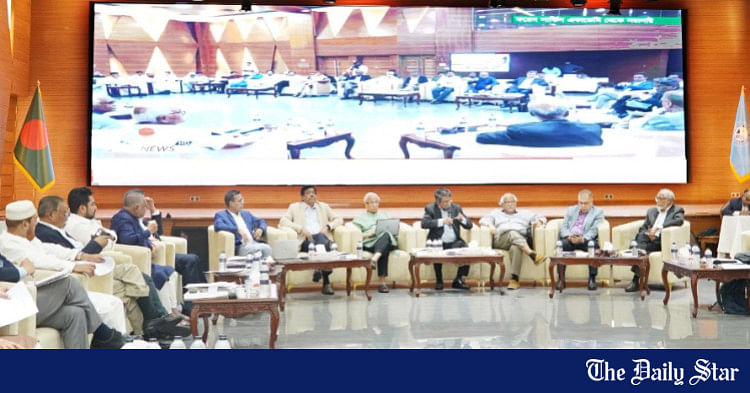
 The issue dominated yesterday’s session of the second phase of the National Consensus Commission’s talks at the Foreign Service Academy in Dhaka.
Although three items were on the agenda, the discussions focused mainly on the constitutional council and the powers of the president.
According to the reform proposal, if parliament is active, the proposed council would be composed of the president, prime minister, opposition leader, speakers and deputy speakers from two proposed houses of parliament, the chief justice, and one member from outside the ruling and opposition coalitions.
Those who oppose the proposal argue the council could disproportionately benefit the opposition and constrain the government, risking instability.
BNP Standing Committee member Salahuddin Ahmed said the party could not support a body with sweeping constitutional powers but no accountability mechanism.
“If an institution holds authority and power without accountability, we, as a democratic party, cannot support it. Creating a separate body to carry out these functions will lead to an imbalance in the system,” he said.
He also opposed introducing a new system for presidential elections, saying the president should continue to be elected by sitting MPs, and, if an upper house is formed, by its members as well. He called for amending and strengthening existing laws governing the constitutional appointments.
In contrast, NCP Convenor Nahid Islam said those opposing the constitutional council were trying to preserve a “fascist” structure. He challenged them to offer alternatives.
Describing the proposed council as a mechanism for balancing power, Nahid said, “Our journey towards a new Bangladesh began with a goal to curb the executive’s unchecked power. That’s why we support the formation of the constitutional council.
“But it should not have the authority to appoint the head of the armed forces. And the president and chief justice should not be on the council,” he said, calling for further discussions on these points.
Expressing his disappointment, the NCP chief said, “We had hoped to reach a policy consensus so that appointments to constitutional bodies would be made impartially, not at the prime minister’s discretion. But that consensus did not emerge.”
Jamaat, which skipped Tuesday’s session in protest against a joint statement after a meeting between Chief Adviser Prof Muhammad Yunus and BNP acting chairman Tarique Rahman in London, participated in yesterday’s discussion.
Nayeb-e-Ameer Syed Abdullah Mohammad Taher said Jamaat supports the constitutional council in principle but echoed concerns about including the president and chief justice in the council, citing the need to protect the dignity of their offices.
Taher also said local government elections must be held under a caretaker government so that representatives are fairly elected. He supported a direct presidential election, but said more discussion was needed on who would vote.
Amar Bangladesh Party President Mujibur Rahman Manju called support for the NCC a “moral imperative”.
“If we do not build accountability mechanisms like a constitutional council, the spirit of the 2024 uprising will be betrayed. Thousands gave their lives for a more democratic Bangladesh. We must not let that go to waste,” he said.
Ganosamhati Andolon Chief Coordinator Zonayed Saki also endorsed the constitutional council, noting that similar councils exist in many democracies.
“At a minimum, appointments to the Election Commission, ACC, and PSC must go through a framework like the constitutional council,” he said.
Ali Riaz, vice-chairman of the consensus commission, said the constitutional council is intended to hold the executive accountable.
“We have an opportunity to design a system where those in power are finally subject to checks and balances,” he said.
Islami Andolon’s Gazi Ataur Rahman also voiced his party’s support, noting that constitutional bodies have never operated freely since independence. He proposed a referendum if consensus remains elusive, criticising left-leaning parties for opposing urgent reforms despite being long-time advocates for structural change.
Meanwhile, Shahadat Hossain Selim, spokesperson for the 12-party alliance and chairman of Bangladesh LDP, an ally of the BNP, said, “We are against forming the constitutional council at this moment. It’s not the priority now.”
During a break in the talks, Ruhin Hossain Prince, general secretary of the Communist Party of Bangladesh, clarified that while his party is not opposed to the constitutional council, such structural reforms should be left to the next elected parliament.
“If this is done now, it may appear as if another government is being created within the government. Our priority should be ensuring credible, impartial elections,” he said.
WALKOUT
After the break, leaders from the CPB and Gono Forum staged a walkout, alleging that the Jamaat was allowed to speak at length while others were restricted.
Prince said the consensus commission took note of their protest, after which CPB and Gono Forum rejoined the talks.
However, Gono Forum’s General Secretary Mizanur Rahman later said the commission had lost neutrality and that their party would not be attending further sessions unless fairness is restored.
Bazlur Rashid Firoz, general secretary of Bangladesher Samajtantrik Dal, also alleged bias in how the session was conducted.
Wrapping up the dialogue, Ali Riaz said most parties agreed on the need for a constitutional institution for key appointments, despite some policy disagreements. He added that proposals to reform both the presidency and the electoral system remain under active discussion.
Consensus commission members Justice Md Emdadul Haque, Badiul Alam Majumdar, Safar Raj Hossain, Iftekharuzzaman, and Md Ayub Miah, attended the talks. Monir Haider, special assistant to the chief adviser on consensus building, was also present. A total of 30 political parties participated in yesterday’s session.