
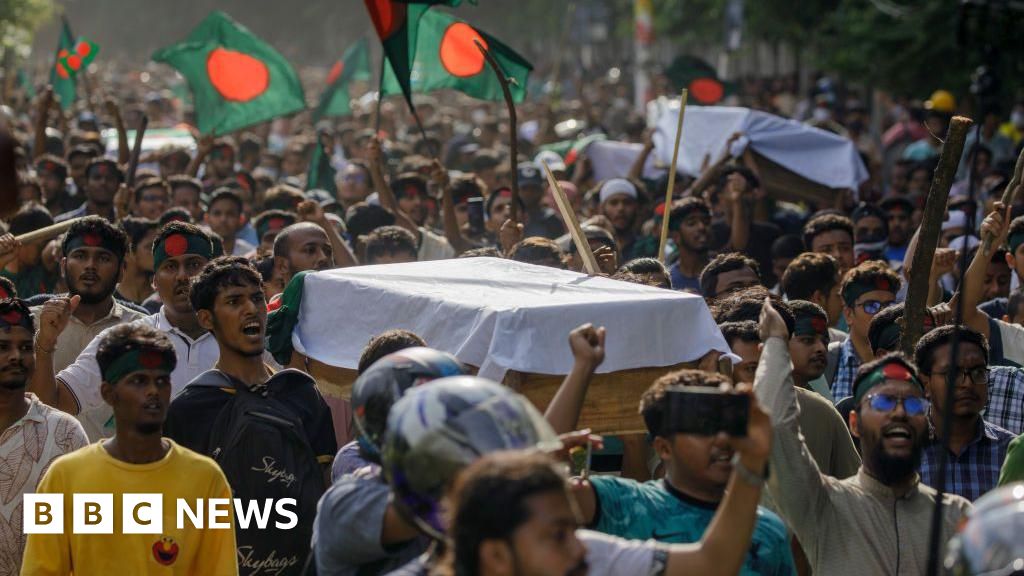
Bangladesh’s Prime Minister Sheikh Hasina has blamed her political opponents for the deadly unrest in the country, adding she was “forced” to impose a curfew for public safety.
“We will lift the curfew whenever the situation gets better,” she said on Monday in a meeting with business leaders in the capital Dhaka.
Security forces are accused of excessive force against student protesters, in which more than 150 people have been killed in the past week. Police have arrested over 1,000 people, including several senior opposition leaders.
Ms Hasina’s comments came a day after Bangladesh’s top court scrapped most of the quotas on government jobs, meeting a key demand of protesters. The rallies have sparked one of the deadliest outbreaks of violence in the country for years and escalated into calls for Ms Hasina to quit.
Ms Hasina has blamed the main opposition Bangladesh Nationalist Party and the Jamaat-e-Islami and their student wings for the violence, saying her government will work to “suppress these militants and create a better environment”.
Political analysts see the unrest as an unprecedented test for one of Asia’s most powerful women.
Ms Hasina, 76, secured her fourth straight term as prime minister in January, in a controversial election boycotted by the country’s main opposition parties.
“The over-politicisation of the spirit of the liberation war by Sheikh Hasina and her party, the denial of basic voting rights to citizens year after year, and the dictatorial nature of her regime have angered a large section of society,” said Mubashar Hasan, a research fellow at the University of Oslo who studies authoritarianism in Asia.
“Unfortunately, she never became the prime minister for everyone in the country. Instead, she remained the leader of just one group,” he told BBC Bangla.
Before Sunday’s court decision, Bangladesh reserved about 30% of its high-paying government jobs for relatives of those who fought in Bangladesh’s war for independence from Pakistan in 1971.
The court ruled that 93% of roles would now be filled on merit.
Ms Hasina is the daughter of Bangladesh’s founding leader Sheikh Mujibur Rahman.
Her government abolished the reservation in 2018, following protests. But a court ordered the authorities to reinstate the quotas in June, triggered fresh unrest.
The protests by mostly university students began about two weeks ago. They say the system unfairly benefits the children of pro-government groups and they have called for it to be replaced with merit-based recruitment.
Ms Hasina initially dismissed the protestors’ concerns, which analysts say exacerbated the unrest. On 14 July, she continued to justify the quota system by reinforcing the divide between the descendants of pro-liberation and anti-liberation forces.
“Why do [the protesters] have so much resentment towards the freedom fighters? If the grandchildren of the freedom fighters don’t get quota benefits, should the grandchildren of Razakars get the benefit?” she said at a press conference.
The Razakars – a derogatory label in Bangladesh – refer to a paramilitary force made up of Bangladeshis who fought on the side of Pakistan during the 1971 war. The group is also accused of heinous crimes during the conflict, which saw atrocities committed on all sides.
Ms Hasina’s comments galvanised even more protesters within hours. Thousands of students took to the streets of Dhaka that night protesting against the prime minister’s remarks.
Over the next few days, many more held rallies across the country. Numerous fires were lit across the country, including at the state broadcaster BTV.
More than 1,000 people have also been arrested in the past two weeks, which saw authorities calling in the military and imposing a nationwide curfew.
The country’s mobile internet and text message services have been suspended for at least five days in an attempt to quell the protests.
Some student leaders have vowed to continue protesting to demand justice for protesters killed and detained in recent days. They are also seeking the resignation of government ministers and an apology from Ms Hasina.