
Listen to any political interview, discussion, or debate on Bangladeshi television and variations of a word surface repeatedly: hotya, khoon—murder. A glance at the country’s history makes this unsurprising. Murder has become a troubling norm in Bangladesh’s strife-torn politics.
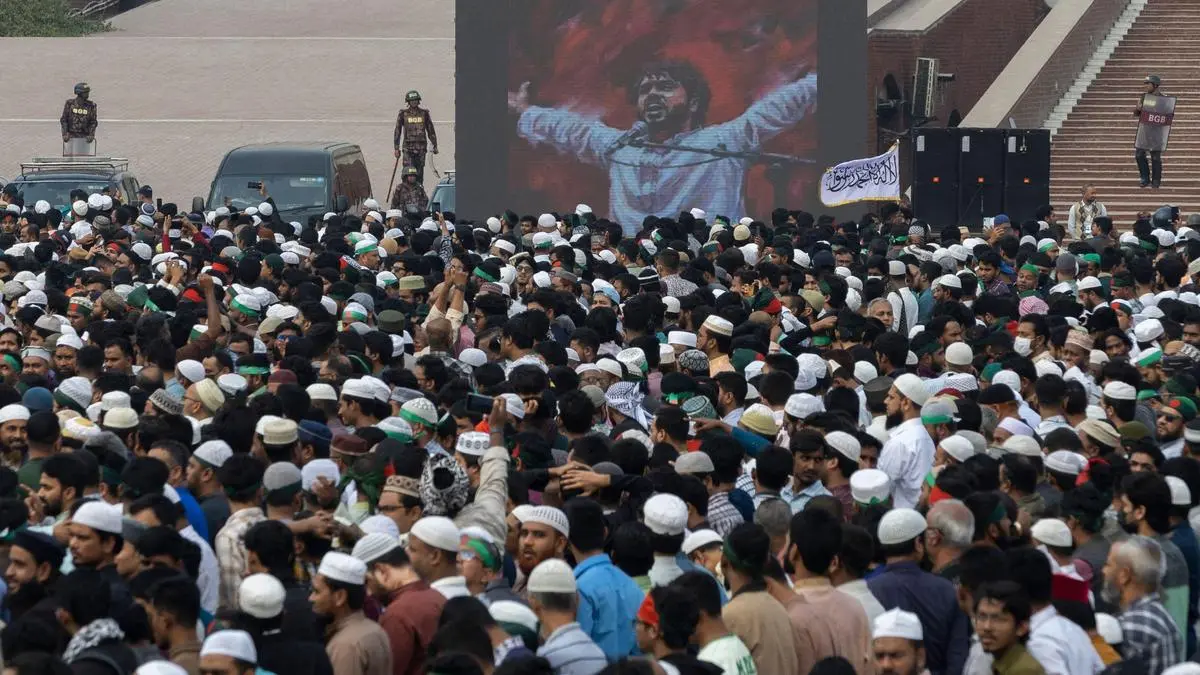
The daylight killing of Sharif Osman Hadi, a 32-year-old student leader and spokesperson for Inquilab Mancha who was contesting the forthcoming elections as an independent candidate, belongs to a long story of political fratricide. On December 12, 2025, masked assailants on a motorcycle shot Hadi in the head while he travelled in an auto-rickshaw in Dhaka. He died six days later in a Singapore hospital. The shadows of such violence over Bangladesh’s political culture have only lengthened over time.
The presence of murder in everyday political conversation traces back to the Liberation War of 1971, when the Pakistan army and the Razakars committed genocide in what was then East Pakistan. The Razakars were a militia group that included Urdu-speaking Bihari migrants and pro-Pakistan Bengalis who collaborated with the Pakistani military against the Bengali nationalist movement. The student wing of the Jamaat-e-Islami was affiliated with the Razakars and provided foot soldiers for the counter-liberation force that committed mass killings and rapes. Numerous massacres occurred during 1971, many targeting Bengali Hindus.
After liberation, the Razakars faced public wrath and persecution. Soon after, Sheikh Mujibur Rahman, the leader of the Liberation War and Bangladesh’s founding president, was assassinated on August 15, 1975, along with most of his family, by a group of Bangladesh Army officers in a military coup. This was followed by General Ziaur Rahman’s regime ordering mass executions in 1977 of over 1,100 military personnel accused of involvement in coup attempts. Ziaur, who succeeded Mujibur as Bangladesh’s second leader from the military, was also assassinated.
Two political differences between the two are significant. Firstly, Mujibur was committed to secularism and enshrined it as a principle in the foundational 1972 Constitution, while Ziaur removed secularism as a state principle in the amendments of 1977 and 1979 (and inserted ‘Bismillahir Rahmanir Rahim’ into the preamble). Ziaur also paved the way for religion-based parties like the Jamaat to re-enter politics.
Secondly, Mujibur was a close ally of India not just during his premiership (recognising India’s military contribution to the Liberation War), but also before 1971, facing accusations and arrests by the Pakistani government for being an Indian agent. Ziaur, until he was assassinated in 1981, maintained cold ties with India. There is a secular-religious divide in Bangladesh’s political psyche that dialectically determines how a person or a party considers India. It also explains the nature of the fraternal divide within Bangladesh.
Sheikh Hasina’s government, which ruled the country for the longest cumulative period since 1996—first from 1996 to 2001, and then from 2009 until her ouster in August 2024—faced accusations of serious human rights violations and killings of political opponents.
Since the July Revolution of 2024, the Jamaat-e-Islami and the Bangladesh Nationalist Party (BNP) regained prominence. The return of these forces was welcomed by student groups that took to the streets against the quota system, a protest that transformed into an uprising. It was backed by the Jamaat and the BNP, political rivals of Hasina’s Awami League. The exit of Hasina and the League has also meant the return to religious nationalism. Though the student groups argue for an egalitarian Bangladesh, their political language often slips into a religious vocabulary, which makes it sound majoritarian. Majoritarianism cannot be egalitarian.
Democracy’s weak promise
Despite the rhetoric of democratic renewal from Muhammad Yunus, the Nobel laureate who leads the interim government as Chief Adviser, Bangladesh has seen a rise in violence against Hindu minorities, Muslim secularists, and political rivals. University professors who expressed secular views have been humiliated and forced to resign by student groups. Cultural events and artefacts have been vandalised. Islamic radicals appear emboldened in a bid to reshape Bangladesh’s secular foundations. On December 18, 2025, a Hindu garment worker named Dipu Chandra Das was lynched by a mob in Mymensingh over blasphemy allegations; his body was set on fire.
The ideological mindset that exists alongside these disturbing incidents goes back to Muslim students and even clerics protecting Hindu temples and property during the July 2024 uprising. When Yunus visited the Dhakeshwari temple in Dhaka, he reiterated his commitment for human rights and asked the Hindus to join the great national regeneration not as Hindus, but Bangladeshis, as an expression of a common humanist aspiration. Yunus found Hindus asking for special safeguards, diversionary. He requested Hindus “not to compartmentalise their demands” and stick to the “main task”. This was a display of paternalistic secularism, which was merely protectionist.
What it failed to address, or remove, was fear among the Hindus. The only structural commitment to the problem of minority fears is offering them political rights. Its absence makes minorities remain vulnerable to real insecurities.
In Bangladesh, political association often determines guilt. There is little middle ground. Fratricide has sickened the political psyche of a country where the memory of murder runs deep.
Also Read | BNP grows restless as Yunus’ reform agenda pushes Bangladesh parliamentary election to 2026
Hadi belonged to a generation of student activists suddenly catapulted to the centre of the current political upheaval. Their appearances on national television, offering views and visions of a new Bangladesh, appeared refreshing but also idealistic. Their politics, however, carries a dark underside: an unwavering investment in political vendetta.
These new leaders seem convinced that Bangladesh must be cleansed of anyone associated with the Awami League, seemingly oblivious to the difference between establishing democracy and pursuing retribution. If fears of Hasina loyalists in the army and state institutions conspiring to regain power are legitimate, it illustrates how fragile the ground for democracy in Bangladesh remains.
Without a semblance of trust, political aspirations will remain haunted by fear. The fear of violence produces the violence of fear. There can be no meaningful political society if the basic tenets of civil society are violated. The legitimacy given to retributive politics overrides any rhetoric of democratic renewal. When politics becomes Hobbesian, the law of the state loses its effectiveness. Violence not only undermines justice—it becomes justice.
Who gains from the killing?
Hadi was also known as an uncompromising critic of India. His followers have connected his murder to the Awami League and hold India responsible, though without proof. Yunus, in a televised address following the attack, described it as an assault by “defeated fascist and terrorist forces” seeking to derail the democratic transition. Such statements intensify an already volatile atmosphere of fear and vendetta.
Yunus’ framing suggests Bangladesh lives in fear of an enemy within. The repressive state apparatus of Hasina’s regime has been replaced by the informal vigilantism of religious radicals. Both sides have their “fascists”.
In a discussion on Channel 24, Hadi once made a commonsensical point about the political logic behind Bangladesh’s unending murders: ask who empowers the killers and which political outfit profits from these killings. Which political actors are most empowered by the current scenario? The BNP and the Jamaat.
Also Read | Can Bangladesh’s student protesters convert street power into electoral success?
Following that logic, it is probable that those who murdered Hadi did not want to derail the upcoming elections but to win them. A close contest is predicted between the BNP and the Jamaat. It remains to be seen who gains politically from Hadi’s death.
The fratricidal violence that has divided Bangladesh since 1971—even as it fought an external enemy to liberate itself—is far from over. Young activists evoking a multitude of afterlives in the name of the slain political leader are trapped in the politics of infinite martyrdom. How long will Bangladesh afford to equate liberation with blood and sacrifice? They might want to remember Gandhi, who toured the villages of Noakhali in 1946-47, encountering communal hate with the politics of love and collective healing.
Bangladesh’s intellectuals and activists must do better than expend energy on the dialectical symptom of neighbourly envy and resentment, manufacturing a phoney spectre of India. Granting asylum to Hasina is, strictly speaking, within the ambit of international law. Hasina is a persecuted leader who also has to answer for the crimes her government committed against the people. Her trial will, however, only help to prolong, not end, the history of retributive politics in Bangladesh. The nation must attend to the more urgent task at hand: constructing a new political and social morality by defusing the monster of fratricidal politics. Otherwise, as commentators on television shows are nervously speculating, Hadi’s murder will not remain the last.
Manash Firaq Bhattacharjee is the author of Gandhi: The End of Non-violence.