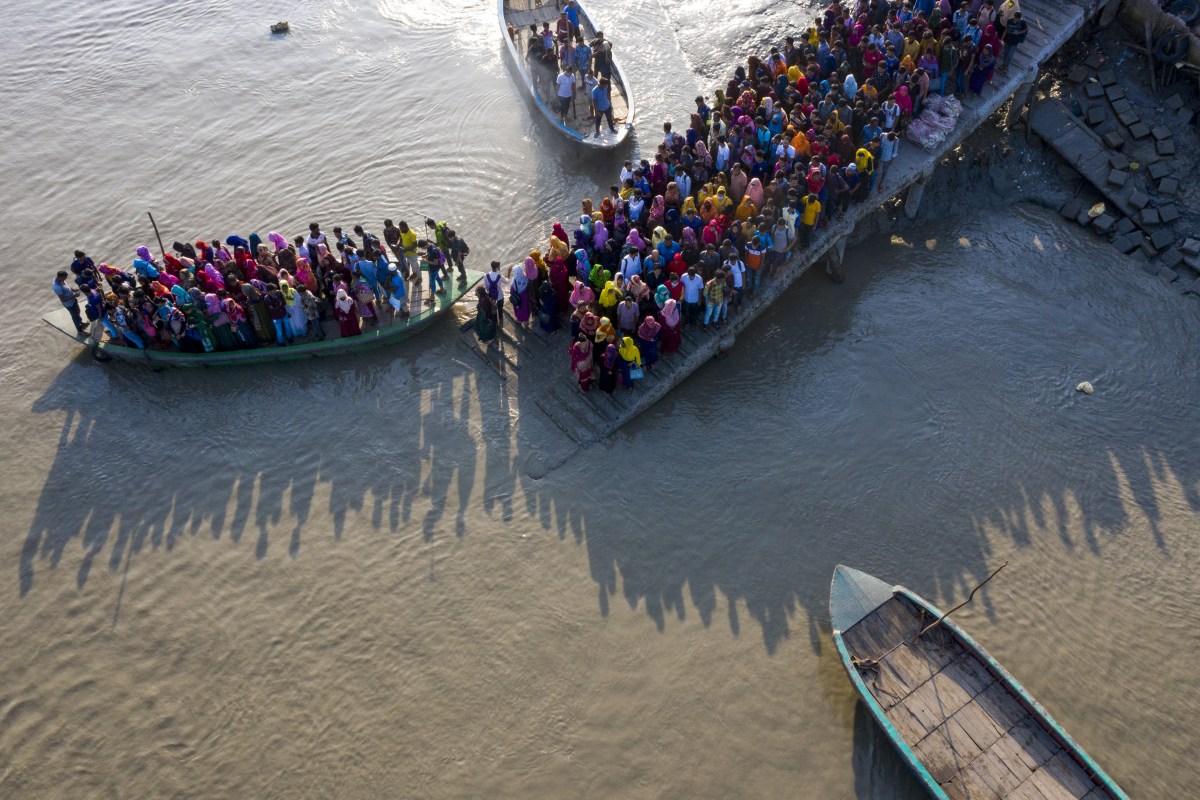
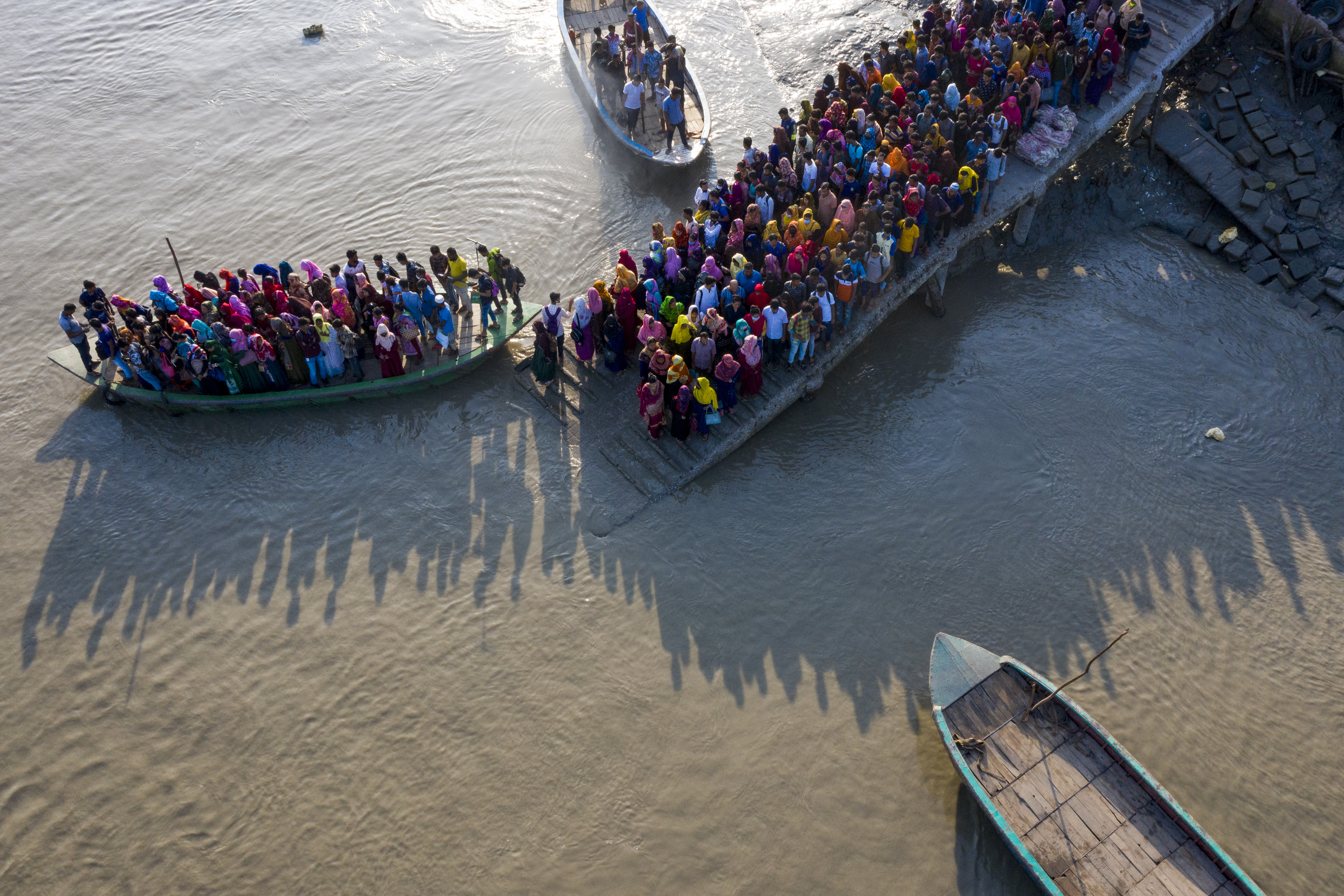
Bangladesh is considered a climate change “hotspot” and faces numerous challenges.
2022 Anadolu Agency
As the number of people affected by climate change continues to rise, one pressing question remains. Where do they go? A recent study on Bangladesh by Switzerland’s federal technology institute ETH Zurich offers some surprising answers.
Korail, one of the largest slums in Dhaka, Bangladesh’s capital, is home to around 50,000 people. Just a stone’s throw away from Gulshan, the city’s affluent business district. It is where Salme and Shajahan, along with their families, relocated from the island of Bhola to find work.

Salme from Korail works as a domestic helper in Gulshan.
Giannis Mavris/SWI swissinfo.ch
Both emigrated after natural disasters destroyed their homes. Like much of Bangladesh’s coastline, Bohla is regularly battered by cyclones which have become more frequent and intense over the past few decades. Erosion and soil salinisation have wiped out the livelihoods of many people, including theirs.
“I am a widow, and I live with my son in a dilapidated house. But what shall we do? We cannot return to Bohla, our land was washed away,” Salme say summing up her predicament. At least there is work in nearby Gulshan, but their situation remains precarious.
The same applies to Shajahan. “The land my wife and I live on with our seven children technically belongs to the government,” he tells SWI swissinfo.ch. “We are at their mercy. They could evict us at any time.” It wouldn’t be the first time. Both had lived in other slums before they eventually settled in Korail many years ago.
Salme and Shajahan belong to the ever-increasing group of climate migrants. Their relocation from the island to the big city is not unusual, it occurs far less frequently than commonly believed.

Shajahan from Korail is a cook, but can no longer work because of an injury
Giannis Mavris/SWI swissinfo.ch
Jan Freihardt of the ETH Zurich looked into this very issue in Bangladesh. His findings External linkrevealed that “climate-driven migration is very localised.” Over four years, Freihardt and his team tracked 2,200 people who live along the Jamuna River in the north of the country. The biggest problem, he says, was the erosion of the river.
“During those four years, more than 10% of the people were forced to leave their villages. Most of them moved to neighbouring villages while only few relocated to nearby cities, and even then, only temporarily. Practically nobody moved abroad.” Freihardt was surprised by the clarity of the results.
With more than 170 million people, Bangladesh is one of the most densely populated countries in the world and ranks among the poorest in Asia. Due to its topography, it is also highly vulnerable to the negative effects of climate change which has earned it the label of being a “hotspot”. Apart from cyclones, the country regularly faces increasingly severe droughts and occasional flooding, driven in part by higher rainfall and, in part, by the glacial melt in the Himalayas, which causes the country’s approximately 800 rivers to swell.

Kai Reusser / SWI swissinfo.ch
Asylum, migration and politics
The notion that climate migrants leave their homes and move to cities or abroad is widespread, but it is a misconception. In reality, the vast majority remain displaced within their own countries and often stay very close to their places of origin.
This is how the International Organization for Migration (IOM) defines the term “climate migrationExternal link”: “The movement of a person or groups of persons who, predominantly for reasons of sudden or progressive change in the environment due to climate change, are obliged to leave their habitual place of residence, or choose to do so, either temporarily or permanently, within a state or across an international border.”
“Politicians increasingly use the subject of migration to instil fear in association with climate change. Hence, it is even more important to provide accurate data,” says Freihardt.
Asylum and migration are playing an increasingly important role in the political debates of many countries, and the narrative is becoming more alarmist. A notable example stems from 2020, when Thomas Matter, a member of the right-wing Swiss People’s Party, said: “For people from the African continent […] where many millions of people want to emigrate to Europe and the population is growing at a fast pace, climate could very well become a convenient pretext for asylum.” This statement came while he was advocating for his parliamentary initiative to exclude so-called environmental and climate migrants form the definition of refugees in asylum law.
Even though Matter’s initiative was rejected, the increasingly hardline stance on migration has had real consequences. Like many other European countries, Switzerland has cut its development aid budget. But the more drastic and far-reaching funding freeze came from the second Trump administration which kicked off this year by freezing funding for the US development agency USAID. Bangladesh, in particular, has felt the weight of both these decisionsExternal link.
Switzerland’s international development cooperation has fallen victim to the country’s austerity measures. Around CHF430 million ($478 million) have been cut from the budget for the next few years, a move that also affects Bangladesh. The Swiss Agency for Development and Cooperation (SDC) will phase out its bilateral development programmes in Bangladesh by the end of 2028, along with those in Albania and Zambia.
Switzerland has been engaged in Bangladesh for five decades, and tackling the negative effects of climate change has been a key pillar of its bilateral support.
Migration abroad is nothing new to Bangladesh. The country has a long history of labour migration with around 7.4 million Bangladeshis living abroad in 2020. This makes Bangladesh one of the top five emigration countries in the world. According to the 2024 World Migration Report, remittances to Bangladesh amounted to $21.5 billion (CHF19.3 billion) in 2022, accounting for just over 4.5% of GDP. Three-quarters of these funds came from the Gulf states, the main destination for Bangladeshi migrant workers. In 2020, an estimatedExternal link 281 million people worldwide were migrants which represents 3.7% of the global population. While the share of climate migrants is still small, forecasts suggest their numbers will rise in the coming years.
Non-governmental organisations (NGOs) regularly warn against discontinuing support for climate-affected communities as this could backfire and lead to more migration. “People often migrate after a disaster because they don’t have the funds to rebuild,” says Prashant Verma, who oversees Helvetas projects in Bangladesh.
“The poorest are the most vulnerable to climate change,” he says. “If they receive support to adapt to the new circumstances, they are more likely to stay in their familiar surroundings. Without support, they are often forced to migrate in search of income, for example, to repay their loan.”
How does climate change affect migration? A video from ETH Zurich about Jan Freihardt’s research:
External Content
Learning from Bangladesh means learning to survive
Jinat Hossein, a research fellow at the University of Zurich, is conducting studies in the Sundarbans, Bangladesh’s vast mangrove forests along the southern coastline. The challenges faced down here are different from those in the north.
“The biggest problem is soil salinisation,” she says. Relocation is difficult which has led to increased migration, often just temporary. Women tend to move to big cities to work in textile factories, while men seek seasonal jobs in other parts of the country. Some migrants venture abroad and often settle in areas where they already know someone from back home.
“The biggest problem is the salinisation of the soil,” which is difficult to escape, she says. Hence there are more migration movements. However, these are often temporary – women temporarily go to work in textile factories in the cities, or men look for seasonal work in other parts of the country. Some go abroad, where they already have friends or relatives from their region.
Hossein does not believe the landscape of the Sundarbans is the only reason people migrate there. The region has long been the focus of both national and international climate change adaptation projects. “New ideas and support open up more opportunities for the affected communities,” she says.
According to Ban Ki-moonExternal link, the former UN secretary-general, Bangladesh is a global pioneer in preparing for climate migrants. Based on scenarios that predict more internal displacement due to climate change, the government in Dhaka supports numerous local initiatives aimed at swiftly integrating climate migrants, preferably near their place of origin.
“If people have the choice, they do not want to leave their homes. What they want is security for their families and opportunities to adapt to the new reality,” says Hossein.
This also means receiving foreign aid, yet the opposite is happening.
Edited by Marc Leutenegger
Adapted from German by Billi Bierling/ds
More