
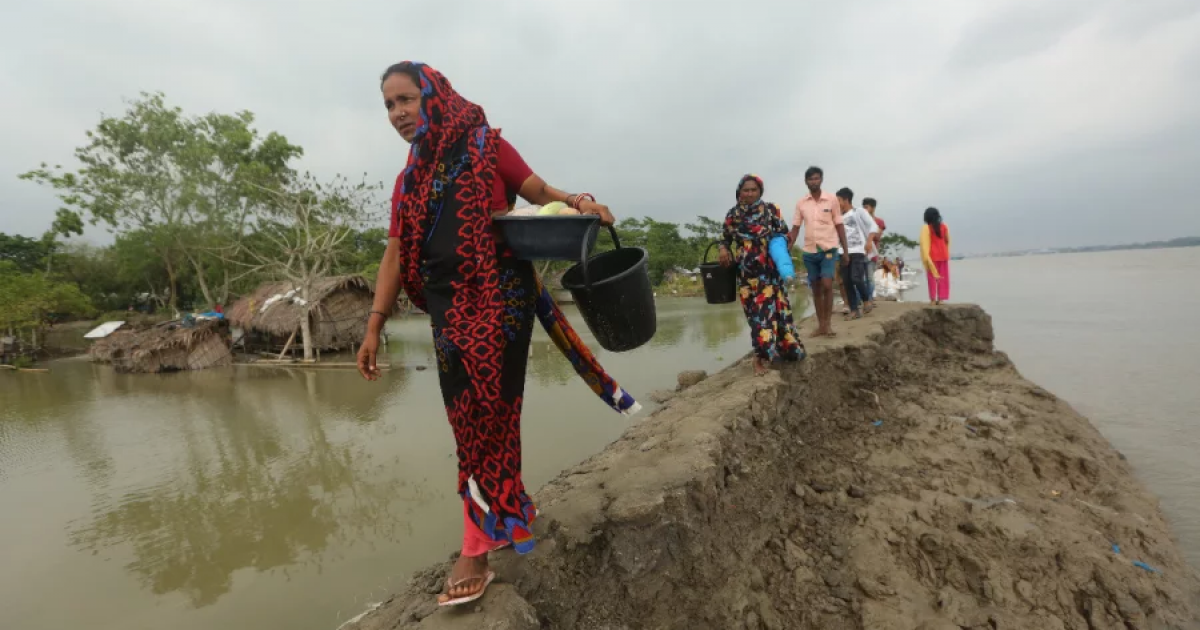
Bangladesh, one of the world’s most climate-vulnerable countries, faces a $232.6 billion financing gap by 2030 in its battle against rising seas, cyclones, and salinity. The shortfall, tied to its Nationally Determined Contributions (NDCs), highlights the cost of survival in a world the country has barely contributed to damaging.
Billion-dollar puzzle
Bangladesh’s climate strategy is detailed, covering embankments, cyclone shelters, renewable energy, and salinity-resistant agriculture. But meeting the $23 billion annual financing requirement until 2030 far exceeds the country’s current access to funds.
Environment-focused research organization Change Initiative (CI) estimated that multilateral development banks (MDBs) had approved about $720 million for climate-related projects in Bangladesh. Yet only $232 million — 32% — was disbursed, covering barely 0.1% of projected needs. CI warns these risks pushing Bangladesh into a “climate debt trap.”
The World Bank, in contrast, highlighted its scale of engagement: $7.2 billion committed from 2016 to 2024 — $4.1 billion for adaptation and $3.1 billion for mitigation. Senior Climate Change Specialist Keisuke Iyadomi said: “We believe Bangladesh can raise $12.5 billion more in the medium term for climate action, and our support is geared toward a resilient, inclusive, and sustainable growth pathway.”
Even these figures fall short: roughly $900 million per year versus a $23 billion need.
Farmers count the cost
On the ground, the impact is measured differently. Sk Al Mamun, a 36-year-old farmer from Burigoalini, Satkhira, said his land is cracked, saline, and barely productive.
“The water is salty — in the soil, the ponds, the wells. After repeated cyclones, we switched to shrimp and crab farming. Each storm pushes the sea further inland,” he said. Local embankments crumble yearly, patched by villagers with bare hands. “Last year, I took out a loan just to buy food. Now I am in debt because of the salty rain.”
Loans, grants, and justice
CI warned that loans, even concessional ones, are unsustainable for adaptation projects like embankments or cyclone shelters. “This increases debt service, squeezes social spending, and risks a debt spiral,” its report says.
The World Bank defended its approach, citing IDA credits with low or zero interest and long grace periods, while urging grants for adaptation from the Green Climate Fund.
Where loans may work: The energy transition
Some experts argued loans can still play a role, but only in revenue-generating mitigation projects. With Bangladesh targeting 30% renewable energy by 2040, MDBs could anchor the transition.
Shafiqul Alam of the Institute for Energy Economics and Financial Analysis noted that the Asian Development Bank now offers local-currency loans for large projects, reducing foreign exchange risks, and urged Bangladesh to build a bankable renewable energy pipeline.
Global financing trends: Record highs, but slow trickles
MDBs reported $137 billion in climate finance in 2024, a 10% rise from the previous year, with $85.1 billion going to low- and middle-income countries and $26.3 billion supporting adaptation. By 2030, MDBs aim to mobilize $120 billion annually, with $42 billion for adaptation.
Yet Bangladesh’s share remains limited. CI notes only a third of approved funds reach projects, often scattered across small, piecemeal initiatives.
Climate shocks also extract a toll: the World Bank estimated heat-related losses at $1.78 billion in 2024, nearly 0.4% of GDP. The IMF provided $1.15 billion to stabilize the economy amid climate and debt stress.
The road ahead
Experts said Bangladesh must secure predictable adaptation grants, debt-for-climate swaps, robust pipelines of bankable projects, and national climate funds as co-financing anchors. Zakir Hossain Khan of CI highlighted lessons from Fiji, Rwanda, and the Maldives. “Bangladesh must align with MDB priorities to unlock speed and volume,” he said.
Youth voices
Sidur Rahman Siam of Brighters Foundation told Dhaka Tribune: “The younger generation must be at the table when decisions of this scale are made.” Sk Mashrur Ishrak, Volunteer for Environment, added: “Grassroots awareness, school-based climate education, and youth-led projects must be embedded in the transition process. Otherwise, the burden falls on ordinary people without empowerment.”
More than numbers
For negotiators, climate finance is about pledges, disbursement rates, and loan terms. For farmers like Mamun, it is about whether their children inherit a farm or a debt ledger.
The $232 billion gap is not only a matter of balance sheets. It is a measure of survival.