
India will benefit if it supports the current transition government in Bangladesh and moves to build relationships with other political parties instead of “focussing on one person and party”, political analysts, foreign relations and security experts said on Sunday (August 18, 2024).
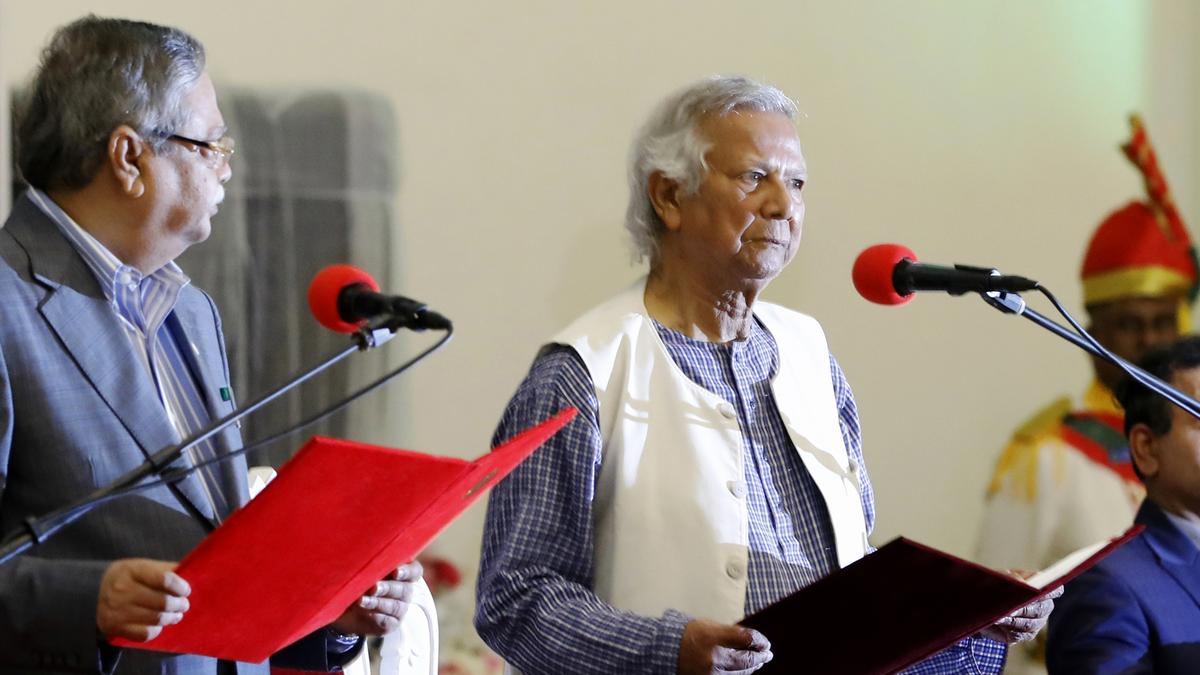
After the ouster of Prime Minister Sheikh Hasina, Nobel laureate Muhammad Yunus, 84, took oath as the Chief Advisor of the interim government on August 8, 2024, amid violence and chaos.
Ms. Hasina, 76, fled to India on August 5, 2024, after she was forced to resign following a massive protest by students against a quota system in government jobs.
“I think understanding should be the starting point for resetting our relationship, having that we have our interdependence, so we need each other to recalibrate our relationship,” head of the leading think tank Bangladesh Enterprise Institute (BEI) Humayun Kabir told PTI.
He said being Bangladesh’s next-door neighbour, India was “always with us when we were in difficulty and in the current transition also if they come and support us then I think people of Bangladesh will look at India as a friend”.
Mr. Kabir, a career diplomat, said India would benefit if it “positively supports” the current transition in Bangladesh along with moving to build relationships with other political parties, instead of “focusing on one person and party” taking into account the “uniqueness” of the change.

In his first direct conversation over a week after becoming the chief advisor of Bangladesh’s interim government, Mr. Yunus on Friday (August 16, 2024) conveyed to Prime Minister Narendra Modi in a phone conversation that Dhaka would prioritise protection and safety of Hindus and all other minority groups.
Prime Minister Modi also reaffirmed India’s support for a democratic, stable, peaceful and progressive Bangladesh and underlined the importance of ensuring the safety of Hindus and other minority communities in the violence-hit country.
President of the Bangladesh Institute of Peace and Security Studies (BIPSS) retired major general ANM Muniruzzaman said India “must see the reality in Bangladesh where a people’s revolution has happened”.
“They (India) need to be on the right side of history and express their desire to cooperate with the people of Bangladesh. For too long they were seen to be siding with a particular party and leader,” he said, adding bilateral ties should be based on people-to-people relationship.
“We look forward to seeing friendship from India which is based on our national interest,” he said while talking to PTI.
Leading civil society figure and economist Debapriya Bhattacharya of Bangladesh’s Centre for Policy Dialogue (CPD) said the Bangladesh-India relationship is important for both the countries from the perspectives of peace, security and development.
“Bangladesh, respecting the verdict of the Indian people, has beneficially lived with the BJP government after Congress had to quit power. India should as well do the same now since the Awami League regime has been deposed through a student-citizen uprising,” Mr. Bhattacharya told PTI.

He said in the coming days India “has to rebuild the relationship based on trust and mutual interest” and “it should not remain hostage to any specific political party of the respective country” as this relationship should be based on bipartisan consensus and both the countries need to work towards that.
“We should (also) be mindful that the religious minority community in one country is the majority in another (and) so treatment of the minority community in our respective countries will be an important variable in our relationship,” Mr. Bhattacharya added.
The analysts said the chemistry between Ms. Hasina and Mr. Modi was very good with India depending on Ms. Hasina over the past 16 years for cementing bilateral ties ignoring other political groups.
The BEI CEO said Bangladesh actually saw two difficult realities during the last 15 years.
The first reality was “the kind of an authoritarian government that engulfed the entire society where the rights of the people, voices of the people, the privacies of the people were subjugated to a kind of political agenda,” he said.
“And we know the how and what happened with regard to the (past three) elections – that was one reality that was one kind of suffocating environment,” he said.
Then, Mr. Kabir said, the new reality unfolded with the students’ movement during the last one month “and then the whole community of people joined them and that saw the ouster of Prime Minister Hasina’s 15-year regime on August 5.” Referring to the U.N. human rights commissioner’s report released two days ago saying that at least 650 people died in the last one month, the former diplomat insisted that the “massacre has qualitatively changed the whole context”.
“Now with regard to our Indian friends they have to understand these two dynamics. Only then perhaps they will understand how Bangladesh is transforming during the last 15 years but particularly during the last one month and eventually there has been a fall of the government,” he said.
The former diplomat said he felt that India and Bangladesh, since the 1971 independence and even during the Liberation War maintained “two sets of relationships”.
“One between the two governments and second between the people of the two nations—and that is what we experienced during our Liberation War where the Indian people opened up their hearts, the Indian government extended full support to us and then helped in the process of creation of Bangladesh as a nation state,” he said.

Mr. Kabir said he believed that as neighbours the two countries were connected at “multiple layers and we are interdependent on each other”.
But, the former diplomat, who previously served as a deputy high commissioner to India, said his sense suggested that “the changes that took place in Bangladesh particularly during the last one-month time, our Indian friends sometimes misunderstand”.
Mr. Kabir, however, said there was a reason for that lack of understanding as well “because it happened so fast and it was so deep and so intensive, it is possible they (India) could not see how it happened, or they have a different perspective or they are looking from a traditional perspective”.
The BEI chief executive officer said he now expected India as “the neighbour and friend” to “understand the urge of the people of Bangladesh, the desires, the aspirations of people of Bangladesh, particularly the aspirations of the younger generation, who are supported by the common people”.
“That’s why you have seen a revolution, what some people call a monsoon revolution, some people call it Bengal Spring, and so on and so forth.” Mr. Kabir said a kind of “misinformation was being spread in India as well with regard to “the minorities and so on and so forth”.
“I think, yes, we understand that there has been violence in some places and violence not only on minority but also against the majority community, because it’s a huge political transformation that took place though any violence is undesirable,” he said.
Mr. Kabir said he expected India to understand the real perspective of that violence and would extend its hands to Bangladesh particularly after the talks between Prime Minister Modi and Professor Yunus.