
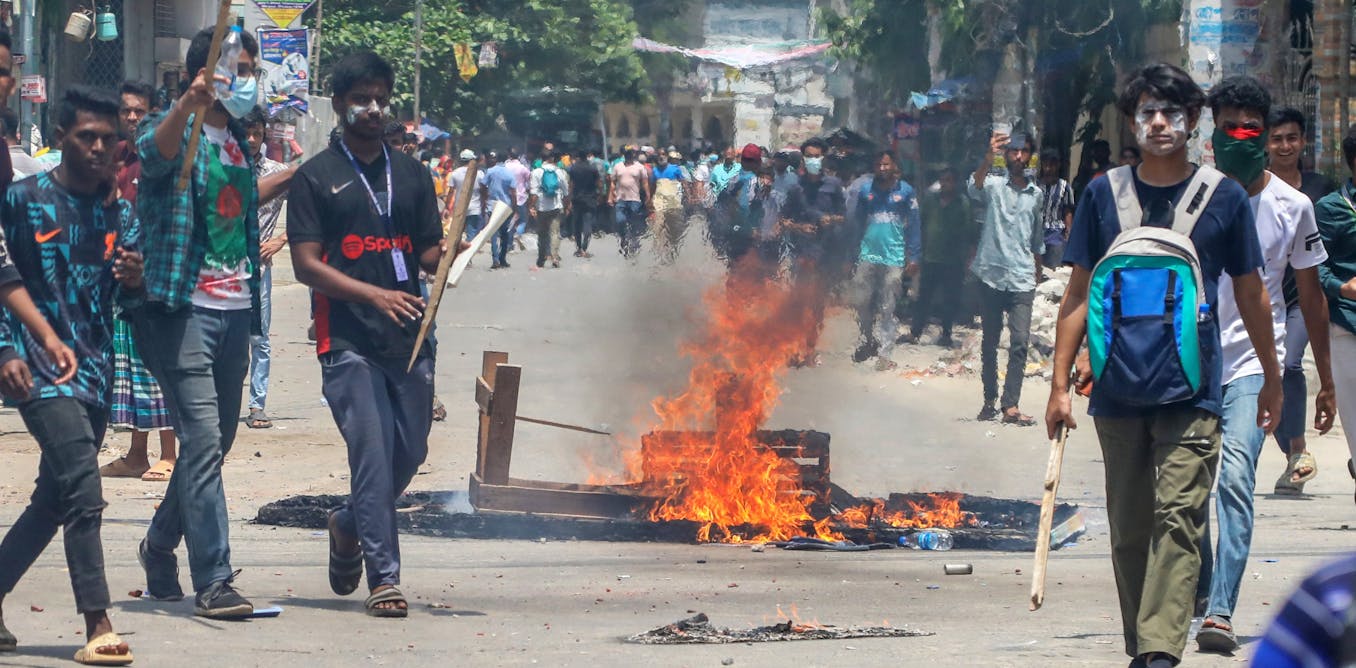
Thousands of students in Bangladesh have taken to the streets over the past few weeks to demand an overhaul of how public sector jobs are distributed. The government had sought to reintroduce quotas that reserve 30% of these jobs for descendants of veterans from Bangladesh’s war of independence with Pakistan in 1971. The quotas, which had initially been scrapped in 2018, are widely regarded as unfair and discriminatory.
The protests started out peacefully on university campuses, but they quickly spread beyond campus grounds and turned violent. Bangladeshi prime minister Sheikh Hasina deployed the police and military to control the protests, and has now imposed an indefinite national curfew. The country is also facing a communications blackout after the government blocked internet and social media access to disrupt the organisation of the protests.
The violence has led to the deaths of at least 174 people and the arrest of around 2,500 students and political activists. The US and the UN have called for “restraint from all sides” and India has advised its residents living in the country to “avoid travel and minimise their movement outside their living premises”.
Bangladesh’s supreme court has since scaled back the job quotas in response to the protests. A ruling on Sunday said that only 5% of jobs would now be reserved for the families of freedom fighters, with another 2% for ethnic minorities or those with disabilities. The rest would be awarded to candidates based on merit.
However, the protesters have refused to negotiate. The student leaders say the protests will continue until all those detained are freed and the officials who ordered the crackdown resign.
The protests reflects deeper issues in the country around political freedom, government accountability and fair access to opportunities. The question now is whether students sustain the movement for broader change in the country.
Capturing state institutions
The quota system is seen by many as an attempt by the ruling Awami League to further capture state institutions. The party, which successfully led Bangladesh to independence and has been in power since 2009, has influenced state institutions such as the military, security forces and civil services by recruiting people with Awami League credentials to key positions.
Two of the most important institutions in Bangladesh, the judiciary and military, are widely seen as having been politicised. And these institutions have been used to keep the Awami League in power by rigging successive elections and suppressing political opposition.
In January, for example, Hasina secured her fourth straight term in a controversial election that the opposition Bangladesh Nationalist Party (BNP) alleged was a sham. The BNP boycotted the poll and official figures suggested a low voter turnout of around 40%.
International non-governmental organisation Human Rights Watch accused the government of “filling prisons with the ruling Awami League’s political opponents” before the election. And the BNP estimated that around 5 million of its members faced politically motivated prosecution.

Monirul Alam / EPA
The government had long enjoyed legitimacy due to the country’s remarkable economic progress over the past decade – it’s now one of the world’s largest garment exporters. This economic growth improved the lives of millions of Bangladeshi citizens, cutting the rate of poverty from 31.4% in 2010 to 18.7% by 2022.
However, many argue that this success occurred despite the actions of the ruling regime. And following the pandemic, this veneer of success began to unravel. Youth unemployment has risen to 40%, inflation remains persistently high at 10% or more and significant corruption scandals have recently come to light.
These economic woes have culminated in dwindling foreign currency reserves. This has forced the government to seek loans from the International Monetary Fund with economic conditions that contradict their election pledges, such as raising utility and tax bills. These economic conditions have provided fuel to recent student protests.
Escalating activism
So, could the protests escalate into a broader movement for change in the country?
Bangladesh does, in fact, have a rich history of student activism that has led to significant political change. One of the most notable examples occurred in 1952 when Pakistani officials announced that the singular national language of Pakistan was to be Urdu. In response, students at the University of Dhaka organised a protest that sparked widespread civil unrest and ultimately saw Bengali recognised as an official language.
However, student movements in Bangladesh have been successful in the past because they took place within a wider context of organised political opposition, relatively independent state institutions and a strong civil society led by academics. Opposition parties, for example, provided support to student movements to challenge the government by offering resources, strategic guidance and legitimacy to the protests.
This time around, opposition parties are weak, with many of their leaders in jail, and state institutions have been captured by the government. On July 23, the government blamed the BNP for the ongoing violence and has threatened more crackdowns against political opponents.
If these protests are to become a wider movement, it will have to be spearheaded by the students themselves, potentially with great cost to human life.