
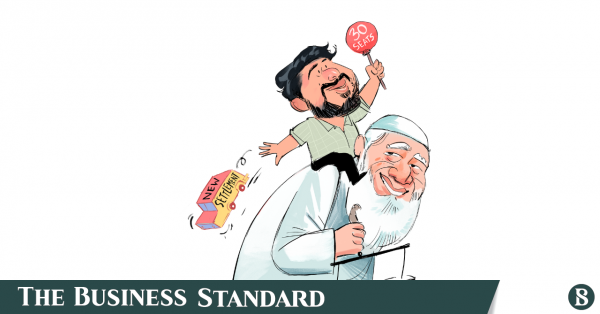
Principles rarely survive election season in Bangladesh, but the speed at which the ‘new settlement’ is collapsing into familiar alliances is deeply unsettling
Illustration: TBS
“>

Illustration: TBS
In Bangladesh, political enmity has always been deeply personal and ideological. But once elections arrive, ideology blurs, memories are forgotten and yesterday’s villains suddenly become today’s ‘strategic partners’.
This contradiction is not new, but the speed and ease with which the newly formed National Citizen Party (NCP) has embraced it has unsettled many who once believed the party represented a break from the past.
Bangladesh’s political history is rich with such reversals. In 1990, the Awami League (AL) and the Bangladesh Nationalist Party (BNP) stood shoulder to shoulder in the mass uprising that toppled military ruler Hussain Muhammad Ershad.
Less than two decades later, the Awami League formed the ‘Grand Alliance’ with Ershad’s Jatiya Party to win the 2008 election. Earlier in 1996, the AL aligned with its ideological opposite, Jamaat-e-Islami, to secure power.

These alliances were often deemed as necessities for survival, justified in the language of national interest or electoral arithmetic. NCP’s decision goes beyond because of what the party claimed to be.
Soon after the ouster of Sheikh Hasina, NCP leaders publicly rejected alliances with major or established political forces, arguing that such arrangements reproduced the very system they sought to dismantle. They positioned themselves as an alternative to entrenched power blocs, insisting that reform was impossible if new actors were absorbed into the old alliance culture.
Mohammed Abdul Baten, assistant professor of Political Science and Sociology at North South University, spoke to TBS on the matter for a previous report. According to him, the party’s problem predates its Jamaat alliance.
“When the NCP leaders spoke of a ‘Second Republic’ or ‘New Settlement’, they were incoherent,” he said. “Whatever occurred to individual leaders at a given moment was articulated randomly, without being organised coherently or collectively as a connected political group.”
This conceptual vagueness hollowed out the promise long before negotiations began. “As a result, neither then nor now has it been clear to us what ‘New Settlement’ actually means,” Baten added. “Beyond rhetoric, we have not seen any direct action, ideological clarity or principled positioning.”
Bangladesh has seen this story before: enemies uniting, ideals discarded, pragmatism triumphing. The difference this time is that NCP promised to end this cycle. Instead, it has reproduced it, trading imagination for realism and ethics for expediency.
That ambiguity soon translated into old habits. As elections approached, NCP earlier briefly made an alliance with the AB Party and Rashtra Shangskar Andolon for the 2026 polls. The coalition collapsed after just 20 days, exposing not strategic flexibility but improvisation under pressure.
Soon after, NCP turned to Jamaat.
Asif Shahan, professor of Development Studies at the University of Dhaka, noted that the implications are severe. “The party is doomed; from the very beginning, there has been scepticism that NCP is Jamaat’s B team. If they now go with Jamaat openly, that suspicion will be permanently validated.”
He argued that NCP’s weak organisational base leaves it powerless within such an alliance. “There is no way NCP will be in the driver’s seat. Jamaat will push it further to the right, and NCP will be forced to accept and even celebrate Jamaat’s narratives.”
Jamaat’s historical baggage only sharpens the tension. Its role in 1971 and its position on women’s rights remain unresolved controversies. “NCP wants to present itself as a party committed to women’s empowerment,” Shahan noted, “yet they are aligning with a party that supports reduced working hours for women without equality and has not nominated a single woman candidate so far.”
Dilara Chowdhury, professor and chair of Government and Politics at Jahangirnagar University, offered a more pragmatic reading. “In practical, on-the-ground electoral politics, a party cannot perform well without organisation and credible leadership,” she says.
According to her, NCP initially attempted a legal arrangement with the BNP, but negotiations failed over seat allocation. “There are around 30 leaders within NCP who want to contest elections. That created internal pressure. Moreover, Jamaat will provide funds for them as well.”
From this perspective, the alliance becomes less ideological betrayal than electoral survival. “This is voting arithmetic, plain and simple,” she argued.
For a party born of uprising and expectation, the question now is not whether alliances are inevitable or not, but whether voters will forgive a “new settlement” that so quickly came to resemble the old order it once condemned.
Bangladesh has seen this story before: enemies uniting, ideals discarded, pragmatism triumphing. The difference this time is that NCP promised to end this cycle. Instead, it has reproduced it, trading imagination for arithmetic and ethics for expediency.